
China Professional Ethernet Cable Manufacturer
OUFU offers a full range of Ethernet cables, including Cat5e, Cat6, Cat6a, Cat7, and Cat8. We can also produce various types of Ethernet cables with different protection levels, such as UTP (unshielded) and STP/FTP/SFTP (shielded).
OUFU uses high-purity oxygen-free copper cores for its transmission lines. The transmission attenuation is low, and the signal is stable. We have passed ISO9001 quality management system certification, CE, UL, and other international authoritative certifications. Moreover, each batch of Ethernet cable undergoes multiple testing procedures, such as conduction test, attenuation test, crosstalk test, etc., ensuring that the qualified rate of our products is above 99.9%.
Welcome to visit our factory. Feel free to contact us at any time!
Types of Ethernet Cable
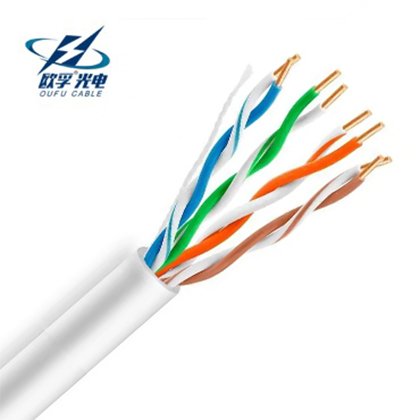 Cat5e Ethernet Cable
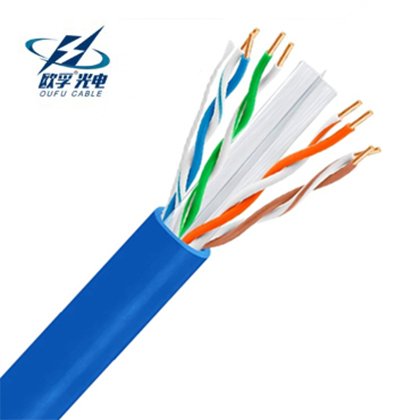 Cat6 Ethernet Cable
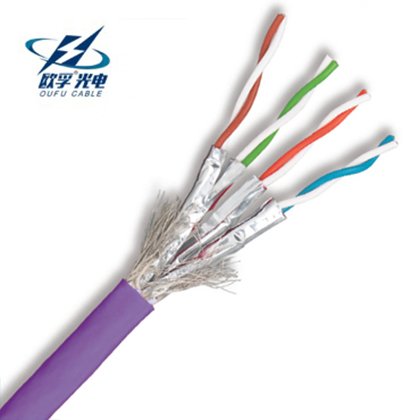 Cat7 Ethernet Cable
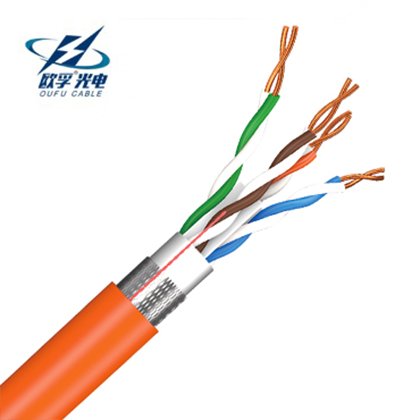 Indoor Ethernet Cable
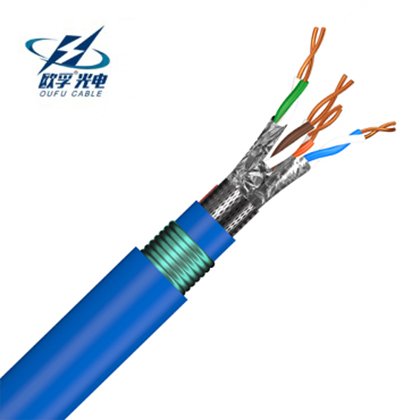 Outdoor Armored Ethernet Cable
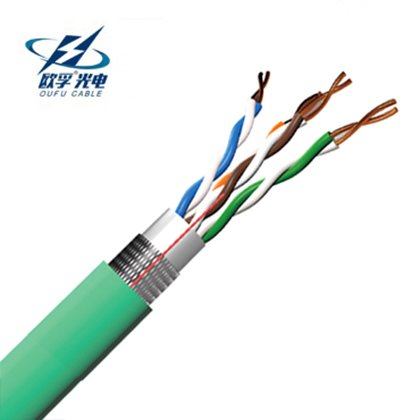 Pure Copper Ethernet Cable
Why Choose OUFU Ethernet Cable
The advantage of OUFU lies in its strict compliance with international standards in the testing process. We can ensure that the Ethernet cables maintain excellent quality throughout the entire production process.

This test measures the degree of signal loss when the Ethernet cable transmits signals within the cable. Excessive attenuation can cause the remote devices to fail to recognize the signals.

This test measures the electromagnetic interference generated when a pair of cores in a ethernet cable transmits signals, and excessive crosstalk can cause signal distortion and packet loss.

This test measures the intensity of the reflected signal when the Ethernet cable signal is transmitted, due to impedance mismatch. Excessive reflection will reduce the effective signal power.

This test detects the crosstalk between the wires at the far end of the Ethernet cable. It is mainly applicable to high-grade Ethernet cables such as Cat6a and above, ensuring the stability of 10-gigabit transmission.

Measures the transmission time of the Ethernet cable signal from one end to the other, as well as the delay difference among the 8 cores.

For the low-smoke halogen-free (LSZH) sheathed ethernet cable, the flame-retardant effect is verified to prevent the generation of toxic smoke in case of a fire.
Customized Services
OUFU Ethernet cables support customization of length, outer sheath (customizable in different colors and materials, such as flame-retardant PVC, low-smoke and halogen-free LSZH materials), printing customization (can print brand logo, specifications, model numbers, meterage, etc.), and can also be customized with special properties like high-temperature resistance, anti-aging, and rodent-proof for special scenarios.
Price Advantage
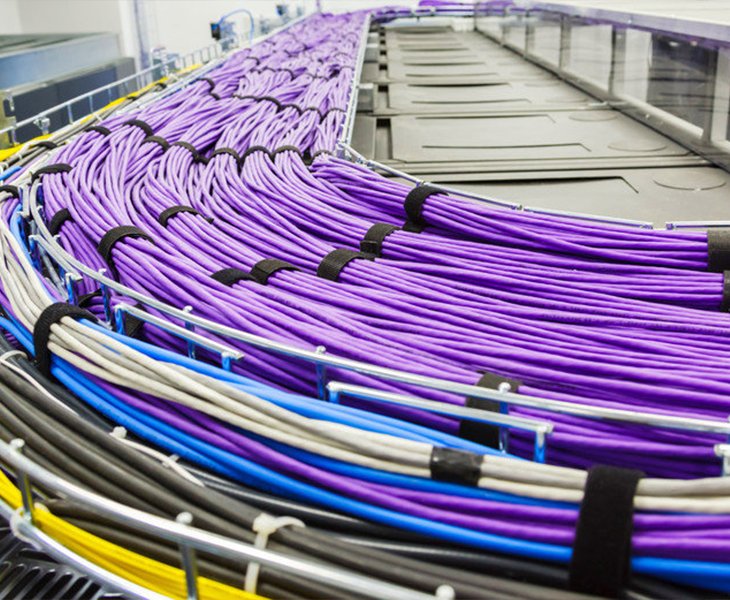
OUFU has multiple automated production lines for Ethernet cables. From copper wire drawing, twisting pairs, cable extrusion, to final product inspection, the entire process is fully automated. Large-scale production significantly reduces unit costs, enabling us to offer you highly competitive wholesale prices. We also support small-batch trial orders and stable large-scale supply.
Technical R & D Capabilities
OUFU has a professional Ethernet cable R&D team. Focusing on technologies such as high-speed transmission, low latency, and anti-interference, we provide you with professional technical support, including Ethernet cable selection suggestions and construction wiring guidance, eliminating your concerns.
It is recommended to choose Cat6. Although Cat5e can support 1Gbps speeds, Cat6 has better anti-interference performance (with an internal cross-structured framework), and it can be compatible with future 10Gbps network upgrades. The price difference from Cat5e is smaller, and its cost-performance ratio is higher. If you only need a 100Mbps broadband connection, Cat5e can also meet your needs.
Not necessarily. Shielded Ethernet cable can block electromagnetic interference and is suitable for scenarios with strong interference, such as computer rooms, weak current wells, and near industrial equipment. However, it needs to be grounded; otherwise, the shielding layer will become an “interference antenna”. For homes and ordinary offices without strong interference, UTP is more cost-effective, and the wiring is more flexible.
Oxygen-free copper has a purity of 99.99%, with low resistance, small signal attenuation, strong oxidation resistance, and long service life. It is the mainstream choice for high-quality Ethernet cables. A pure copper core has a lower purity and more impurities, resulting in poorer transmission performance and durability compared to oxygen-free copper. It is suitable for temporary wiring or short-distance use.
Yes. The Ethernet cable transmission has signal attenuation, and different types have maximum transmission distance limitations (the maximum distances for Cat5e/Cat6/Cat6a are all 100m). Beyond these limits, there will be issues such as reduced speed, packet loss, and network disconnection; if long-distance transmission is needed, a switch repeater can be used for connection.
It can be used in an emergency, but it is not recommended for long-term use. Directly connecting them is prone to poor contact and interference. If repair is needed, it is recommended to use the Ethernet cable to connect the connector or repress the crystal head. If conditions permit, it is best to replace the entire Ethernet cable.
Choose an outdoor-specific ethernet cable, which must meet the following 3 conditions: The sheath should have the properties of resisting ultraviolet rays, withstanding high and low temperatures, and preventing rat bites (such as PE sheath); If used underground, a cable with armor should be selected to prevent soil corrosion and external damage; In strong interference environments, a shielding layer can be used.
It is recommended to choose Cat5e or higher grade oxygen-free copper Ethernet cables. POE-powered systems have high requirements for the stability of Ethernet cable transmission. Poor-quality cables may cause an insufficient power supply to the camera or even a disconnection. It is suggested to select Ethernet cables with a diameter of ≥ 0.5mm, and the transmission distance should be controlled within 80m for better stability.