How fiber optic cables work by transmitting light signals via slender threads of glass or plastic to transfer information at great distances with speed and minimal degradation. Each cable contains hundreds of fibers, each no thicker than a human hair, that transmit the light in pulses. These light bursts convert into digital information, enabling high-speed internet, telephone, and streaming inside homes and businesses. Fiber optic cables are designed for durability and flexibility, so they can withstand harsh conditions and bend with ease. Used worldwide, these cables help make global communication quicker and sharper. To demonstrate why we entrust fiber optic cables with our lives, the body will explain how they transmit signals and why it is so important today.
Fiber optics utilize the phenomenon of total internal reflection to transmit light signals down their core, enabling distance and high-speed data communication.
How fiber optic cables work The design of fiber optic cables determines where they are used best, as single-mode and multi-mode cables have different applications and strengths.
Making fiber optics involves precision materials and processes, with every strand passing quality testing.
Fiber optic cables provide far superior speed and bandwidth compared to copper cables, allowing internet and data services to become much faster and more reliable around the world.
Though less susceptible to eavesdropping and signal interference, fiber optics require routine upkeep and careful installation to reduce signal degradation and physical weaknesses.
The future of fiber optics looks bright with innovations such as hollow-core fibers, quantum networking, and integrated photonics heralding unparalleled speed, security, and flexibility for the communications of tomorrow.
How Do Fiber Optic Cables Work?
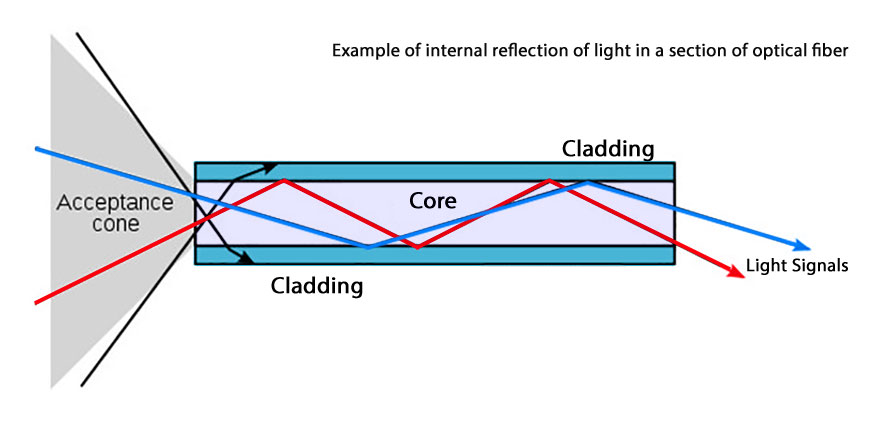
Fiber optic cables reinvent the way we share information by substituting light for electricity. These cables transmit information as flashes of light through tiny glass or plastic fibers, known as the core, that are surrounded by a cladding layer. Light bounces along the core and does not escape until it reaches the other end. That design gives fiber optics the advantage of transmitting massive data volumes over long distances at high speeds.
1. The Light Pulse
Light pulses are like runners carrying messages along a long track. Each pulse is a piece of digital data, pulsing the light on and off to transmit information in bits. Lasers and LEDs are the chief light sources. Lasers generate tight, focused beams for single-mode fibers. LEDs are used in multi-mode fibers and are a bit less sharp but are cheaper.
Light waves transmit the information. Their length, termed the wavelength, determines the distance and speed at which the signals can propagate. The majority of cables operate at wavelengths of 850 nm, 1,300 nm, or 1,550 nm. Using the correct wavelength reduces signal attenuation. Sending light at different wavelengths on one fiber can send more data at once, which is called wavelength division multiplexing.
2. Total Internal Reflection
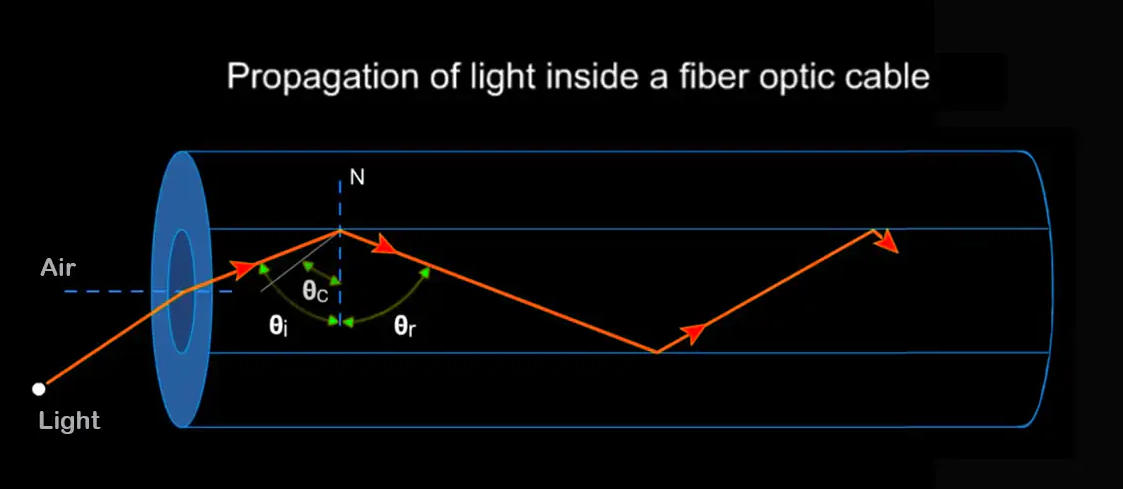
Total internal reflection keeps light traveling within the fiber without any loss. When light strikes the cladding at a particular angle, it reflects back inside. This is due to the difference in refractive indices. The core has a higher index than the cladding.
The signal can go long distances with little loss. It’s what makes fiber cables so good for things like long-haul internet and undersea cables. Even subtle variations in the core or cladding can alter how well the light remains entrained.
3. The Cable Anatomy
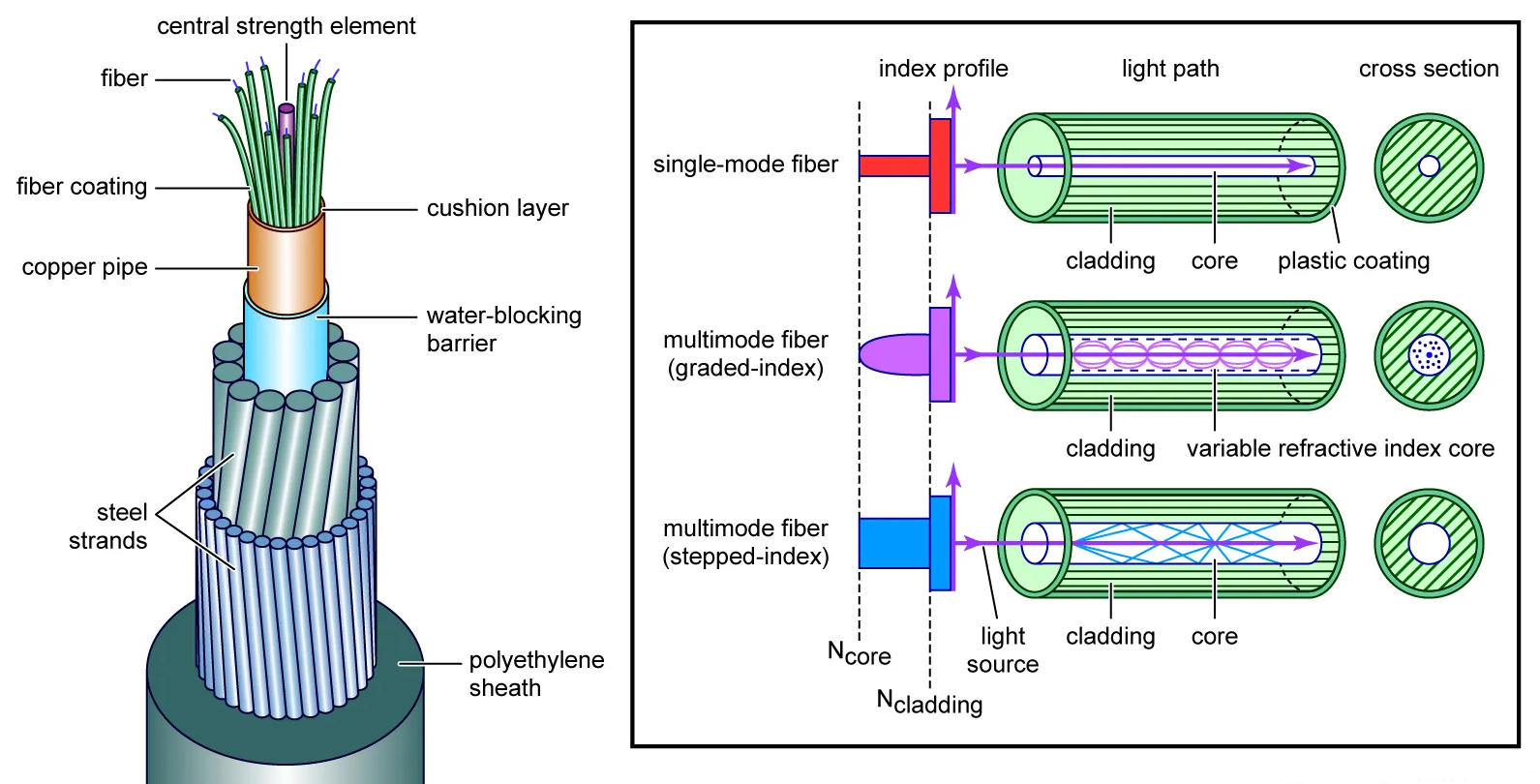
Fiber optic cable is made up of core, cladding, and protective coatings. The core transports the light, the cladding contains it, and the coating protects against moisture, bending, and damage. Other cables include additional jackets or strength members for protection.
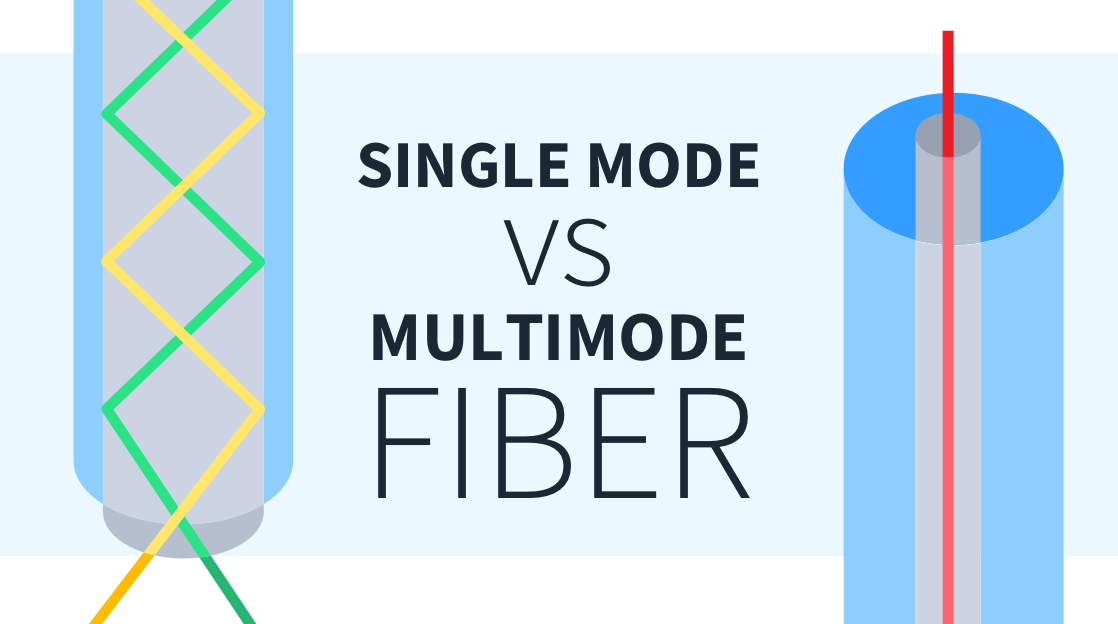
About single-mode and multi-mode fibers. Single-mode cores are around 9 microns across and are designed for long-distance, high-speed links. Multi-mode cores are wider, around 62.5 microns, and perform best for short connections, such as those within buildings. The way the fibers are bundled and arranged into a cable depends on the job, with tight-buffered cables for indoor use and loose-tube for outdoor use.
4. Signal Conversion
Fiber optics require a means to convert electrical information into light and vice versa. Optical transmitters, such as lasers, convert information from computers or mobile phones into light. Optical receivers capture the light and convert it back to electrical signals. Optical amplifiers amplify the light signal when it becomes weak over long distances.
Connectors connect cables to devices and networks. They must fit snugly and keep the tips clean to prevent signal loss.
Specialists like oufu make custom fiber optic cables for all sorts of uses, from telecoms and data centers to medical imaging and more.
The Art of Creation
Manufacturing fiber optic cables is a combination of science, craftsmanship, and strategic planning. Every cable begins with months of design and testing, tapping into expertise from materials science, optics, and engineering. These hair-thin cables transmit beams of light across continents and under oceans, enabling high-speed internet for millions globally.
Preform Creation
We start with the preform — a solid glass rod that becomes the blueprint for each fiber that follows. The thumbprint step utilizes high purity silica glass, melted and molded meticulously. Workers must be attentive to the temperature. If it is too hot or too cold, the glass structure could shift, creating flaws. The preform’s core, which is sometimes only 9 microns wide, must have been exactly centered. A shift would cause signal loss down the line. The materials and processes selected in this stage, such as chemical vapor deposition, assist in maintaining the bubble- and particle-free nature of the glass. How the preform is designed, in particular the thickness of the core and cladding, determines how efficiently the final fiber will reflect light and transmit information.
Fiber Drawing
The preform is transformed into fiber by heating it in a furnace until it becomes soft and gravity draws it down into a slender filament. This stage is where the precision comes in. The fiber needs to maintain the same width throughout its length, typically about 125 microns. Expert technicians and machines oversee the production process, employing cameras and lasers to ensure the fiber doesn’t become too thin or thick. The heat employed here is fierce, often in excess of 2,000°C, but it must be consistent or else the blade will have frail places. Immediately following the drawing process, the fiber receives a light ‘sealer’ coat to guard against dust and scratches. How fine the fiber is drawn determines the path of light inside, ensuring that information moves quickly and with minimal loss.
Quality Assurance
Testing is critical before any fiber leaves the mill. They test each fiber for attenuation by passing light pulses through it and measuring how much comes through. High-grade cables exhibit virtually no loss, even over many kilometers. Visual inspection via microscopes or cameras helps identify minute bubbles or cracks which could otherwise damage performance. Each batch has to pass international benchmarks like those from the International Electrotechnical Commission to make sure cables can withstand tough, safe, real-world application.
Types of Fiber Optic Cables
Fiber optic cables come in two main types: single-mode and multi-mode. Both have a huge impact on how we transport information in cities, countries, and around the world. Their construction, core size, and composition distinguish them, defining their advantages, limitations, and ideal applications.
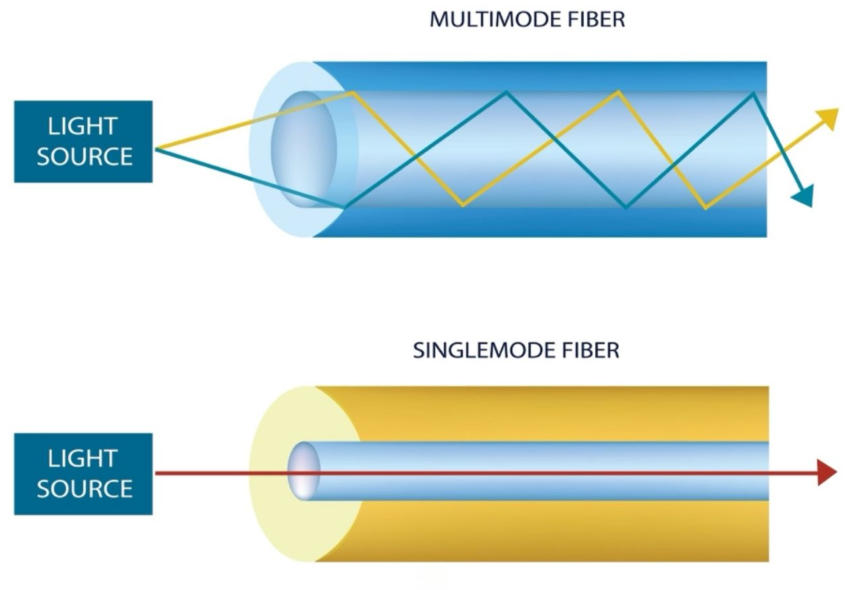
Single-mode fibers have a very small core, approximately 8.3 or 9 µm, allowing a single path of light. This prevents the light from scattering, so the signal remains powerful even over long hauls. Multi-mode fibers have a bigger core, typically 50 or 62.5 µm, that allows multiple light paths to travel simultaneously. This is why they’re good for short distances. If you go too far, the signal blurs.
Single-mode cables excel in long-distance tasks such as internet backbones and telecom networks. They are more expensive to install and require more expensive equipment. Multi-mode cables are less expensive, simpler to install, and perform well indoors and on campuses. They can’t transmit as far or as fast as single-mode alternatives.
Single-mode cables maintain low signal loss, accommodate faster speeds, and are ideal for links above 2 km. Multimode is easier to work with and can handle commute jams at busy places like data centers. Distance and speed fall off fast after 550 meters.
Cable types influence both the volume and distance data can travel, so selecting the right one is important in network design.
Single-Mode
Single-mode fiber uses a thin core that maintains the light compact and direct. This design allows signals to traverse dozens or even hundreds of kilometers with minimal attenuation. It is the fiber of choice for phone lines, undersea internet cables, and TV feeds. The decreased signal fading translates into fewer repeaters necessary.
Most times, single-mode is chosen for high-speed, high-bandwidth requirements in telecom and service provider environments. The cables aren’t necessarily expensive, but the connectors for them are more expensive than those for multimode. This makes single-mode less prevalent in SOHO environments.
Multi-Mode
Multimode fiber, with its larger core, allows light to travel multiple paths. This is good for short distances, such as inside a building or between adjacent buildings. It means the signals diffuse more, so they can’t travel as far without getting garbled. It’s simpler to deploy and compatible with less costly equipment.
Ideal for LANs and places where speed is less important than price. They come in types like OM3, OM4, and OM5, each with varying bandwidth and reach. In a bustling office or data center, multi-mode is usually the smarter choice due to its versatility and ease of deployment.
Mode Conditioning cables assist in bridging single-mode signals to multi-mode gear, so networks can upgrade gradually without massive expenses.
Application Differences
Single-mode: Best for long-haul, high-speed links such as telecom, wide-area networks, and undersea cables.
Multi-mode: Suited for short runs, data centers, local area networks, and inside buildings.
Simplex cables are single fiber strands that allow for one-way data transmission. Duplex cables consist of two strands for two-way data transmission.
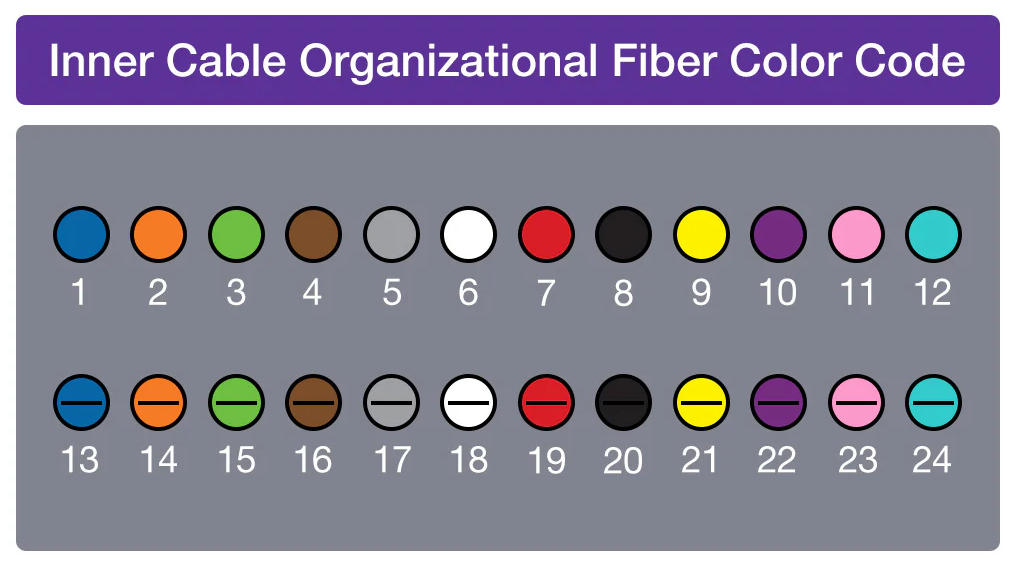
Multi-strand cables: Often 12 or 24 fibers per cable, supporting large networks.
Single-mode is used in both indoor and outdoor settings. Single-mode works well for environments with excessive electrical interference and extreme weather with its low attenuation and high-intensity signals. Multi-mode is a better fit where the distances are short and you’re working with a limited budget.
Performance hinges on core size and light path. Single-mode wins for distance and speed, while multi-mode is better for cost and ease. Demand for higher bandwidth is on the rise, with OM5 multi-mode and new single-mode designs pushing the limits in cloud and 5G networks.
The Unseen Challenges
Fiber optic cables boast blazing speed and rock-solid connection. The path from conception to launch is filled with unseen challenges. These are the challenges that typically remain hidden from the end user, but they define how effectively fiber networks perform in real-world environments. From lost light signals to fragile cable, every problem requires thoughtful design, clever engineering, and ongoing maintenance.
Signal Attenuation
Signal loss is when the light signal gets weaker as it goes down the fiber. This weakening can hinder or even prevent data from reaching its target. A lot of factors can make the signal dissipate, such as impurities in the glass, kinks in the cable, and external interference. The longer the cable, the more signal strength drops.
To combat attenuation, engineers frequently employ repeaters or amplifiers. These devices amplify the light signal at intervals, allowing it to propagate long distances with minimal attenuation. This means more upkeep and more expense. Maintaining the cables, keeping them straight and clean, and regular inspection prevent signal loss from worsening. Even minute dust or loose connectors can harm performance, so maintaining everything in good shape is crucial.
Physical Vulnerability
Fiber optic cables are thin, light, and brittle. They can snap if you use them the wrong way or if they’re cheap. Outside, storms, animals, or digging can break lines. Occasionally, proximity to heavy machinery or heights predisposes them to breakage.
Protective covers, armored cables, and smart routing can protect cables from damage. Even with these, cables can be vulnerable in cramped areas. If a cable snaps, the network can go down, sometimes for hours or days. That’s why periodic inspections and prompt patching are important for maintaining the network.
Installation Nuances
Installing fiber optic cables isn’t a cakewalk. Installers have to toil in hard-to-work locations, high in skyscrapers, deep inside cramped ducts, and next to live electrical wiring. These cables must be managed and routed carefully to prevent any sharp bends or kinks. Tools like fusion splicers and air compressors have limits and require proper configurations to perform well.
Space is frequently tight, particularly in urban areas. Mapping out the path and ensuring there’s space and securing everything takes time. Cabling splices are a sensitive task requiring specialized training. Safety first, installers suit up and adhere to rigorous protocols to remain safe around heights and equipment.
Why Choose Fiber Optics?
Fiber has revolutionized the way we communicate information. They provide fast, secure, and reliable connections for individuals and businesses around the globe. That’s why fiber optics is so special. It offers unparalleled speed, broad bandwidth, powerful security, and future readiness.
Unmatched Speed
Fiber cables transmit data using light pulses, so data moves at or near the speed of light.
Fiber optics is capable of speeds as high as 10 Gbps or above. That’s way faster than copper wires, which typically max out at a few hundred Mbps.
Fiber optics, as opposed to the antiquated systems of the past, allow you to stream 4K movies, have video calls, or upload large files virtually immediately. This rapidity isn’t solely for amusement. For businesses, it translates to speedier cloud backups, real-time collaboration, and seamless online meetings.
When a company has to transfer large volumes of data at high speeds, fiber lines help keep the work moving even for companies across the globe.
Superior Bandwidth
Bandwidth is the amount of data that could simultaneously move through a network. Fiber optics provide significantly more bandwidth than copper cables, which is why they’re a favorite for high-traffic networks. More bandwidth means nobody has to deal with buffering while you stream HD videos and download large files. Homes, hospitals, and schools can all be served by the same connection for different things without slowing down. As additional devices go online, from phones to smart home appliances, the demand for bandwidth continues to increase. Fiber optic systems are primed for this future and cope with straining new tech as it arrives.
Enhanced Security
Fiber optic cables are nearly impossible to tap or hack. If someone tries to break into the cable, it is easy to detect since the signal immediately drops off. Copper wires, meanwhile, can be tapped secretly. This is what makes fiber optics good for banks, hospitals, and military data. Confidential data travels securely as it moves through cities or even the ocean floor. The cables protect vital networks around the globe.
Future-Proofing
Fiber optic cables have a long lifespan. Submarine cables operate for over 25 years. This installed base will backstop the world’s data needs for decades, probably 30 or 40 years. These cables are simple to update, so when extra speed is required, techs can dial things up without unearthing the lines. They pair well with emerging technologies, such as VR or AI, keeping networks cutting-edge.
The Future of Light Speed
Fiber-optic cables have transformed the global transmission of data, allowing information to shoot across continents at close to light speed. With research racing ahead, scientists are seeking ways to improve these cables still more. The vision is straightforward: connecting everything from streaming ultra-HD video to fueling future wireless networks like 5G and beyond, faster, safer, and more reliably. Fiber optics already transmit at speeds of up to 800 Gbps, and every five years, these rates nearly double. This chapter investigates ways emerging concepts such as hollow-core fiber, quantum networking, and integrated photonics will influence the future.
Hollow-Core Fiber
Hollow-core fiber is a new class of fiber optic cable. Rather than having a solid glass core, it utilizes a hollow core filled with air or gas. Light travels in these hollow areas rather than glass, reducing the amount that light slows or bends.
Less signal loss is the BIG WIN here! Hollow-core fibers can hold onto a powerful signal for longer distances with fewer repeaters. This is important for global networks where cables run for hundreds of kilometers underwater.
Telecoms think they can slash expenses and accelerate long-haul routes. Imagine, for instance, streaming 8K video or operating cloud systems across continents being more seamless and less expensive.
Having a lot to work out still. Scientists attempt to make hollow-core fibers as robust and bendable as the normal variety. European and Asian labs are spearheading the effort, hoping to commercialize these fibers imminently.
Quantum Networking
Quantum networking employs the bizarre principles of quantum physics to transmit information. It transmits information as quantum bits or qubits, typically employing single photons within fiber optic cables.
Quantum networks offer nearly unhackable security. Quantum encryption sends alerts if someone attempts to tap the line, thus protecting secrets better. Data speed might leap, as quantum links employ light in novel fashions.
It might alter the way banks, hospitals, and even governments exchange information. What if hacking fiber lines was nearly impossible?
It’s hard to construct. Quantum signals are delicate and require specialized equipment. Holding them strong across distances is hard. Yet teams in the US and China have already installed mini quantum networks—demonstrating what can be done.
Integrated Photonics
Integrated photonics is about cramming lots of optical components onto a miniscule chip, sort of the way microchips transformed computing.
More compact, less expensive, and speedier configurations could now be realized. These chips have the capacity to miniaturize huge, expensive optical systems to the size of a coin. This translates into more fiber optic components crammed into phones, cars, and even home gadgets.
Factories, medical labs and data centers will all run these chips. They assist in sorting, switching and sending data in parallel, drastically reducing power consumption and saving space.
Integrated photonics means these networks can be upgraded without ripping up those old cables, making future fiber optic systems both smarter and easier to run.
Technology | Applications | Benefits |
|---|---|---|
Hollow-Core Fiber | Telecom, cloud, streaming | Low loss, high speed, long reach |
Quantum Networking | Secure comms, finance, health | Unbreakable security, faster data |
Integrated Photonics | Data centers, industry, IoT | Mini size, low power, easy upgrades |
Conclusion
Fiber optic cables transmit light through tiny glass or plastic threads. Light reflects rapidly and easily within the core and delivers fast data with minimal loss. Constructors mold every cable to the demand. Some serve houses, while others electrify entire urban areas. They rely on fiber for speed, consistent usage, and reliable connections. Despite hard builds and hard fixes, fiber just keeps building. Each day, people discover new applications for this light, including smart instruments, massive data, and crisp videoconferencing. Fiber optic technology keeps life humming right along. Feeling geeky? Go and see local networks, observe a fiber install, or talk to someone who works with these cables. The fiber world is evolving, and you can be part of it.
Frequently Asked Questions
What is a fiber optic cable?
Fiber optic cables are strands of glass or plastic that transmit data as beams of light. They allow speedy, dependable distance communication.
How do fiber optic cables transmit data?
What is fiber optic cable and how does it work? These pulses navigate the cable’s core, bounce off the walls, and transport data at high speed.
What are the main types of fiber optic cables?
There are two common types of fiber: single-mode and multi-mode. Single-mode cables are optimal over long distances and multi-mode cables work better for short runs.
Are fiber optic cables better than traditional copper cables?
Yes, fiber optic cables are faster, support more bandwidth, and carry signals longer distances than copper cables. They are less susceptible to interference and loss.
What are common challenges with fiber optic cables?
They’re expensive to set up and easy to break or bend. Technicians are required for installation and repairs.
Why are fiber optic cables used for internet connections?
Fiber optic, for instance, is fast, stable, and has high capacity. They power streaming, video conferencing, and cloud computing with barely a lag.
What does the future hold for fiber optic technology?
Fiber optic technology will continue to advance, providing even greater speeds and enabling new innovations in communication and data transfer.