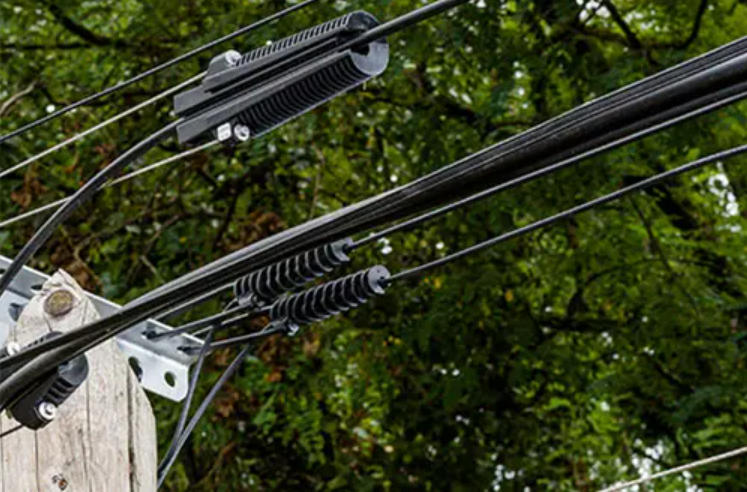
In today’s hyper-connected world, reliable high-speed internet and communication networks are no longer luxuries—they are essential infrastructure. Among the many solutions powering global digital transformation, aerial fiber optic cable stands out as one of the most practical, efficient, and widely used options for building long-distance and last-mile communication networks.
Unlike underground fiber cables that require extensive trenching, aerial fiber optic cable is installed above ground, suspended between utility poles, transmission towers, and existing overhead structures. This design makes it ideal for rapid deployment, challenging terrains, and budget-sensitive projects across urban, suburban, and rural areas.
This comprehensive guide explores every key dimension of aerial fiber optic cable: definitions, main types, technical advantages, installation best practices, maintenance strategies, regional applications, and future industry trends. Whether you are a telecom operator, network engineer, project contractor, or infrastructure investor, this article will help you fully understand how aerial fiber optic cable supports modern communication systems worldwide.
What Is Aerial Fiber Optic Cable?
Aerial fiber optic cable refers to a type of optical fiber cable specifically engineered for overhead installation. It is designed to withstand outdoor environmental stress, including wind, ice, ultraviolet radiation, extreme temperatures, and physical tension, while maintaining stable data transmission performance.
Unlike indoor fiber cables or buried duct cables, aerial fiber optic cable focuses on three core performance requirements:
- High mechanical strength to support long spans between poles
- Excellent weather and UV resistance for long-term outdoor use
- Stable optical transmission with low signal loss
Most aerial fiber optic cable is built with reinforced strength members, waterproof gel filling, and durable outer sheaths to ensure a service life of 25 to 30 years even in harsh outdoor conditions. By using existing utility pole infrastructure, aerial fiber optic cable greatly reduces construction difficulty, shortens project cycles, and lowers overall deployment costs.
Today, aerial fiber optic cable has become the backbone of global broadband expansion, 5G base station backhaul, smart grid communication, and rural internet access projects.
Main Types of Aerial Fiber Optic Cable and Their Applications
The aerial fiber optic cable market includes several specialized designs to meet different span distances, voltage environments, and project needs. Choosing the right type directly affects network reliability and total cost.
1. ADSS Aerial Fiber Optic Cable
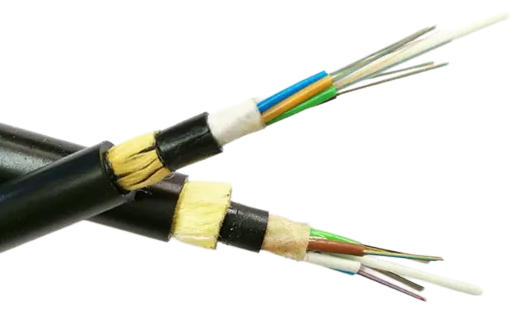
ADSS (All-Dielectric Self-Supporting) fiber optic cable is the most advanced aerial fiber optic cable for high-voltage power line corridors.
- Fully non-metallic structure to avoid electromagnetic interference (EMI)
- High tensile strength for long spans up to 700 meters
- Anti-tracking (AT) sheath for resistance to electrical corrosion
- Suitable for high-voltage transmission lines, smart grids, and long-distance rural links
ADSS aerial fiber optic cable is widely used in power communication systems because it can be installed without power outages.
2. Figure‑8 Aerial Fiber Optic Cable
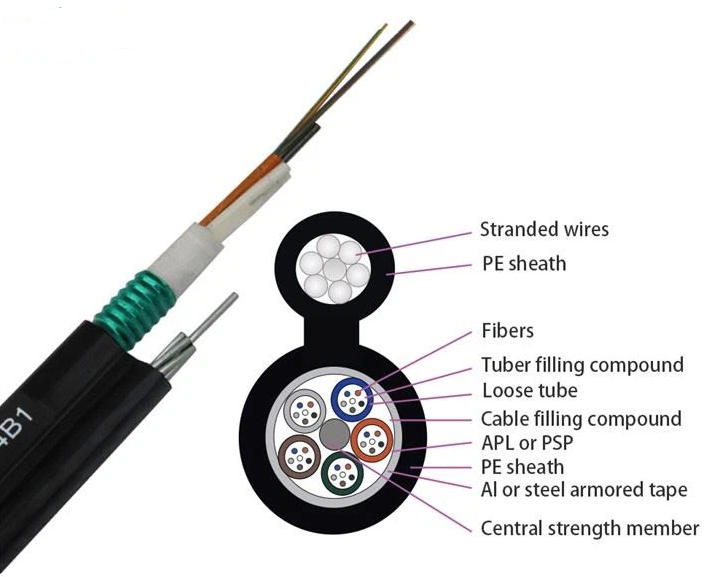
Figure‑8 (or “8‑shaped”) fiber optic cable integrates a steel messenger wire and fiber unit into one compact structure.
- Self-supporting design for medium spans of 30–80 meters
- Easy to install and splice
- Cost-effective for urban and suburban FTTH networks
- Common core counts: 4–288 cores
This type of aerial fiber optic cable is the first choice for residential fiber-to-the-home (FTTH) projects.
3. GYXTW Central Tube Aerial Fiber Optic Cable
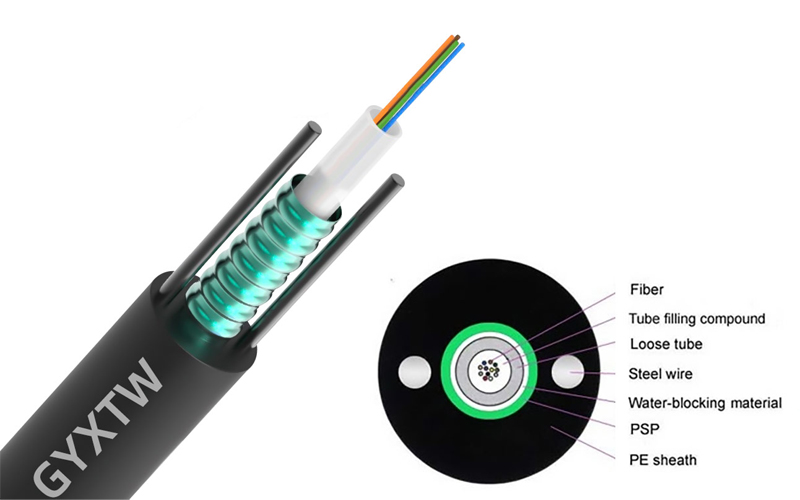
GYXTW fiber optic cable is a general-purpose armored aerial fiber optic cable with a central loose tube and steel tape armor.
- Good crush resistance and moisture protection
- Lightweight and flexible for easy construction
- Suitable for short‑to‑medium aerial and duct applications
- Typical core range: 2–24 cores
It is widely used in metro networks, industrial parks, and community access networks.
4. Lashed Aerial Fiber Optic Cable
Lashed aerial cable is a non‑self-supporting design that requires lashing to an existing steel messenger wire.
- Lower material cost
- Ideal for network upgrades and retrofitting
- Commonly used in dense urban areas with existing overhead lines
This aerial fiber optic cable helps telecom companies expand capacity quickly without full infrastructure reconstruction.
Key Advantages of Aerial Fiber Optic Cable
Aerial fiber optic cable offers unmatched benefits compared to underground cabling, making it dominant in global telecom construction.
1. Lower Overall Deployment Cost
The biggest advantage of aerial fiber optic cable is cost efficiency. Trenching, road restoration, and land acquisition account for more than 50% of underground fiber costs. Aerial installation eliminates these expenses, reducing total project cost by 30%–60%.
This makes aerial fiber optic cable especially economical in rural areas, wetlands, rocky regions, and areas with high groundwater levels.
2. Faster Installation and Network Launch
Aerial fiber optic cable can be installed 3–5 times faster than buried cable. Teams can complete route laying, suspension, and splicing in a short period, allowing telecom providers to launch services ahead of schedule.
In emergency communication, disaster recovery, and temporary network projects, aerial fiber optic cable supports rapid deployment within days.
3. Easy Maintenance and Fault Location
Since aerial fiber optic cable is exposed above ground, maintenance teams can visually inspect cable conditions, quickly locate faults, and repair damage without digging. This reduces network downtime and lowers long-term maintenance costs.
Fault detection using OTDR testers is also more efficient on aerial routes than buried routes.
4. Strong Environmental Adaptability
High-quality aerial fiber optic cable supports an operating temperature range from -40°C to +70°C. Advanced PE or AT sheaths resist UV aging, rain, snow, ice loading, and coastal salt spray.
Special designs also protect against bird pecking, rodent damage, and wind-induced vibration, ensuring stable performance in different climates.
5. High Flexibility for Complex Terrains
Aerial fiber optic cable easily crosses rivers, highways, railways, mountains, and forests. It does not damage the natural landscape and requires minimal civil work. This flexibility makes it irreplaceable in remote and geographically difficult areas.
Installation Best Practices for Aerial Fiber Optic Cable
To ensure long-term stable operation, aerial fiber optic cable must follow strict engineering standards during installation.
Pre‑Installation Preparation
- Conduct a full route survey to confirm pole distance, height, and clearance
- Select appropriate hardware: suspension clamps, splice closures, brackets
- Calculate safe spans based on wind speed, ice load, and local weather standards
- Ensure safe distances from high-voltage power lines
Core Installation Requirements
- Control tension strictly to avoid fiber microbending and signal loss
- Maintain reasonable sag to adapt to thermal expansion and contraction
- Use protective sleeves at pole attachment points to reduce abrasion
- Ensure waterproof sealing for all splice and connection points
- Comply with local electrical safety regulations
Regional Installation Differences
Different regions have adapted standards for aerial fiber optic cable:
- North America: emphasizes ice load and low-temperature resistance
- Europe: focuses on environmental protection and aesthetic integration
- Asia‑Pacific: optimized for typhoons, high humidity, and dense urban layouts
- Africa & Middle East: enhanced heat, sandstorm, and UV resistance
Maintenance of Aerial Fiber Optic Cable
With proper maintenance, aerial fiber optic cable can achieve a service life of over 25 years.
Routine Inspection
- Quarterly visual inspections for sheath damage, loose clamps, and excessive sag
- Semi‑annual OTDR testing to monitor optical loss
- Post-storm inspections to check for wind or ice damage
Common Maintenance Solutions
- Repair minor sheath damage with protective tape
- Replace corroded hardware and aging splice closures
- Trim overgrown branches to prevent cable abrasion
- Install bird and rodent deterrents in high-risk areas
Regular maintenance greatly extends the service life of aerial fiber optic cable and reduces network failure rates.
Global Applications of Aerial Fiber Optic Cable
Aerial fiber optic cable supports critical communication infrastructure across every continent.
1. Rural Broadband Connectivity
Governments worldwide are investing in universal broadband access. Aerial fiber optic cable is the primary solution for connecting remote villages, as it costs far less than underground construction.
In North America, Europe, and Southeast Asia, aerial fiber optic cable is accelerating digital inclusion in underserved regions.
2. 5G Base Station Backhaul
5G networks require high-capacity, low-latency backhaul links. Aerial fiber optic cable provides stable 10G–40G transmission between towers and core networks, enabling fast 5G deployment in suburban and rural zones.
3. Smart Grid and Power Communication
ADSS aerial fiber optic cable is widely used in smart grid systems. It enables real-time data transmission for power monitoring, remote control, and grid automation, supporting the energy transition worldwide.
4. Urban FTTH and Metro Networks
In cities, aerial fiber optic cable provides a cost-effective alternative to crowded underground pipelines. It supports high-density FTTH deployment, multi-dwelling unit connections, and municipal public networks.
5. Industrial and Enterprise Communication
Factories, ports, mines, and logistics parks use aerial fiber optic cable for internal data transmission. Its anti-EMI performance makes it especially suitable for heavy-industry environments.
Market Trends and Future of Aerial Fiber Optic Cable
The global market for aerial fiber optic cable continues growing steadily, driven by digital transformation policies and infrastructure investment.
Current Market Drivers
- Global 5G network construction
- National broadband plans (BEAD, Digital Decade, Digital Indonesia, etc.)
- Smart grid modernization
- FTTH expansion in developing countries
- Demand for low-cost rural connectivity
Technological Innovations
- Higher-performance fibers with lower attenuation
- Longer-span ADSS cable for river and valley crossings
- Smart sensing cables for real-time condition monitoring
- Eco-friendly, recyclable sheath materials
- Higher fiber counts for greater network capacity
Future Opportunities
Aerial fiber optic cable will play a key role in:
- AI and data center interconnection
- IoT and smart city infrastructure
- Emergency communication and disaster recovery
- Cross-border connectivity in emerging markets
As bandwidth demand continues to rise, aerial fiber optic cable will remain a foundational component of global digital infrastructure.
Conclusion
Aerial fiber optic cable is a versatile, cost-efficient, and high-performance solution that powers modern communication networks across the globe. Its unique advantages in fast deployment, low cost, easy maintenance, and strong environmental adaptability make it irreplaceable in 5G, FTTH, smart grid, and rural broadband projects.
From ADSS long-distance cables to Figure‑8 residential access cables, aerial fiber optic cable comes in diverse designs to meet different engineering needs. With proper installation and maintenance, it delivers reliable service for decades.
As the world moves toward full digital connectivity, aerial fiber optic cable will continue to be the backbone of global telecom development, connecting people, businesses, and regions with high-speed, stable communication networks.