In the rapidly evolving landscape of global telecommunications and data centers, the demand for high-speed, reliable connectivity is insatiable. While standard fiber optic cables are the backbone of this digital era, they possess a fundamental vulnerability: fragility. This is where the Armored Fiber Optic Cable becomes indispensable. Designed to withstand harsh environments, mechanical stress, and external threats, armored cable ensures network integrity where ordinary cables fail.
This comprehensive guide explores everything you need to know about armored fiber optic cable, including its structure, types (such as steel tape armored fiber optic cable and single mode armored fiber optic cable), technical specifications, installation best practices, and how to choose the right one for your project.
What is an Armored Fiber Optic Cable?
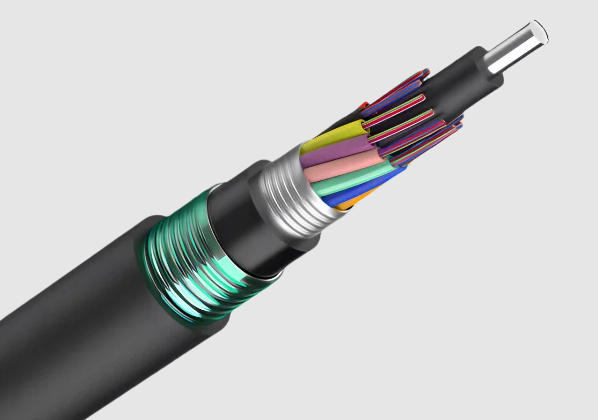
An Armored Fiber Optic Cable is a specialized type of optical cable that incorporates a protective armor layer—usually made of steel tape, steel wire, or aluminum—beneath the outer jacket. This armor provides enhanced mechanical protection against crushing, rodent bites, tensile stress, and environmental hazards.
Unlike standard non-armored fiber optic cable, which is suitable for controlled indoor environments like data centers or office buildings, armored variants are engineered for rugged applications. These include direct burial, outdoor aerial installations, industrial plants, and even submarine communications.
The inclusion of the armor does not interfere with the optical transmission performance. Modern manufacturing ensures that the armored fiber cable maintains low attenuation and high bandwidth, compliant with standards such as ITU-T G.652Dand IEC 60794.
Key Structure and Components
To understand the durability of an armored optical cable, one must look at its multi-layered structure:
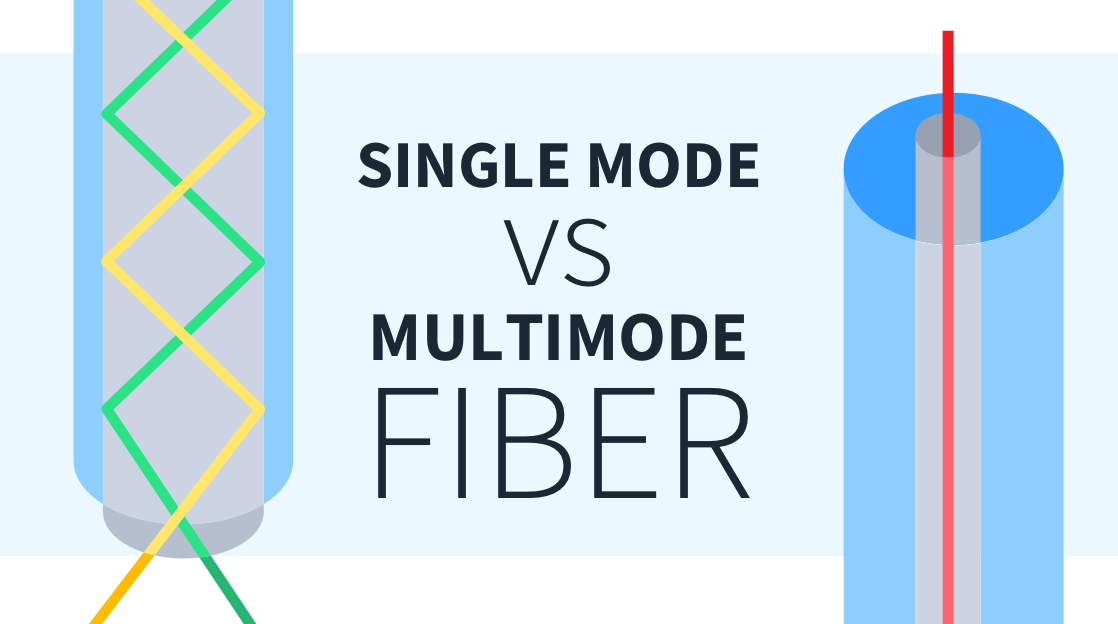
- Optical Fiber (Core): Usually single-mode (9/125µm) or multimode (50/125µm or 62.5/125µm), responsible for light signal transmission.
- Buffer Tube: Protects the fiber from micro-bending; can be tight-buffered or loose-tube.
- Strength Member: Typically Aramid yarn (Kevlar) or FRP (Fiber Reinforced Plastic) to resist tension.
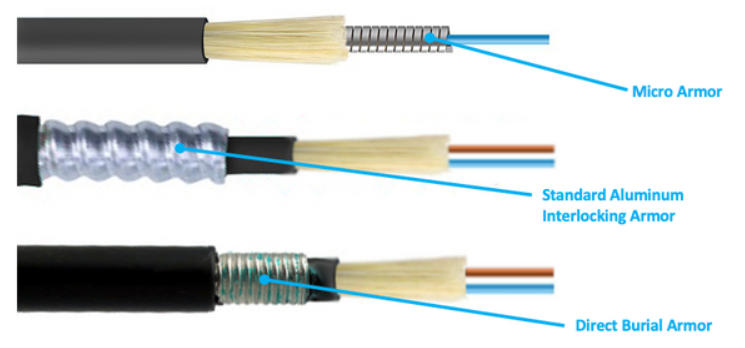
- Armor Layer: The defining feature. It can be corrugated steel tape armor, interlocked aluminum armor, or steel wire armor.
- Outer Jacket: Made of PE (Polyethylene) for outdoor use or LSZH (Low Smoke Zero Halogen) for indoor safety. UV, moisture, and chemical resistance are often integrated.
This robust construction allows the armored fiber optic patch cable and bulk cable alike to survive in environments where standard cables would be compromised.
Types of Armored Fiber Optic Cables
Choosing the correct type of armored fiber cable is critical for project success. Here are the most common variants:
1. Steel Tape Armored Fiber Optic Cable
This type uses a corrugated steel tape wrapped around the cable core. It offers excellent crush resistance and is ideal for direct burial or duct installations. It also provides shielding against electromagnetic interference (EMI).
2. Steel Wire Armored Fiber Optic Cable
Utilizing steel wires stranded around the core, this cable is designed for high-tension environments, such as aerial deployments or vertical riser applications. It offers superior tensile strength.
3. Aluminum Interlock Armored Fiber Optic Cable
Lighter than steel, aluminum armor is often used in indoor or lightweight outdoor applications. It is easier to handle and terminate while still offering good protection against physical damage.
4. Single Mode Armored Fiber Optic Cable
Designed for long-distance, high-bandwidth transmission (commonly using OS2 fiber), this is the standard for telecom backbones, ISP networks, and metropolitan area networks (MAN).
5. Multimode Armored Fiber Optic Cable
Typically OM3 or OM4 rated, these are used for shorter distances such as campus backbones, data centers, and industrial control networks where 10G/40G/100G speeds are required.
6. Double Armored Fiber Optic Cable
For extreme conditions (e.g., mining, underwater, or heavy industrial zones), double armor (combination of tape and wire) provides maximum protection.
Technical Specifications and Performance Parameters
When sourcing an armored fiber optic cable, certain technical parameters must be evaluated:
- Fiber Count: Ranges from 1 fiber (simplex armored patch cord) up to 144 cores or more in bulk cables.
- Operating Temperature: Standard range is -20°C to +70°C; some industrial grades support -40°C to +85°C.
- Crush Resistance: Often rated up to 3000 N/100mm (short term).
- Tensile Strength: Varies by design; e.g., 2000N short-term pull for a 12-fiber cable.
- Minimum Bend Radius: Usually 20x the cable diameter (installation), 10x (operation).
- Attenuation: Typical values are ≤0.36 dB/km at 1310nm and ≤0.22 dB/km at 1550nm for single-mode.
- Fire Rating: Indoor cables often comply with OFCR, OFNP, or LSZH standards (e.g., IEC 60332, UL 1666).
These metrics ensure that the armored fiber optic cable price you pay translates into reliable, long-term performance.
Application Scenarios: Where to Use Armored Cable
The primary advantage of armored fiber optic cable is its versatility in hostile environments. Common applications include:
- Direct Burial: Roadways, railways, and landscaping where excavation risks exist.
- Aerial Installation: Between utility poles; requires resistance to wind, ice, and sag.
- Industrial Plants: Refineries, factories, and power stations where chemicals, heat, and machinery are present.
- Data Centers (Inter-building): When cables must traverse outdoor plenums or riser shafts.
- Military and Aerospace: Where durability and security are paramount.
- Rodent-Prone Areas: Rural or wooded environments where gnawing animals threaten infrastructure.
Frequently Asked Questions
1. What is an armored fiber optic cable?
An armored fiber optic cable is a standard fiber cable core that is protected by an additional layer of metal (such as steel tape, steel wire, or aluminum) or high-strength non-metallic material (like Kevlar or glass yarn). This “armor” acts like a protective “bulletproof vest” for the fragile fiber, shielding it from mechanical damage, moisture, crushing, and rodent bites.
2. Where are armored fiber cables typically used?
Due to their robust protection, they are mainly used in environments with physical threats or harsh conditions:
- Outdoor & Direct Burial: Directly buried underground (without conduit), installed in ducts, or used for cross-campus connections.
- Industrial Environments: Factories, workshops, mines, or areas with heavy machinery, vibration, chemicals, or rodent infestations.
- High-Traffic Indoor Areas: Data centers (under raised floors or overhead cable trays), hospitals, and campuses where cables are prone to foot traffic, crushing, or pulling.
3. What are the common types of armoring?
There are two main structures, each suited for different scenarios:
- Corrugated Steel Tape (CST): A longitudinally folded coated steel tape. It offers extremely high hardness, excellent moisture resistance, and strong rodent protection. Ideal for direct burial, duct installation, and harsh industrial settings, but it is less flexible.
- Interlocking Armor: Helically wound and interlocked aluminum or steel tape. It is highly flexible and easy to bend and route, making it suitable for indoor data center cable trays and risers. It can sometimes replace conduit but offers slightly less rodent protection than seamless steel tape.
4. Does the armor affect optical signal transmission?
No. Optical signals travel via light pulses within the glass core and are immune to electromagnetic interference (EMI). The metallic armor layer only provides physical protection and does not interfere with optical performance (e.g., attenuation or bandwidth).
5. What are the pros and cons compared to non-armored cables?
- Pros: Superior protection against crushing, impact, and rodent bites; better environmental adaptability; in some cases, it eliminates the need for external conduits, potentially reducing overall installation costs.
- Cons: Heavier weight and larger diameter; stiffer (especially CST); higher material and manufacturing costs; termination requires special tools and handling of the armor layer.
6. Can armored fiber cables be used indoors?
Yes. However, indoor armored cables must have a fire-retardant outer jacket (e.g., PVC or LSZH/LSOH low-smoke, zero-halogen material) that complies with safety standards like OFNR (Riser) or OFNP (Plenum). Interlocking aluminum armor is commonly preferred for indoor use due to its flexibility.
7. Are there any special installation considerations?
- Cutting & Stripping: Requires specialized tools to cut through the metal armor without damaging the internal fiber core.
- Grounding: The metallic armor layer often needs to be grounded to dissipate induced currents or provide shielding (depending on specifications).
- Bend Radius: Always adhere to the manufacturer’s minimum bend radius to prevent armor deformation that could crush the fiber inside.
- Termination: Field termination involves properly securing the armor (e.g., using armored grounding boots) before performing standard polishing or fusion splicing.