In the rapidly evolving landscape of fiber-to-the-home (FTTH) deployments, selecting the right transmission medium is critical for balancing performance with budget constraints. While ADSS (All-Dielectric Self-Supporting) cables dominate long-span applications, a more compact, cost-effective solution has emerged as the industry standard for urban and suburban distribution: the ASU Cable.
This comprehensive guide dives deep into the world of ASU fiber optic cables, exploring their unique structure, technical parameters, and why they are often the preferred choice for short-span aerial installations. Whether you are an network engineer, a procurement officer, or a contractor looking for ASU cable price per meter, this article will provide the insights needed to make an informed decision.
What is an ASU Cable? Definition and Structure
The term ASU stands for All-dielectric Self-supporting Universal (or sometimes interpreted as Single Unit/Tube). It is a type of miniature ADSS cable designed specifically for short-distance aerial networking.
Unlike traditional stranded loose tube cables, the ASU cable features a central tube (single loose tube) design. This structure is optimized to house a smaller number of fibers—typically ranging from 2 to 24 cores—making it significantly lighter and more flexible than its full-sized counterparts.
Key Structural Components
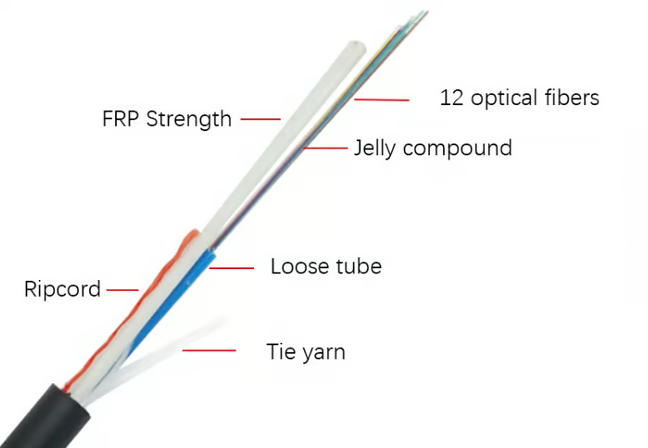
To understand the durability of the ASU80 or ASU120 cable, one must look at its internal construction:
- Optical Fibers: Usually G.652D or G.657A1/A2 single-mode fibers, housed within the central tube.
- Loose Tube: Made of high-modulus polyester (PBT), filled with water-blocking jelly or thixotropic compound to prevent moisture ingress.
- Strength Members: Two parallel Fiber Reinforced Plastic (FRP) rods are positioned on either side of the central tube. These provide the necessary tensile strength for self-supporting aerial spans without the need for a separate messenger wire.
- Outer Sheath: Typically made of UV-resistant PE (Polyethylene) or HDPE, available in black to withstand harsh outdoor environments.
Technical Specifications and Performance Parameters
When evaluating ASU fiber optic cable datasheets, several technical metrics stand out. These specifications ensure the cable can withstand environmental stressors while maintaining signal integrity.
- Span Length: The most defining characteristic. ASU cables are engineered for short spans, typically 80m, 100m, or 120m between utility poles. They are not recommended for spans exceeding 150m.
- Tensile Strength: Rated for short-term tensile loads often between 800N to 1500N, depending on the manufacturer and specific model (e.g., ASU80 vs ASU120).
- Temperature Range: Standard operating temperatures range from -40°C to +70°C, ensuring stability in extreme climates.
- Attenuation: Standard performance at 1310nm (≤0.36 dB/km) and 1550nm (≤0.22 dB/km).
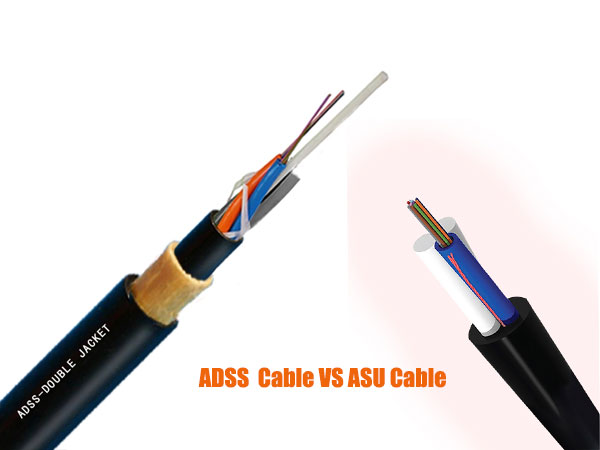
ASU Cable vs. ADSS Cable: Which One Should You Choose?
A common question in network planning is the comparison between ASU cable vs ADSS cable. While both are all-dielectric and suitable for aerial installation, they serve different niches.
| Feature | ASU Cable | ADSS Cable |
|---|---|---|
| Structure | Central Tube (Single Tube) | Loose Tube Stranded |
| Max Fiber Count | Usually up to 24 cores | Up to 144 cores or more |
| Span Capability | Short span (up to 120m-150m) | Long span (up to 1000m+) |
| Diameter & Weight | Small diameter (approx. 6-9mm), lightweight | Larger diameter, heavier |
| Cost | Lower material and installation cost | Higher cost due to robust design |
| Best Application | Urban FTTH distribution, last-mile | Long-haul, backbone, river crossings |
Verdict: If your project involves FTTH drop cable deployment in a densely populated area with frequent pole changes, the ASU cable is the economical and practical winner. For crossing wide highways or rivers, ADSS is mandatory.
Primary Applications of ASU Cables in Modern Networks
The versatility of the ASU cable makes it a staple in various scenarios:
- FTTH Distribution Networks: Ideal for connecting the distribution point to the subscriber’s premises in residential areas.
- Duct and Aerial Hybrid: Can be installed in ducts where rodent protection is not the primary concern, or directly aerially supported between poles.
- Power Line Communication: Since it is all-dielectric (no metal), it can be safely installed alongside high-voltage power lines without risk of conduction or interference.
- Campus and Industrial Networks: Perfect for interconnecting buildings within a confined campus environment.
Installation Guide: Best Practices for ASU Fiber Optic Cable
Proper installation is crucial to prevent fiber stress and future signal degradation. Here are the essential steps for ASU cable installation:
- Route Planning: Verify that pole distances do not exceed the cable’s rated span (e.g., do not use an ASU80 cable for a 100m gap).
- Tension Control: Use appropriate stringing blocks and tension meters. Over-tensioning can stretch the fibers, increasing attenuation.
- Bending Radius: Never exceed the minimum bend radius (usually 20x the cable diameter for dynamic/installation bending).
- Attachment: Use preformed dead-end grips or standard pole brackets designed for figure-8 or self-supporting cables. Ensure the FRP strength members are securely clamped, not just the sheath.
- Sag Adjustment: Adjust the sag based on ambient temperature to prevent the cable from becoming too tight in winter or touching obstacles in summer.
Cost Analysis: Understanding ASU Cable Price Factors
The ASU cable price can vary significantly based on raw material costs and market demand. Key factors influencing the price include:
- Fiber Count: A 24-core ASU cable will naturally cost more than a 6-core version.
- Raw Materials: Fluctuations in the price of PE resin and FRP rods.
- Supplier Location: Sourcing directly from an ASU cable manufacturer in China often yields better pricing than buying through local distributors due to lower overheads.
- Order Volume: Bulk purchases (e.g., full drum lengths of 3km or 5km) significantly reduce the per-meter cost.
How to Source Reliable ASU Cable Suppliers
When looking to buy ASU cable online, it is vital to vet your suppliers. Look for manufacturers who provide:
- Test Reports: Third-party verification of optical and mechanical performance.
- Customization: Ability to print client-specific markings on the sheath.
- Logistics: Experience in exporting to avoid customs delays.
OUFU is leading fiber optic cable suppliers offer OEM services, allowing you to brand the cables for your own distribution network.
Conclusion
The ASU cable represents the perfect balance of efficiency, cost-effectiveness, and reliability for short-span aerial fiber networks. Its lightweight design reduces the load on utility poles, while its all-dielectric construction ensures safety near power lines. By understanding the technical requirements and following strict installation guidelines, network operators can deploy robust FTTH networks that stand the test of time.
If you are planning a deployment and need a detailed quotation or technical drawing for an ASU80 or ASU120 cable, consulting with a OUFU specialized manufacturer is the next best step to ensure project success.
Frequently Asked Questions
Q1: What is an ASU cable? How does it differ from standard fiber optic cables?
A: ASU stands for All-dielectric Self-supporting Uni-tube Cable. You can think of it as a “miniature version of ADSS cable.” Its defining features are its compact structure (typically using a single loose tube), light weight, and the absence of any metal components (all-dielectric). This allows it to be suspended directly between utility poles without the need for an external messenger wire, making it ideal for short-span, high-density urban network cabling.
Q2: What do the numbers “80” and “120” in the model name signify?
A: These numbers represent the cable’s designed Maximum Span Length in meters.
- ASU80: Designed for scenarios where the distance between two poles does not exceed 80 meters.
- ASU120: Designed for spans up to 120 meters.When selecting a cable, you must ensure the actual pole distance is less than or equal to the cable’s rated span; otherwise, excessive tension may damage the cable.
Q3: Is an ASU cable the same as an ADSS cable?
A: Not exactly, although both are “All-dielectric Self-supporting.” ASU is generally considered a lightweight subset of ADSS.
- ASU: Typically features a single-tube design, offers fewer fiber cores (commonly 2–24), has a shorter span (80m–120m), is lower in cost, and is mainly used for access networks (FTTH).
- ADSS: Usually features a stranded loose-tube design, supports more cores (up to 144+), has a longer span (hundreds of meters to kilometers), offers higher mechanical strength, and is often used for backbone transmission or complex environments like river crossings.
Q4: How many fiber cores does an ASU cable usually have?
A: Mainstream ASU cables typically contain 2 to 24 fiber cores. Because they utilize a single loose tube structure, they have lower fiber capacity compared to multi-tube stranded cables. However, this capacity is sufficient for most residential distribution and building riser wiring needs.
Q5: What is the mechanical strength and weather resistance of ASU cables?
A:
- Tensile Strength: Short-term tensile strength typically ranges from 1500N to 2000N, which is sufficient to handle daily wind loads and the cable’s own weight.
- Weather Resistance: The outer jacket is usually made of High-Density Polyethylene (HDPE), providing excellent UV resistance to withstand outdoor exposure. The operating temperature range is generally -40°C to +70°C.
Q6: Why can it be installed near high-voltage power lines?
A: Because ASU cables are “All-dielectric,” meaning both the strength members (usually FRP, or Fiber Reinforced Plastic) and the sheath are non-conductive. This eliminates induced currents and makes the cable immune to electromagnetic interference, allowing it to be safely installed on the same poles as high-voltage power lines.
Q7: When should I choose an ASU cable?
A: An ASU cable is the most cost-effective choice when:
- Short Spans: Poles are close together (e.g., in cities or residential complexes) with spacing of 80–120 meters.
- Safety/Eliminating Electrical Risk: You need to run cable along power poles but want to avoid complex grounding and lightning protection issues.
- Budget Constraints: The project has a limited budget, and a standard ADSS cable would be unnecessarily expensive.
Q8: Can ASU cables only be used for aerial installation?
A: Although they are designed as “self-supporting” for aerial use, their robust structure and waterproof properties also make them suitable for duct installation. Their small diameter (typically 6mm–9mm) is a significant advantage in conduit systems where space is limited.
Q9: Are there any special precautions for installing ASU cables?
A: There are three key recommendations:
- Do Not Over-Tension: During installation, the pulling tension must not exceed the “short-term tensile strength” specified in the datasheet. It is advisable to use a tension meter for monitoring.
- Bend Radius: The bend radius during installation should be greater than 20 times the cable diameter. After fixation, the static bend radius should be greater than 10 times the diameter to prevent fiber breakage.
- Use Appropriate Hardware: Although lightweight, it is recommended to use matching suspension clamps (e.g., helical vibration dampers) to protect the cable jacket and improve stability.
Q10: Does an ASU cable require grounding?
A: No, it does not. This is one of its core advantages. Since there are no metallic components, it fundamentally prevents lightning strikes or induced currents. This saves the material cost of ground wires and simplifies the installation process.