G657A2’s benefits are primarily its increased bend resistance and robust performance in confined spaces. Here are some of the benefits of G657A2. That’s why so many new homes, offices, and data centers choose G657A2 because it maintains speed in tight spots where cables bend and turn. Thanks to its bendable design, G657A2 is suitable for locations with limited space or historic buildings where straight cable runs are not feasible. Supporting connectors across the entire ecosystem means smooth upgrades. In the second half, the article reveals additional methods G657A2 assists networks in operating efficiently, with actual usage cases.
G657A2 fiber is highly flexible, which makes it perfect for those hard-to-install spots in urban and other high-density environments.
Its bend-insensitive architecture reduces attenuation and promotes dependable, high-bandwidth communications for extended spans and fuels exceptional customer experiences.
The inherent installation simplicity of G657A2 cables can save you considerable time and labor expenses. This is a boon to hard-pressed project schedules.
Superior durability and environmental resistance translates into less maintenance costs and more reliability throughout the lifecycle of your network.
It’s super compatible with existing infrastructure, so upgrades and expansions go smoothly and data keeps flowing.
By investing in G657A2 technology, you future-proof your network, enabling scalability and meeting the needs of next generation applications for years to come.
What is G657A2 Fiber?
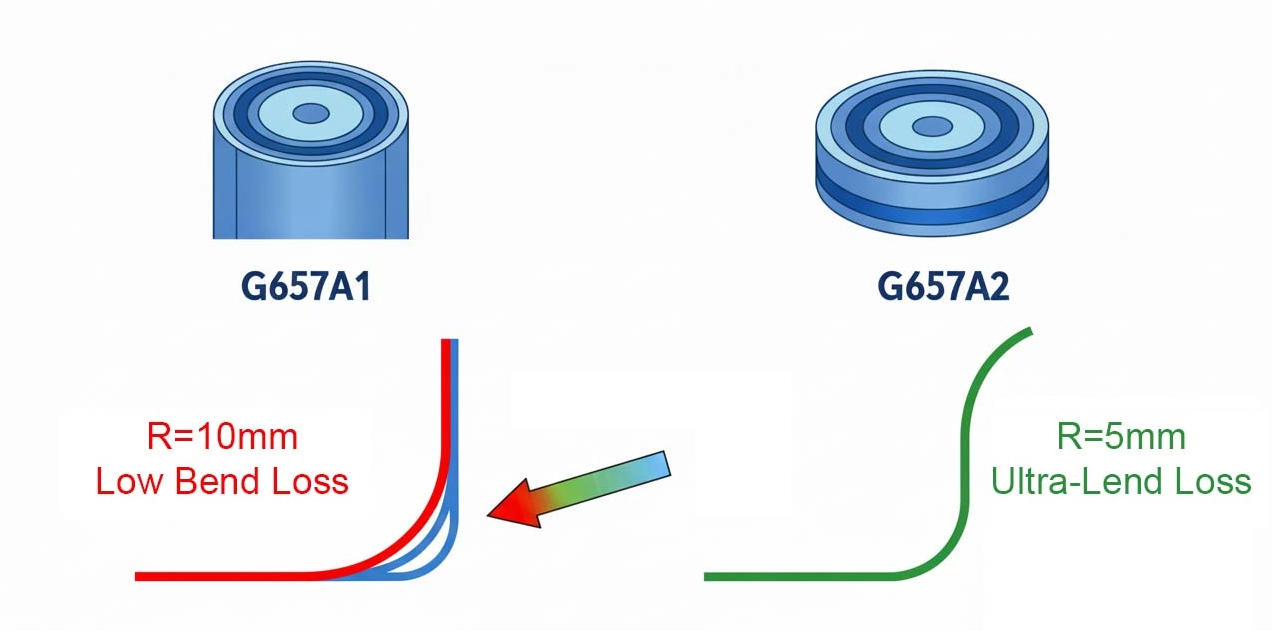
G657A2 fiber is a single-mode fiber designed for specialized high-performance tasks, where networks need to be both robust and flexible simultaneously. What makes it special is that it is bend-insensitive, so it can withstand tight bends and turns without degrading the signal. The minimum bend radius is 7.5 mm, smaller than most other fibers including G657A1, which requires 10 mm. This makes a huge difference when space is at a premium, such as threading cables through congested building conduits or around corners in data centers, making G657 fiber a preferred choice for modern installations.
The fiber conforms to the ITU-T G.657 standard, which is recognized globally to ensure fiber performs optimally and has durability. Both G657A2 and G657A1 are part of this family, with G657A2 designed for even sharper bends. It’s why it’s the default pick for new construction and renovations, particularly in tight spaces like FTTH networks—Fiber to the Home—where cables must coil through walls, little ducts, and acute bends. The fiber’s attenuation, or the loss of signal as light passes through it, is slightly higher than that of standard G.652D fibers, but this is offset by how much simpler it is to deploy in hard-to-reach locations.
Physically, G657A2 is identical to G652D and G657A1 fibers with a core diameter of 9 microns and a cladding diameter of 125 microns. This compatibility means it can easily integrate into legacy G652 networks without the need for special connectors or tools. As a reminder, it’s a solid choice for environments that demand robust and bendable links, such as cramped data center racks, sprawling office campuses, and the last leg of fiber optic cables into a home or SMB.
The need for bend-insensitive fiber solutions such as G657A2 is rising rapidly, increasing at greater than 8% per year through 2030. With the drive to space-saving, future-proof networks, this fiber is more relevant than ever, particularly as more users and devices depend on speedy, reliable connections in their telecommunications infrastructure.
The Core Advantages of G657A2
G657A2 fiber offers significant advantages for today’s networks, which encounter growing demands for flexibility, durability, and efficient deployment in confined spaces. Its design meets the requirements of metro networks, dense network topologies, and upgrading broadband services.
1. Superior Flexibility
What differentiates G657A2 fiber cables is their small bend radius, down to a mere 7.5mm. This low bend loss allows installers to snake cables around tight corners or through overstuffed conduits without concerns of signal loss. In bustling metro networks or within tight telecom closets, that translates to less constraints on cable routing. High-density projects, such as multi-story apartments or office buildings, gain from this flexibility. G657A2 readily conforms to intricate paths, meandering around ceilings, walls, and floors without danger, making it ideal for fiber optic technology.
2. Reduced Signal Loss
Built to be bend-insensitive, G657A2 fibers maintain low loss even in tight loops, making them ideal for optical fiber cable applications. With a low attenuation of less than or equal to 0.4 dB/km at 1310 nm and less than or equal to 0.25 dB/km at 1550 nm, G657A2 fibers ensure data transmission at full speed. This translates to less jitter and quicker downloads, particularly in FTTH networks, while superior signal retention keeps networks reliable and effective, even as bandwidth demands increase.
3. Installation Efficiency
G657A2 fiber’s flexibility allows it to be pulled through tight spaces or around corners, making it an ideal choice for modern optical fiber cable installations. Installers complete work quicker, saving both time and labor costs. In space-constrained buildings or equipment-packed data centers, G657A2 fiber solutions eliminate cable management headaches, ensuring projects remain on schedule and within budget.
4. Enhanced Durability
Designed for durability, G657A2 fiber optic cables withstand everyday abrasion and are ideal for outdoor installations due to their weather and temperature shift resistance. This high tensile strength construction implies less maintenance, aligning with the needs of modern telecommunications infrastructure that must support increased traffic in FTTH networks, ultimately saving you money in the long run.
5. Network Reliability
G657A2 cables maintain network stability whether strained physically or in challenging environments such as data centers. They’re signal-retentive even in tight bends or under heavy use. Dependable links count in mission critical use cases from enterprise to sports streaming. High bandwidth support ensures G657A2 is suited to today’s expanding networks.
Fiber Type | Min Bend Radius | Macro Bending Loss (1550 nm, dB) |
|---|---|---|
G652D | 30 mm | 0.5 |
| G657A2 | 7.5 mm | Less than or equal to 0.03
For projects needing custom fiber solutions, oufu offers tailored G657A2 cables for any installation challenge.
G657A2 vs. G652D
These two optical fibers, G657A2 and G652D, both have major roles in today’s network infrastructure. They have some fundamental optical characteristics in common, but their applications and technical advantages differ. The table below shows their performance, differences, and where each one works best:
Feature | G657A2 | G652D |
|---|---|---|
Minimum Bend Radius | 7.5 mm (static), 10 mm (dynamic) | 30 mm |
| Bend Loss (1550/1625) | Lower, high resistance | Higher, less resistance |
| Attenuation (1310/1550/1625 nm) | ≤0.35/≤0.20/≤0.23 dB/km | ≤0.35/≤0.20/≤0.23 dB/km |
| Maximum Transmission Distance (1 Gbit/s / 10 Gbit/s) | Tens of km / up to 2 km | More than 3,000 km (10 Gbit/s) | | Use cases | FTTH, indoor, tight spaces, data center | Long-haul, metropolitan, backbone |
Bend Performance
The G657A2 fiber’s bend radius is just 7.5 mm, making it far tighter than G652D’s 30 mm. This tight bend tolerance allows it to navigate sharp corners and tight bends often found in crowded equipment racks or small wall boxes. Installers can easily route G657A2 fiber optic cables through bustling ceilings and behind desks without worrying about large loops or unintended pinches.
This superior bend performance translates to reduced signal loss when fibers are bent or compressed, a common issue in urban structures or when optical fiber cables are bundled. In contrast, G652D can experience significant signal distortion if bent too far, which can kill connections or severely degrade network speeds.
In network design, especially for FTTH networks, bend tolerance is crucial in apartment complexes, offices, or data centers. G657A2’s flexibility is essential in cramped spaces where mode fiber solutions are needed to wrap around obstructions.
Application Suitability
FTTH (Fiber to the Home) deployments
Indoor riser and drop cables
High-density data centers
MDU (multi-dwelling unit) wiring
Metropolitan area networks with space limits
G657A2’s bend tolerance makes it the better pick for dense cities. It’s a match for retrofits and moves where you need to snake fiber through ancient conduit or duct work.
It makes a difference which type you choose. G652D is fantastic for long-haul. G657A2 excels at short-run, high-curve assignments.
Cost Implications
Cost Aspect | G657A2 | G652D |
|---|---|---|
Cable Cost (per km) | Slightly higher | Standard |
Install/Maintenance Cost | Lower | Higher |
Long-term Signal Loss | Lower | Higher |
G657A2 fiber optic cables might be a little more expensive initially, but they offer economical advantages in the long run. Their low signal loss and tight bend tolerance lead to fewer installation failures, reducing rework and service calls, ultimately keeping bills down for years.
Compatibility
G657A2 matches core size and attenuation with G652D.
Splices and connectors are simple to use together.
By upgrading old networks with G657A2, you don’t have to replace everything in one giant painful update.
This keeps data flowing with minimal fuss or downtime.
Legacy and new installs of g657 fiber can coexist, ensuring seamless and affordable network expansion.
Ideal Deployment Scenarios
G657A2 fiber cables really come into their own in environments where space is at a premium or the route for your cables is complicated. They excel in environments where a tight bend radius is important — utility rooms that are tight on space, city buildings, contemporary homes, and congested wiring closets. Most installers encounter tight corners, ducts, and small access panels. G657A2 cables assist a great deal in this regard, as they curve with little signal degradation. This means no stressing about how or where the cable is laid, making work faster and more dependable, especially when using mode fiber solutions.
Bend-insensitivity is a game changer for fiber optic technology. Nothing is worse than having to snake cables around sharp corners or through tight spaces in a building or on city streets. G652.D fibers, which are great for long outdoor runs and aerial lines, drop signal if bent too tightly. G657A2, with its lower bending loss and smaller bend radius, preserves signal strength even in the tightest spaces. This is crucial for locations such as server rooms, apartment complexes, or vintage city flats where you aren’t guaranteed to map out the optimal route.
Metropolitan area networks, or MANs, routinely have to wedge cables into congested subterranean ducts or common carrier conduits. This is where G657A2 provides real value, enabling tighter curves and sharper bends without compromising performance. That’s what enables cities to bring these networks up to date without tearing up streets or swapping out antiquated pipes. G657A2 splices well to G652.D but would require some adjustment for low-loss maintenance in telecommunications infrastructure.
For FTTH projects—bringing fiber directly into residences—G657A2 is frequently the preferred choice. Indoor runs, cabinets, and wall boxes are all constrained spaces. Installers love G657A2 because it enables them to route fiber through tight bends, up walls, and around corners. It maintains top speeds and reduces service calls, saving money in the long run. G657A2’s flexibility translates into fewer breaks and easier upgrades in microducts and small risers, which is essential for effective data transmission.
When picking a fiber type, it’s smart to look at the job’s needs: space, cost, and how much splicing is needed. G657A2 is ideal for tight, bend-heavy or indoor work. G652.D suits outdoor and trunk lines, ensuring that installers have the best mode fiber standards to meet their specific project requirements.
Beyond the Bend Radius
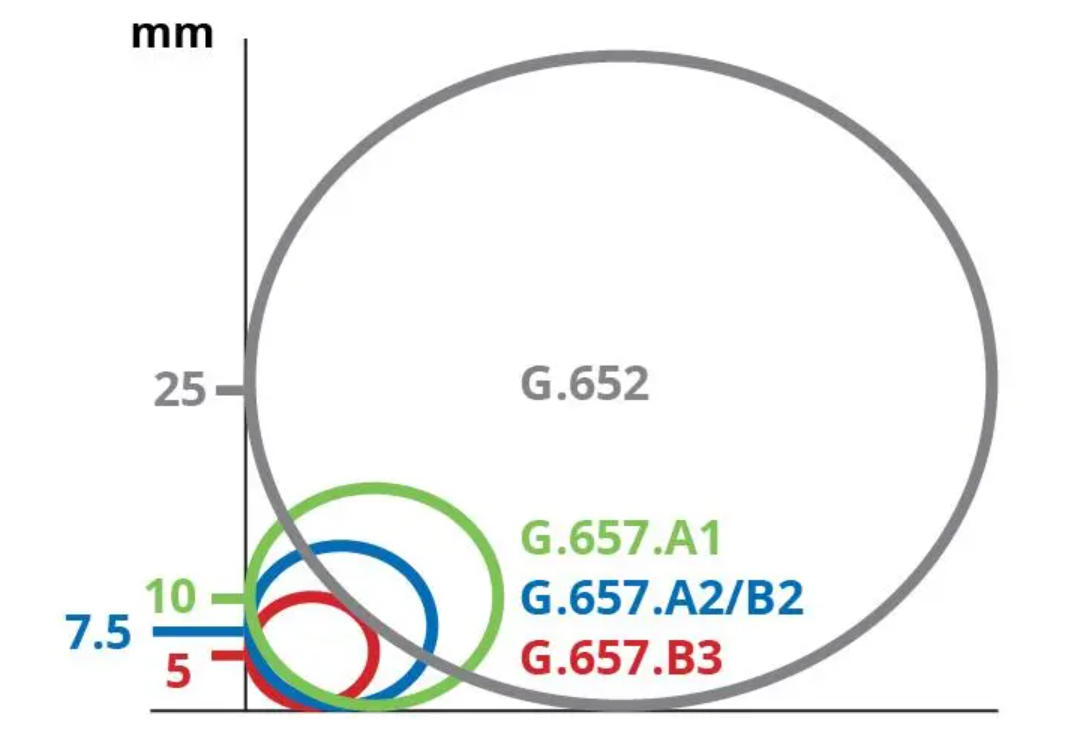
Bend radius is a crucial factor for fiber optic technology. It refers to how far you can twist or turn a cable before the signal inside starts to degrade or drop out. The ITU-T G.657 standard defines the specifications for bend-insensitive fibers, such as G657A2 fiber, which can be bent around tighter radii than traditional G652 fibers. For instance, G657A2 has a minimum bend radius of 7.5 millimeters, significantly better than G657A1 at 10 millimeters, and just falling behind G657B3 at an aggressive 5 millimeters. This aspect is vital because whenever a fiber experiences an excessive bend, there’s a potential for insertion loss and return loss that can interfere with network speed and stability.
A fiber’s minimum bend radius is more than just a technical specification — it directly impacts how you can install a network in real-world buildings. The tighter the bend radius, as provided by G657A2, the easier it is to install optical fiber cables in cramped or limited spaces. This elasticity helps maintain low signal loss, even when cables need to wrap around corners or behind walls. Exceeding the safe bend radius, typically 10 to 15 times the cable’s diameter, could lead to significant drops in performance, affecting overall network efficiency.
Environmental Resilience
G657A2 that stands up under the sun. It doesn’t care for big temperature swings or a little bit of rain. This allows you to put it anywhere, buried under streets, strung between buildings, or within wet tunnels. Its durability reduces breakage and maintains signal attenuation at a minimum, even through dramatic weather swings.
Which is why it’s a smart choice for extended projects. Less fixing, less pain. When you need a cable that works regardless of whether it’s hot, cold, or wet, G657A2 is the one.
Material Science
G657A2 uses new materials that render it bend-insensitive. Our glass and coatings are engineered to maintain light signals strong even if your cable bends. This couldn’t be done with older fiber types.
They’re the result of genuine fiber tech breakthroughs. By adjusting the core and the cladding, engineers ensured that the signal remains on course. This sort of science lays the groundwork for even more robust cables in the future.
Long-Term Value
G657A2 is a higher initial cost, but it rewards you with less maintenance. Fewer signal issues lead to less troubleshooting. That’s a no-brainer win for any network operator.
It scales well as networks grow too. If you’re envisioning a system that endures and scales to more users, G657A2 provides the space to grow without new cables.
Future-Proofing Your Network
Future-proofing your network means choosing fiber optic technology that can grow with demand. G657A2 fiber is a clever selection, particularly if you have to cram cables into hard-to-reach places. It’s future-proof, with a 7.5 mm bend radius that allows you to snake it around sharp corners and crowded racks without signal degradation. In locations such as data centers or dense apartment complexes, it’s an actual boon. Most networks need to cram cables into little panels or ducts, and traditional G652 fibers may not endure those sharp bends. G657A2 future-proofs your network by keeping it running smoothly when space is tight.
Selecting flexible, adaptable mode fiber solutions is the trick. G657A2 is significant because it performs very well with many connectors in limited spaces. This makes it ideal for last-mile FTTH networks and for retrofits in older structures. Have your older G652D fiber? No problem, you can still use G657A2. These fibers are compatible, and you just may notice a slight splice loss. The increases in flexibility and performance make it worth the switch. Bend-insensitive fibers such as G657A2 translate to less labor correcting signal issues down the road. Fewer repairs mean you save time and money.
Networks need to be prepared for emerging technologies and large applications, too. These days, more people stream videos, work from home, utilize cloud storage, and play games online. All these activities consume bandwidth. G657A2 fiber accommodates the full spectrum of wavelengths ranging from 1260 to 1625 nanometers, spanning O, S, C, and L bands. It is able to support faster speeds and larger data volumes, providing a future-proof foundation for whatever is next. With low attenuation and low polarization mode dispersion, it helps keep data flying quickly and clearly even over long distances.
Designed for future-proofing your telecommunications infrastructure, G657A2 ensures your network can grow as demands increase. It’s not simply about more speed; it’s about future-proofing the network as new amenities and uses emerge. The right optical fiber cable today means fewer limitations and less concern years into the future.
Conclusion
G657A2 fiber shines in tangible ways. Its bend strength works well in tight spaces, such as small tech rooms or congested city streets. Crews install it quickly since it flexes easily and remains durable. Planners can rely on it for new work or to repair old wiring. G657A2 works well with most equipment, so squads don’t have to ditch their old stuff. This fiber keeps pace as data demands increase, meaning fewer upgrades later on. Schools, offices, and homes use it and experience less downtime. For speed and less headache, opt for G657A2 for your next project. Tell your story or pose a question below. Let’s collectively give ourselves better networks.
Frequently Asked Questions
What makes G657A2 fiber different from other optical fibers?
G657A2 fiber optic cables are optimized for greater bend resistance, allowing for tighter installation spaces without signal loss, making them ideal for today’s complex FTTH networks.
Can G657A2 fiber replace G652D fiber in existing networks?
Yes, G657A2 fiber is 100% compatible with G652D fibers, serving as a drop-in replacement while offering enhanced flexibility and low bend loss performance.
Why is bend radius important in fiber optic cables?
The small bend radius of g657 fiber optic cables enables them to fit in tighter spaces, minimizing signal loss and ensuring superior performance in tight installations.
Where is G657A2 fiber most commonly used?
G657A2 fiber optic cables are perfect for FTTH networks, data centers, and smart buildings, especially in areas where tight bend tolerance and cramped spaces are prevalent, making it a leading choice in fiber optic technology.
Is G657A2 fiber suitable for future network upgrades?
YES, G657A2 fiber solutions support high-speed rates and advanced optical fiber technology, helping to future-proof networks by addressing changing connectivity needs.
Does using G657A2 fiber increase installation costs?
First, G657A2 fiber can be a bit more expensive. Its flexibility cuts installation time and labor, frequently leading to cost savings.
How does G657A2 fiber help with network reliability?
G657A2 fibers’ bend resistance minimizes signal loss, ensuring reliable network performance and stability, making them ideal for modern fiber optic technology applications.