

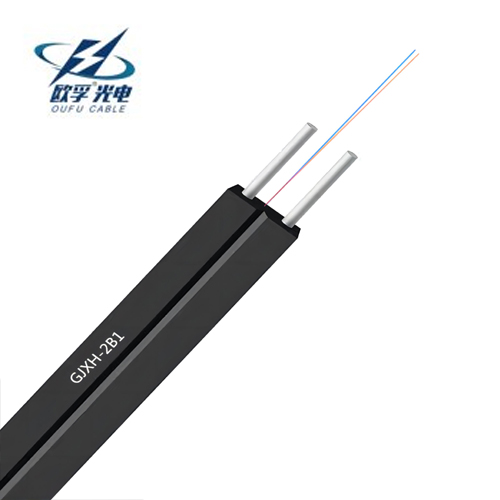
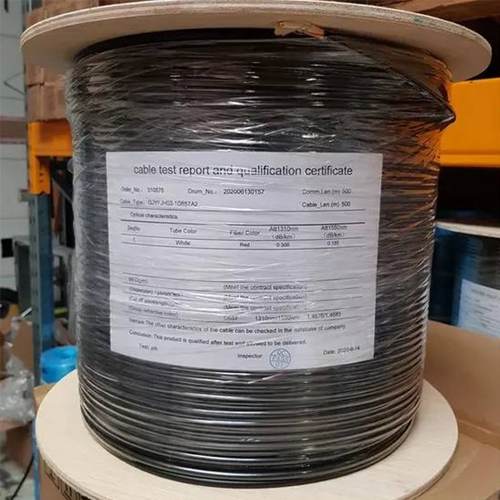
GJXH Self-Supporting FTTH Drop Cable
GJXH is commonly used in FTTH (Fiber to the Home), FTTB (Fiber to the Building), and FTTO (Fiber to the Office) access networks. Its small size and flexible structure make it suitable for routing along walls, inside buildings, through conduits, and around corners.
Typical GJXH constructions use 1, 2, 4 or other customized fiber counts, depending on the project. G.657A1 or G.657A2 bend-insensitive single-mode fiber is commonly selected for indoor applications where the cable may need to make relatively tight bends.
Technical Specifications — GJXH Drop Cable
| Item | Technology parameter | ||
| Cable type | GJXH-1B6 | GJXH-2B6 | GJXH-4B6 |
| Cable specification | 3.0×2.0 | ||
| Fiber type | 9/125 (G.657A2) | ||
| Fiber counts | 1 | 2 | 4 |
| Fiber color | Red | Blue, orange | Blue, orange, green, brown |
| Sheath color | Black | ||
| Sheath material | LSZH | ||
| Cable dimension mm | 3.0(±0.1)*2.0(±0.1) | ||
| Cable weight Kg/km | Approx. 10.0 | ||
| Min. bending radius mm | 10 (Static) 25 (Dynamic) | ||
| Attenuation dB/km | ≦ 0.4 at 1310nm, ≦ 0.3 at 1550nm | ||
| Short term tensile N | 200 | ||
| Long term tensile N | 100 | ||
| Short term crush N/100mm | 2200 | ||
| Long term crush N/100mm | 1100 | ||
| Operation temperature ℃ | -20~+60 | ||
Data is for reference only. Custom fiber counts, messenger diameters, and jacket markings (meter counting) are available on request.
Need a quote for your FTTH project? Contact our sales team or request a free sample of GJXH drop cable today.
Main Applications of GJXH Fiber Optic Cable
This makes GJXH particularly suitable for residential broadband networks where optical fiber needs to be extended from the building distribution point to the customer’s premises.
This GJXH compact profile makes it easier to install along corridors, walls and other restricted indoor spaces.
In Fiber to the Building (FTTB) networks, GJXH can be used for indoor fiber distribution from a building-level optical distribution point toward individual rooms, offices or subscribers.
GJXH can also be used for Fiber to the Office (FTTO) applications where optical connectivity needs to reach individual offices, workspaces or communication rooms.
Because of its compact structure and indoor-oriented sheath options, GJXH can be used for: Building risers/Indoor corridors/Wall routing/Residential access wiring/Office buildings/Indoor distribution systems
This is one reason GJXH is commonly classified as an FTTH drop cable rather than a backbone or long-distance distribution cable.
Compact and Lightweight
GJXH has a relatively small cable profile compared with many conventional distribution cables.
Some commercially available GJXH products have cable dimensions around a few millimeters, although exact dimensions vary according to the manufacturer and design.
Excellent Bend Performance
A major advantage of GJXH is the use of bend-insensitive optical fiber, particularly G.657A1 or G.657A2.
G.657 fibers are designed to tolerate tighter bending than conventional G.652 fiber, helping maintain optical performance in compact indoor installations.
LSZH Sheath
Many GJXH cables use an LSZH (Low Smoke Zero Halogen) outer sheath.
This is particularly useful for indoor telecommunications installations because LSZH materials are designed to produce low smoke and no halogen gases under fire conditions.
However, the exact flame-retardant classification should be confirmed against the manufacturer’s datasheet and the applicable local building code.
Easy Installation
GJXH is designed with installation efficiency in mind.
Some GJXH designs are also compatible with field-installable fast connectors, which can reduce installation time in FTTH deployments.
Good Mechanical Protection
Strength members help protect the optical fiber from mechanical stress during installation.
Steel-reinforced designs can provide higher mechanical strength, while all-dielectric designs can be advantageous where electrical isolation is important.
Low Installation Cost
Because GJXH is lightweight, compact and relatively easy to terminate, it can reduce installation labor compared with larger and more complex cable constructions.
This is especially valuable for large-scale FTTH deployments involving thousands or millions of subscriber connections.
Frequently Asked Questions
GJXH is an indoor FTTH drop optical cable used primarily for subscriber-side fiber connections in homes, apartments, offices and buildings.
GJXH is mainly used for FTTH, FTTB and FTTO indoor access networks, including residential broadband, apartment buildings, offices and indoor subscriber connections.
Yes. GJXH is primarily designed for indoor or protected building applications. Many versions use LSZH sheathing for indoor installation.
GJXH can be manufactured with different optical fibers. G.657A1 and G.657A2 are common choices for indoor FTTH because of their bend-insensitive characteristics. Some manufacturers also offer G.652D configurations.
Common versions include 1, 2 and 4 fibers, while some manufacturers offer higher fiber counts such as 6 or 8 fibers. The available fiber count depends on the cable design.
Generally, no. GJXH is primarily an indoor drop cable. For outdoor aerial FTTH applications, a self-supporting cable such as GJYXCH is normally more appropriate.
The primary difference is the installation environment and construction. GJXH is mainly intended for indoor drop applications, while GJYXCH is designed for self-supporting outdoor aerial FTTH connections.
The main difference is usually the strength-member construction. GJXH commonly uses metal/steel reinforcement in many designs, while GJXFH is commonly offered with non-metallic FRP/KFRP reinforcement. However, manufacturers can offer variations, so the product drawing should be checked before purchasing.
Yes. When equipped with an appropriate bend-insensitive fiber such as G.657A1 or G.657A2, GJXH is well suited to indoor routes that involve bends and space restrictions.