ASU cable (All-Dielectric Self-Supporting Unit Fiber Optic Cable) is a type of aerial fiber optic cable designed for outdoor installation without the need for metallic strength members.
It is specifically engineered for self-supporting aerial deployment, meaning it can be installed directly between poles without requiring a separate messenger wire.
ASU cables are commonly used in access networks, FTTH deployments, and rural broadband projects, where cost efficiency and easy installation are critical.
Key Definition:
ASU cable is a non-metallic (all-dielectric) aerial fiber optic cable with built-in strength elements that allow it to be suspended between poles.
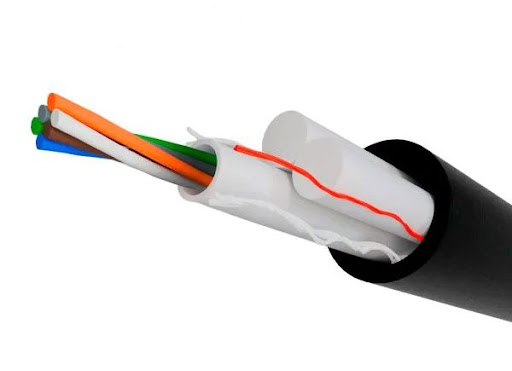
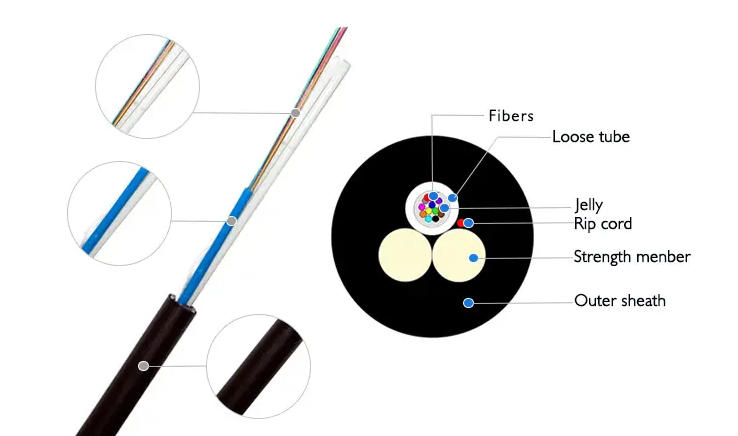
ASU Cable Structure
Understanding the structure of ASU cable helps explain why it is strong, lightweight, and cost-effective.
Core Components
An ASU cable typically consists of:
1. Optical Fibers
- The core transmission medium
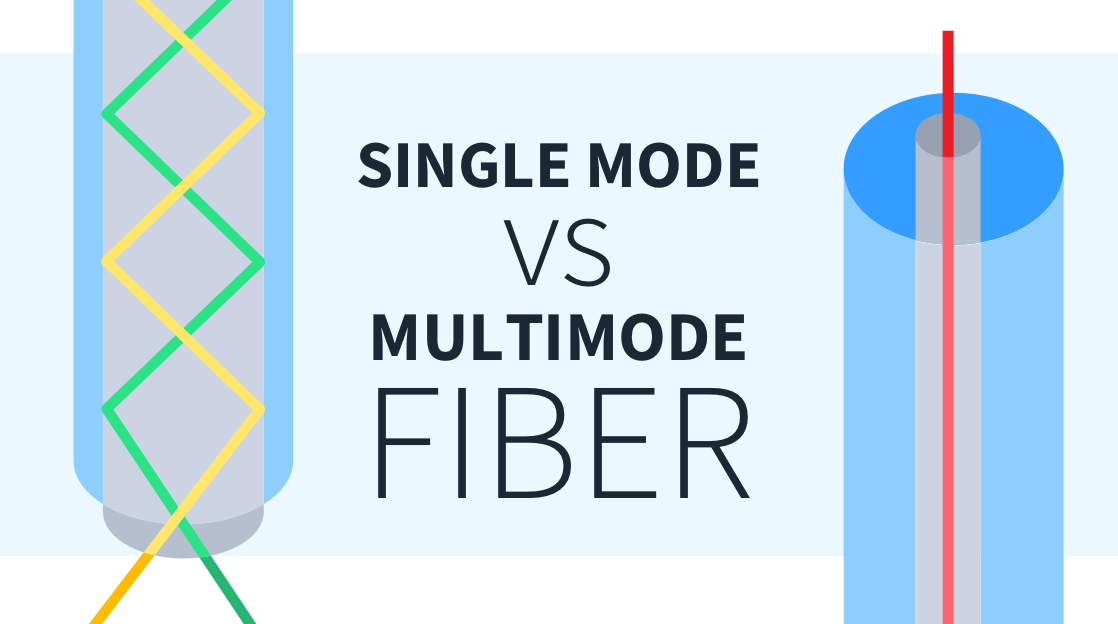
- Usually single-mode fibers (G.652D or G.657A1/A2)
- Responsible for high-speed data transmission
2. Loose Tube
- Protects optical fibers
- Filled with water-blocking gel or dry water-blocking materials
- Allows fibers to move freely under stress
3. Water-Blocking System
- Prevents moisture penetration
- Ensures long-term stability in outdoor environments
4. Strength Members (FRP Rods)
- Made of Fiber Reinforced Plastic (FRP)
- Provide tensile strength
- Completely non-metallic (important for lightning resistance)
5. Outer Jacket
- Usually made of HDPE (High-Density Polyethylene)
- UV resistant and weatherproof
- Protects internal components from sunlight, rain, and mechanical damage
Why is it Called “All-Dielectric Self-Supporting”?
The term ASU highlights two key features:
All-Dielectric
- No metal components inside the cable
- Resistant to lightning and electromagnetic interference (EMI)
- Safe for power-adjacent installations
Self-Supporting
- Can be directly installed between poles
- No need for additional messenger wire (in many designs)
- Reduces installation cost and complexity
Types of ASU Cable
ASU cables are generally classified based on fiber count and mechanical strength.
1 Based on Fiber Count
- 2–12 cores: FTTH drop networks
- 24 cores: small access networks
2 Based on Span Length
- Short-span ASU cable (50–80m)
- Medium-span ASU cable (80–120m)
- Reinforced ASU cable (up to 200m in some designs)
3 Based on Structure
- Central loose tube ASU cable
- Stranded loose tube ASU cable
Key Features of ASU Cable
ASU cable has become popular due to its unique technical advantages:
1 Lightweight Design
- Easy to handle during installation
- Reduces load on poles and towers
2 High Tensile Strength
- FRP strength members support aerial spans
- Suitable for windy and harsh environments
3 Anti-EMI and Anti-Lightning
- No metal components
- Safe near power lines
4 Cost-Effective Installation
- No need for messenger wire in many cases
- Lower labor and material costs
5 Excellent Weather Resistance
- UV-resistant outer sheath
- Performs well in extreme temperatures
Advantages of ASU Cable
ASU cable offers several important benefits compared to traditional fiber optic cables.
1 Reduced Installation Cost
Since ASU cable is self-supporting, it eliminates:
- Messenger wire
- Additional hardware
- Extra labor for lashing systems
This significantly reduces total deployment cost.
2 Faster Deployment
- Lightweight structure
- Easier tensioning
- Simple pole-to-pole installation
Telecom operators can deploy networks much faster, especially in rural areas.
3 High Safety Level
- Non-metallic construction prevents electrical hazards
- Suitable for power line corridors
4 Strong Environmental Adaptability
ASU cables perform well in:
- Coastal regions (humidity resistance)
- High UV exposure areas
- Cold and hot climates
5 Ideal for FTTH Networks
ASU cable is widely used in:
- Fiber-to-the-home (FTTH)
- Fiber-to-the-building (FTTB)
- Last-mile connectivity
7Applications of ASU Cable
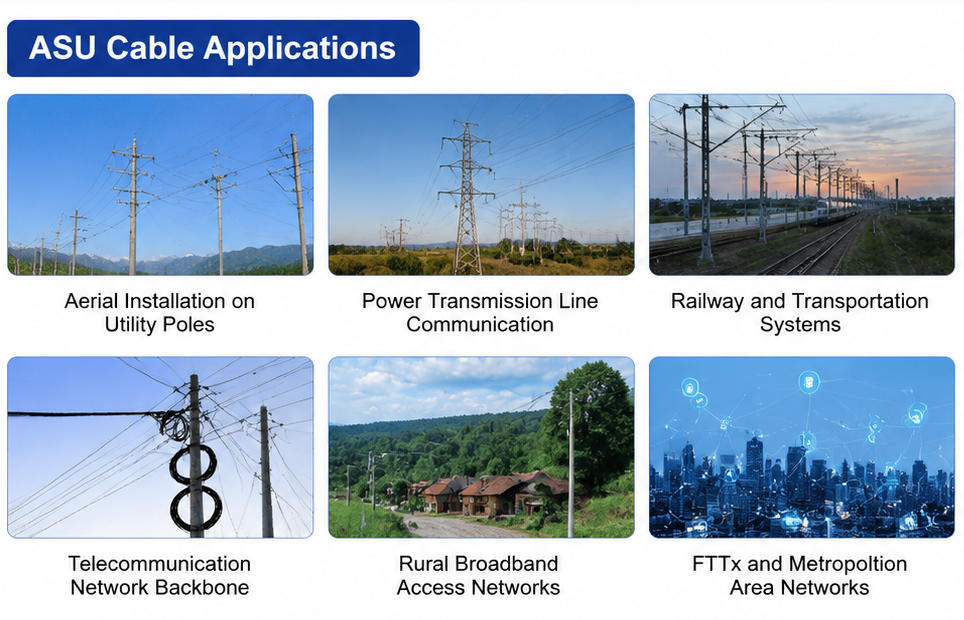
ASU cables are widely deployed in modern optical communication systems.
1 FTTH (Fiber to the Home)
One of the most common applications:
- Connecting residential users
- Supporting high-speed internet, IPTV, VoIP
2 Rural Broadband Expansion
Governments and telecom operators use ASU cable to:
- Connect remote villages
- Expand digital infrastructure
- Reduce installation costs in low-density areas
3 Aerial Backbone in Access Networks
- Used in distribution networks
- Connects street cabinets to end users
4 Smart City Infrastructure
- Supports surveillance systems
- Traffic control networks
- IoT-based city systems
5 Utility and Power Corridor Deployment
- Installed alongside power lines
- Safe due to dielectric design
ASU Cable vs ADSS Cable
ASU cable is often compared with ADSS (All-Dielectric Self-Supporting) cable.
| Feature | ASU Cable | ADSS Cable |
|---|---|---|
| Fiber Count | Low to medium | Medium to high |
| Span Length | Short to medium | Long span (up to 1500m+) |
| Cost | Lower | Higher |
| Strength | Moderate | High |
| Application | FTTH, access network | Backbone, high-voltage corridors |
| Installation | Easier | More complex |
Key Insight:
- ASU cable = cost-effective access solution
- ADSS cable = high-performance backbone solution
ASU Cable Installation Guide
Proper installation is essential to ensure long-term performance.
1 Pre-Installation Checks
- Inspect cable drum
- Verify fiber count and specifications
- Check environmental conditions
2 Aerial Installation Steps
- Set up poles and hardware
- Use proper tensioning tools
- Pay out cable carefully to avoid twisting
- Maintain correct sag levels
- Secure cable with clamps
3 Key Installation Tips
- Avoid excessive bending radius
- Do not exceed maximum tension
- Protect cable from sharp edges
- Ensure proper grounding near equipment (if applicable)
Common Problems and Solutions
Problem 1: Cable Sagging
Cause: Incorrect tension
Solution: Re-adjust tension and span support
Problem 2: Fiber Breakage
Cause: Excess bending or pulling
Solution: Follow minimum bending radius guidelines
Problem 3: Moisture Damage
Cause: Poor sealing
Solution: Ensure proper water-blocking integrity
How to Choose the Right ASU Cable
When selecting ASU cable, consider:
1 Fiber Count
- Small networks: 2–12 cores
- Medium networks: 24 cores
2 Span Requirement
- Short spans: standard ASU cable
- Longer spans: reinforced ASU versions
3 Environmental Conditions
- High UV areas → HDPE jacket required
- Coastal areas → enhanced moisture protection
4 Network Type
- FTTH → lightweight ASU cable
- Distribution → higher fiber count ASU cable
Future of ASU Cable in Telecommunications
As global internet demand increases, ASU cable will continue to play an important role in:
- 5G backhaul networks
- Rural broadband expansion programs
- Smart grid infrastructure
- IoT connectivity systems
With increasing demand for cost-efficient and easy-to-deploy fiber solutions, ASU cable is expected to grow steadily in the coming years.
Frequently Asked Questions (FAQ)
Q1: What does ASU cable stand for?
ASU stands for All-Dielectric Self-Supporting Unit cable, a type of aerial fiber optic cable.
Q2: Is ASU cable suitable for long-distance transmission?
ASU cable is mainly used for short to medium span access networks, not long backbone transmission.
Q3: What is the difference between ASU and ADSS cable?
ASU is lighter and more cost-effective for access networks, while ADSS is stronger and used for long-span backbone applications.
Q4: Where is ASU cable commonly used?
It is widely used in:
- FTTH networks
- Rural broadband
- Urban access networks
- Utility corridors
Q5: Is ASU cable metal-free?
Yes, ASU cable is fully dielectric, meaning it contains no metal components.
Conclusion
ASU cable is a highly efficient, cost-effective, and reliable solution for modern fiber optic access networks. Its all-dielectric construction, self-supporting design, and ease of installation make it especially suitable for FTTH and rural broadband deployments.
While it is not designed for long-span backbone systems like ADSS cables, ASU cable plays a crucial role in bridging the “last mile” of global connectivity.
As digital infrastructure continues to expand, ASU cable will remain a key component in delivering fast, stable, and affordable internet access worldwide.