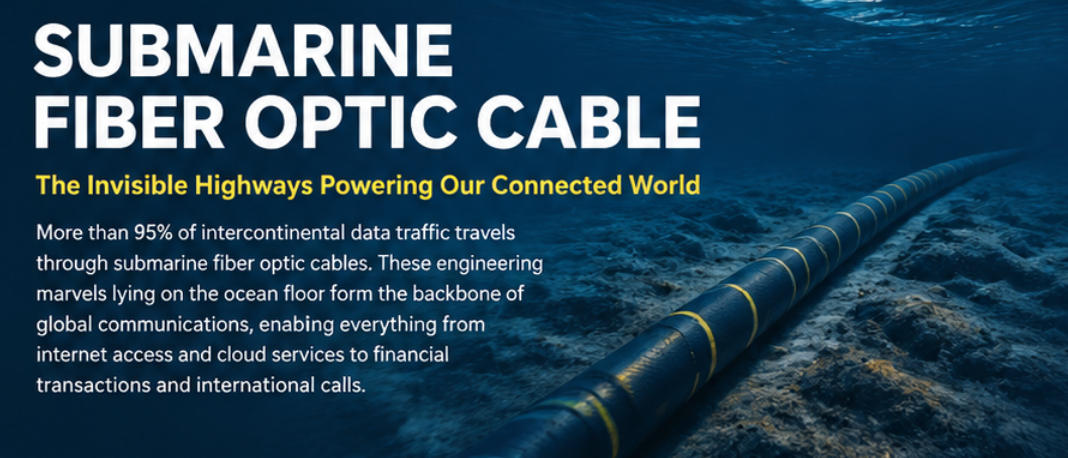
Submarine fiber optic cable is a specialized communication cable laid on the seabed between land-based stations to carry optical signals across oceans and seas. These cables are designed to transmit data using light signals through ultra-thin glass fibers.
Unlike terrestrial cables, submarine cables must withstand:
- Extreme water pressure at deep sea levels
- Corrosion from saltwater
- Potential damage from fishing activities and anchors
- Seismic and geological movement
Modern submarine cable systems are engineered for durability and can operate reliably for 25 years or more.
Why Submarine Cables Are Essential for Global Internet
In the digital economy, speed and reliability are everything. Submarine cables form the backbone of:
- International internet connectivity
- Cloud computing infrastructure
- Global financial systems
- Cross-border communication
- Video conferencing and streaming platforms
Companies like Google, Meta Platforms, Amazon, and Microsoft heavily invest in private submarine cable networks to improve speed, reduce latency, and ensure independent control over global data flow.
Without submarine cables, satellite communication alone would not be able to handle today’s massive global data demand due to higher latency and limited bandwidth.
How Submarine Fiber Optic Cables Work
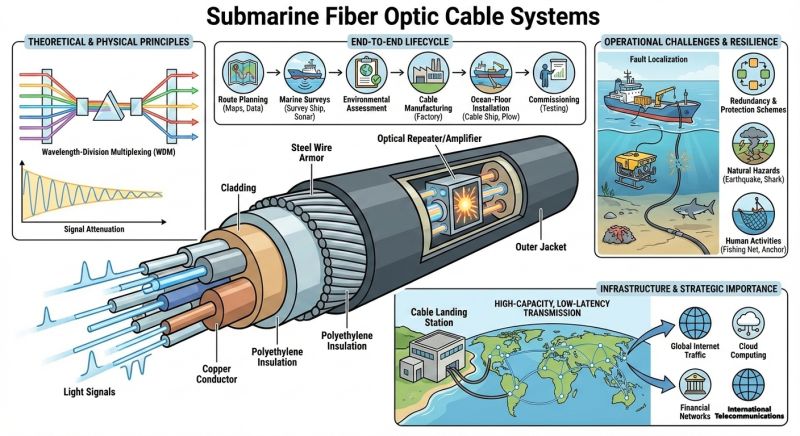
Submarine cables transmit data using pulses of light through fiber optic strands. The basic working principle includes:
1. Data Conversion
Electrical signals from computers are converted into optical signals using lasers.
2. Light Transmission
These light signals travel through ultra-pure glass fibers at nearly the speed of light.
3. Signal Amplification
Over long distances, optical amplifiers (repeaters) boost the signal without converting it back into electrical form.
4. Signal Reception
At the destination landing station, signals are converted back into electrical data for internet networks.
This system allows data to travel across thousands of kilometers with minimal delay and high reliability.
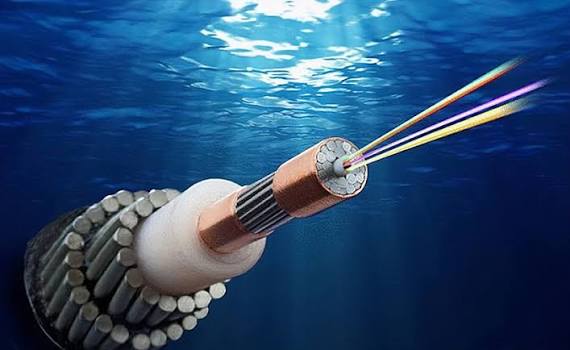
Structure of a Submarine Fiber Optic Cable
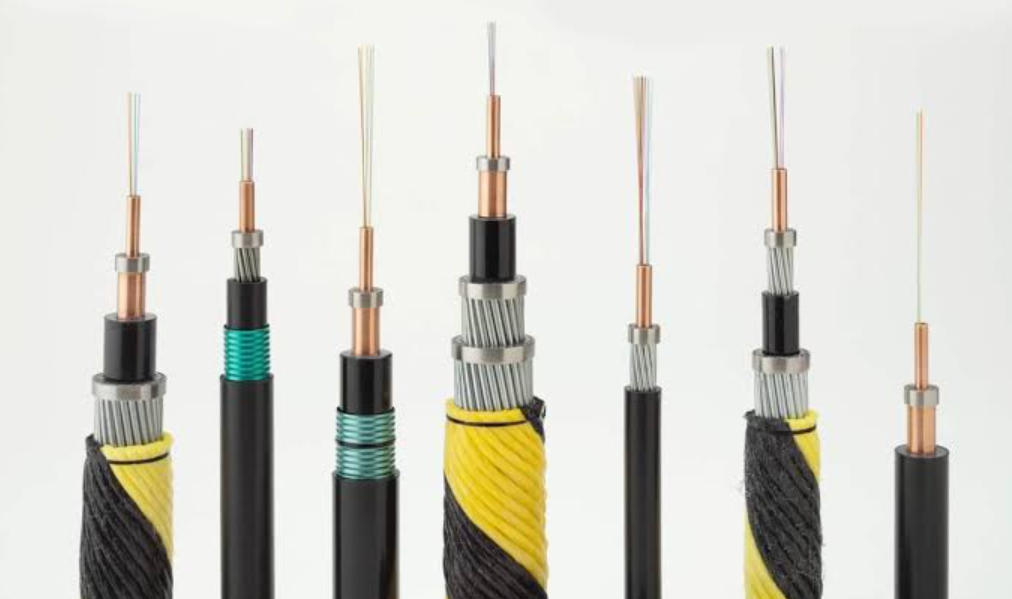
A submarine cable is not just a fiber strand—it is a highly engineered layered system.
Core Components:
- Optical Fiber Core: Transmits light signals
- Glass Cladding: Keeps light inside the core
- Protective Coating: Adds durability
- Steel Wire Layer: Provides mechanical strength
- Copper Sheath: Supplies power to repeaters
- Polyethylene Outer Jacket: Waterproof and corrosion-resistant
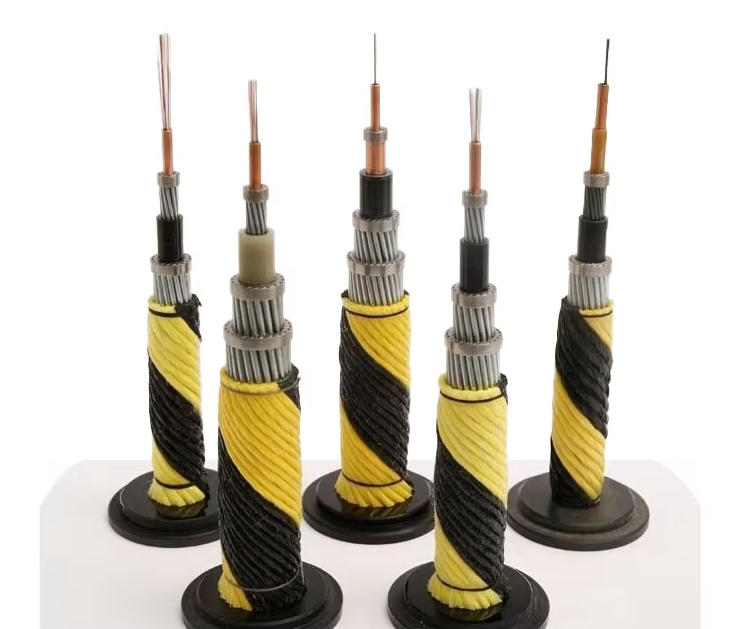
In deep-sea regions, cables are thinner and lighter. In shallow coastal areas, they are heavily armored to protect against fishing nets and anchors.
Types of Submarine Fiber Optic Cables
1. Deep-Sea Cables
- Laid at depths of up to 8,000 meters
- Lightweight design
- Focus on signal transmission efficiency
2. Shallow Water Cables
- Heavily armored
- High protection against physical damage
- Used near shorelines and continental shelves
3. Repeatered Cables
- Include optical amplifiers every 50–100 km
- Used for long-distance transoceanic communication
4. Unrepeatered Cables
- No amplifiers
- Used for shorter distances (e.g., islands or coastal regions)
How Submarine Cables Are Installed
Installing submarine cables is a complex engineering process involving multiple stages:
1. Marine Survey
Specialized ships map the seabed to identify the safest route.
2. Cable Manufacturing
Cables are produced in continuous lengths and loaded onto cable-laying vessels.
3. Cable Laying
Ships slowly deploy cables onto the ocean floor with precise navigation systems.
4. Burial Process
In shallow waters, underwater plows bury the cable beneath the seabed for protection.
5. Testing and Activation
Once installed, the system undergoes signal testing before becoming operational.
Companies such as SubCom and Alcatel Submarine Networks are major leaders in designing and deploying these systems.
Global Submarine Cable Network Overview
There are currently over 400 active submarine cable systems worldwide, spanning more than 1.4 million kilometers.
Key routes include:
- Transatlantic (Europe ↔ North America)
- Transpacific (Asia ↔ North America)
- Europe ↔ Africa connections
- Asia ↔ Middle East routes
- Intra-Asia regional networks
These routes form a global digital highway that connects continents seamlessly.
Major Players in Submarine Cable Industry
The submarine cable industry is highly specialized and dominated by a few key companies:
Leading Manufacturers and Operators:
- SubCom
- Alcatel Submarine Networks
- NEC Corporation
- Prysmian Group
Tech Giants Investing in Submarine Cables:
- Google (Equiano, Dunant, Curie cables)
- Meta Platforms (2Africa cable system)
- Microsoft (MAREA cable system)
These companies invest in undersea cables to improve cloud services, video streaming performance, and global network reliability.
Advantages of Submarine Fiber Optic Cables
Submarine cables offer several critical advantages:
1. High Bandwidth Capacity
They can transmit terabits of data per second, supporting global internet demand.
2. Low Latency
Optical transmission ensures minimal delay, crucial for financial trading and cloud services.
3. High Reliability
Modern systems are highly redundant and can reroute traffic automatically.
4. Cost Efficiency
Despite high initial installation costs, long-term operational costs are lower than satellite systems.
5. Scalability
Additional capacity can be upgraded using advanced optical technologies without laying new cables.
Challenges Facing Submarine Cable Systems
Despite their advantages, submarine cables face several challenges:
1. Physical Damage
- Fishing trawlers
- Ship anchors
- Earthquakes and landslides
2. Cybersecurity Risks
While difficult to tap, cables are still potential targets for surveillance or sabotage.
3. High Installation Costs
Laying a single transoceanic cable can cost hundreds of millions of dollars.
4. Maintenance Complexity
Repairs require specialized cable ships and can take weeks to complete.
5. Environmental Factors
Ocean conditions, seabed shifts, and corrosion must be continuously monitored.
Submarine Cable vs Satellite Communication
| Feature | Submarine Cable | Satellite |
|---|---|---|
| Speed | Very high | Moderate |
| Latency | Very low | High |
| Capacity | Extremely high | Limited |
| Cost per data | Low | High |
| Reliability | High | Weather-dependent |
Submarine cables dominate global internet infrastructure due to their superior performance.
Future Trends in Submarine Fiber Optic Technology
The submarine cable industry is rapidly evolving with new innovations:
1. Higher Capacity Cables
Next-generation fiber systems support multi-terabit transmission per fiber pair.
2. AI-Based Network Monitoring
Artificial intelligence is used to predict faults and optimize routing.
3. Green Cable Systems
New designs focus on reducing carbon footprint during manufacturing and installation.
4. Expanded Global Coverage
New routes are being developed to connect underserved regions in Africa, Southeast Asia, and South America.
5. Private Cloud Networks
Big tech companies are building dedicated submarine cables for exclusive cloud ecosystems.
Economic and Strategic Importance
Submarine cables are not just technical infrastructure—they are geopolitical assets. Countries and corporations invest heavily in them because they:
- Control data flow
- Influence global internet performance
- Enable digital trade
- Support national security communications
As digital economies expand, control over submarine cable networks becomes increasingly strategic.
Environmental Considerations
Modern submarine cable systems are designed to minimize environmental impact:
- Cables are laid carefully to avoid sensitive marine ecosystems
- Studies show minimal long-term impact on marine life
- Cable routes are optimized to avoid coral reefs and protected zones
In many cases, cables can even act as artificial reef structures over time.
Frequently Asked Questions (FAQ)
1. How deep are submarine fiber optic cables laid?
They can be laid at depths exceeding 8,000 meters in ocean trenches.
2. How long do submarine cables last?
Typically 25 years or more with proper maintenance.
3. Can submarine cables be repaired?
Yes, specialized ships retrieve and repair damaged sections.
4. Are submarine cables faster than satellites?
Yes, they provide significantly lower latency and higher bandwidth.
5. Who owns submarine cables?
They are owned by telecom companies, governments, and tech giants like Google and Meta.
Conclusion
Submarine fiber optic cables are the hidden foundation of the global internet. They enable instant communication across continents, support global commerce, and power the digital services we rely on every day.
From engineering complexity to geopolitical importance, these underwater networks represent one of the most critical infrastructures of the modern world.
As demand for data continues to grow, submarine cable systems will remain at the heart of global connectivity—quietly carrying the world’s information beneath the oceans.