As global demand for high-speed internet, cloud computing, artificial intelligence (AI), 5G communications, and data centers continues to grow, network infrastructure has become more important than ever. Businesses, telecom operators, governments, and consumers increasingly face a critical question:
Why is fiber optic cable faster than copper cable?
For decades, copper cables have been the backbone of telecommunications and Ethernet networks. However, fiber optic technology has rapidly become the preferred solution for modern communication systems due to its superior speed, bandwidth, reliability, and scalability.
In this comprehensive guide, we’ll explain the science behind fiber optics, compare fiber and copper technologies, explore real-world applications, and help you understand why fiber optic cable has become the future of global communications.
What Is Fiber Optic Cable?
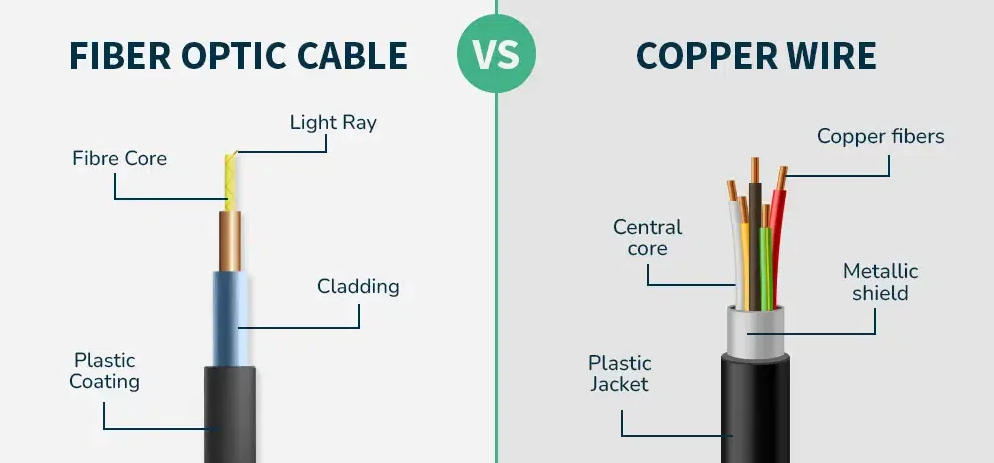
Fiber optic cable is a communication medium that transmits data using pulses of light instead of electrical signals.
A fiber optic cable consists of:
- Core
- Cladding
- Coating
- Strength members
- Outer jacket
The core is made of ultra-pure glass or plastic through which light signals travel.
Unlike copper cables that use electrons to carry information, fiber optics use photons (light particles), allowing much higher transmission capacities.
Types of Fiber Optic Cable
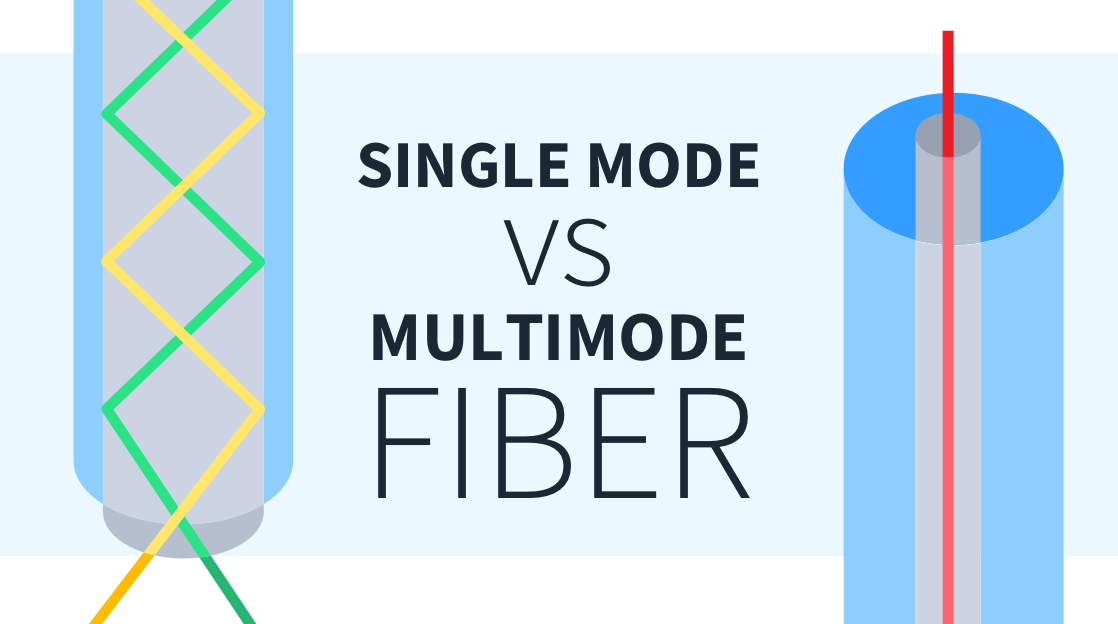
Single Mode Fiber (SMF)
- Core diameter: 8–10 μm
- Long-distance transmission
- Telecom networks
- FTTH deployment
- Data center interconnections
Multimode Fiber (MMF)
- Core diameter: 50–62.5 μm
- Short-distance communication
- Enterprise networks
- Campus networks
- Data centers
What Is Copper Cable?
Copper cable transmits information through electrical currents.
Common copper cable types include:
- Cat5e
- Cat6
- Cat6A
- Cat7
- Cat8
- Coaxial cables
Copper remains widely used in:
- Office LANs
- Home networking
- Industrial systems
- Legacy telecom infrastructure
Despite its popularity, copper technology faces physical limitations that restrict speed and bandwidth growth.
Why Fiber Optic Cable Is Faster Than Copper
The answer lies in how each technology transmits data.
Fiber Uses Light Instead of Electricity
Fiber optic communication relies on light pulses generated by lasers or LEDs.
Copper communication relies on electrical voltage changes.
Because light can oscillate at much higher frequencies than electrical signals, fiber can carry vastly more information simultaneously.
This fundamental difference creates a massive advantage in transmission capacity.
Higher Bandwidth Capacity
Bandwidth represents the amount of data a cable can carry per second.
Copper Bandwidth Limitations
Typical copper Ethernet speeds include:
| Cable Type | Maximum Speed |
|---|---|
| Cat5e | 1 Gbps |
| Cat6 | 10 Gbps |
| Cat6A | 10 Gbps |
| Cat8 | 40 Gbps |
While improvements continue, copper is approaching its physical limits.
Fiber Bandwidth Advantages
Modern fiber networks support:
- 10 Gbps
- 25 Gbps
- 40 Gbps
- 100 Gbps
- 200 Gbps
- 400 Gbps
- 800 Gbps
- 1.6 Tbps
Using technologies like:
- DWDM (Dense Wavelength Division Multiplexing)
- CWDM
- Coherent Optics
A single fiber pair can transmit multiple terabits per second.
This makes fiber the clear winner in bandwidth performance.
Lower Signal Attenuation
Attenuation refers to signal loss over distance.
Copper Signal Loss
Electrical signals weaken rapidly because of:
- Resistance
- Heat generation
- Electromagnetic interference
- Crosstalk
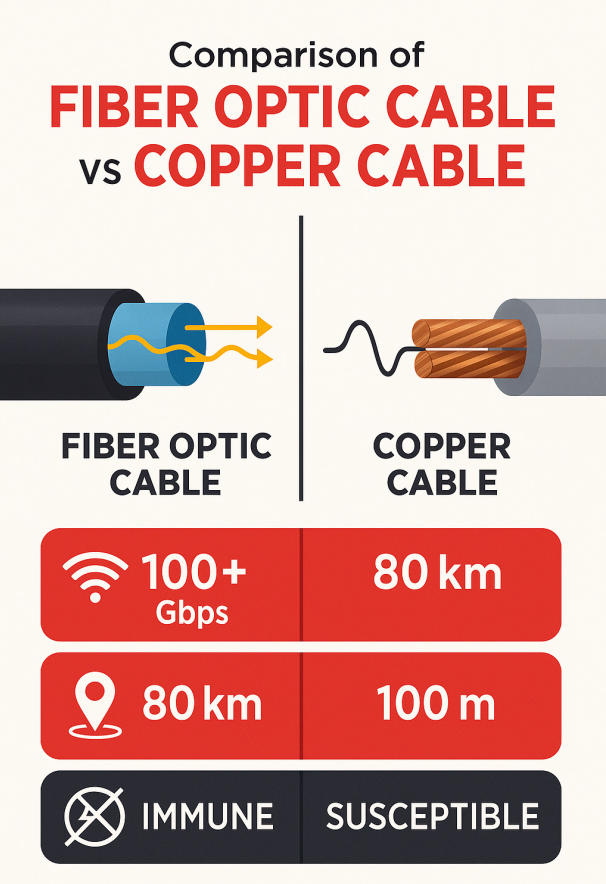
Copper Ethernet links are generally limited to:
- 100 meters
without requiring signal regeneration.
Fiber Signal Loss
Light experiences significantly less attenuation.
Typical attenuation values:
- Single mode fiber: 0.2–0.35 dB/km
- Multimode fiber: 2–3 dB/km
Fiber can transmit:
- 10 km
- 40 km
- 80 km
- 120 km
- 200 km+
before amplification becomes necessary.
This allows faster and more efficient long-distance communication.
Reduced Electromagnetic Interference (EMI)
One major weakness of copper is its susceptibility to interference.
Common sources include:
- Electrical motors
- Power lines
- Industrial machinery
- Wireless systems
- Lightning
Interference introduces:
- Data corruption
- Packet loss
- Slower network performance
Fiber optic cables are immune to:
- EMI
- RFI (Radio Frequency Interference)
- Electrical surges
Because fiber transmits light rather than electricity, external electromagnetic fields have virtually no impact.
The result is more stable high-speed performance.
Lower Network Latency
Latency measures the delay between sending and receiving data.
Fiber generally provides lower latency because:
- Fewer repeaters are required
- Lower error rates
- Less signal processing
- Higher transmission efficiency
Applications benefiting from low latency include:
- AI training clusters
- Financial trading
- Online gaming
- Cloud services
- Autonomous vehicles
Even a few milliseconds can have a major impact in these environments.
Greater Data Density Through Wavelength Multiplexing
One of fiber’s greatest advantages is the ability to carry multiple signals simultaneously.
WDM Technology
Wavelength Division Multiplexing allows different wavelengths of light to travel through the same fiber.
Examples include:
- 8 wavelengths
- 16 wavelengths
- 40 wavelengths
- 80 wavelengths
- 96 wavelengths
Each wavelength can independently carry:
- 10G
- 100G
- 400G
- 800G
This dramatically increases total network capacity without installing additional cables.
Copper has no comparable capability.
Longer Transmission Distances
Distance is another area where fiber vastly outperforms copper.
| Technology | Typical Distance |
| Cat5e | 100 m |
| Cat6 | 100 m |
| Cat6A | 100 m |
| Multimode Fiber | Up to 2 km |
| Single Mode Fiber | 10–200+ km |
For telecom operators and ISPs, this means:
- Fewer network devices
- Lower maintenance costs
- Better reliability
Better Scalability for Future Technologies
Global internet traffic doubles approximately every few years.
Emerging technologies requiring enormous bandwidth include:
Artificial Intelligence
AI models require:
- Massive datasets
- GPU clusters
- Distributed computing
Fiber supports the high-speed interconnects needed by modern AI infrastructure.
5G Networks
5G base stations generate significantly more traffic than 4G.
Fiber serves as the preferred:
- Fronthaul
- Midhaul
- Backhaul
solution.
Cloud Computing
Cloud providers depend on fiber for:
- Data center connectivity
- Global backbone networks
- High-capacity storage systems
Copper simply cannot scale at the same pace.
Why Data Centers Prefer Fiber Optic Cable
Modern hyperscale data centers increasingly deploy fiber for:
Spine-Leaf Architecture
Fiber supports:
- 100G Ethernet
- 200G Ethernet
- 400G Ethernet
- 800G Ethernet
between switches and servers.
High-Density Connectivity
Fiber cables:
- Occupy less space
- Weigh less
- Improve airflow
This helps reduce cooling costs.
Future-Proofing
A fiber infrastructure installed today can support future bandwidth upgrades without replacing the cable plant.
Security Advantages of Fiber Optics
Security is another reason organizations choose fiber.
Copper cables emit electromagnetic radiation that can sometimes be intercepted.
Fiber cables:
- Do not radiate signals
- Are difficult to tap
- Provide enhanced data protection
This makes fiber attractive for:
- Military networks
- Government agencies
- Financial institutions
- Healthcare systems
Energy Efficiency Benefits
Fiber networks consume less energy than copper-based systems.
Reasons include:
- Lower signal loss
- Fewer amplifiers
- Reduced cooling requirements
- Less electrical resistance
As sustainability becomes a priority, energy-efficient fiber infrastructure is increasingly attractive.
Fiber vs Copper: Side-by-Side Comparison
| Feature | Fiber Optic Cable | Copper Cable |
| Transmission Medium | Light | Electricity |
| Maximum Speed | Tbps | Up to 40 Gbps |
| Bandwidth | Extremely High | Limited |
| EMI Resistance | Complete | Susceptible |
| Distance | Hundreds of km | 100 m |
| Latency | Lower | Higher |
| Security | High | Moderate |
| Weight | Lightweight | Heavy |
| Future Scalability | Excellent | Limited |
| Energy Efficiency | Better | Lower |
Common Applications of Fiber Optic Cable
Fiber technology is widely deployed in:
FTTH (Fiber to the Home)
Provides:
- Gigabit internet
- IPTV
- VoIP
Data Centers
Supports:
- High-speed server interconnection
- Cloud computing
- AI clusters
Telecommunications
Used for:
- National backbone networks
- Metro networks
- Long-haul transmission
Smart Cities
Enables:
- Surveillance systems
- Traffic control
- IoT infrastructure
Industrial Automation
Supports:
- Factory communication systems
- Robotics
- Remote monitoring
Frequently Asked Questions
Is fiber optic internet faster than copper internet?
Yes. Fiber internet typically offers significantly higher download and upload speeds, lower latency, and more stable performance than copper-based broadband technologies.
Does light travel faster than electricity?
Not necessarily in all transmission media. However, fiber’s primary advantage comes from its enormous bandwidth and lower signal degradation rather than raw propagation speed alone.
Can copper ever match fiber speeds?
Copper technology continues to improve, but physical limitations make it difficult to compete with fiber’s long-term capacity and scalability.
Why do telecom companies invest in fiber?
Because fiber provides:
- Higher bandwidth
- Longer transmission distance
- Better reliability
- Lower operating costs
- Future-proof infrastructure
Is fiber more expensive?
Initial installation costs may be higher, but fiber often delivers lower total cost of ownership over time due to reduced maintenance and upgrade expenses.
Conclusion
Fiber optic cable is faster than copper because it uses light instead of electricity to transmit information. This enables dramatically higher bandwidth, lower attenuation, greater transmission distances, improved reliability, enhanced security, and superior scalability.
As technologies such as artificial intelligence, cloud computing, 5G, IoT, and hyperscale data centers continue to expand, the advantages of fiber become even more compelling.
While copper remains useful for short-distance and legacy applications, fiber optic cable has become the global standard for modern high-speed communication networks. Organizations investing in future-ready infrastructure increasingly choose fiber because it delivers the speed, capacity, and performance required for the digital economy.
For businesses, telecom operators, and network designers planning the next generation of connectivity, the answer is clear:
Fiber optic cable is faster than copper because light can carry more data, over longer distances, with greater efficiency than electricity ever can.