In the high-stakes world of global telecommunications, where 5G rollouts and Fiber-to-the-Home (FTTH) expansion demand speed and cost-efficiency, network engineers face a constant challenge: how to bridge the “last mile” without breaking the budget. Enter the ASU Cable, often referred to as Mini ADSS or the “Figure-8 Dielectric Cable.”
While traditional ADSS (All-Dielectric Self-Supporting) cables have long dominated long-span aerial deployments, the ASU cable has emerged as the undisputed champion for short-span, cost-sensitive projects. This comprehensive guide will dissect the ASU cable from every angle—its unique structure, technical parameters, application scenarios, and why it is rapidly becoming the preferred choice for wholesale fiber optic cable buyers worldwide.
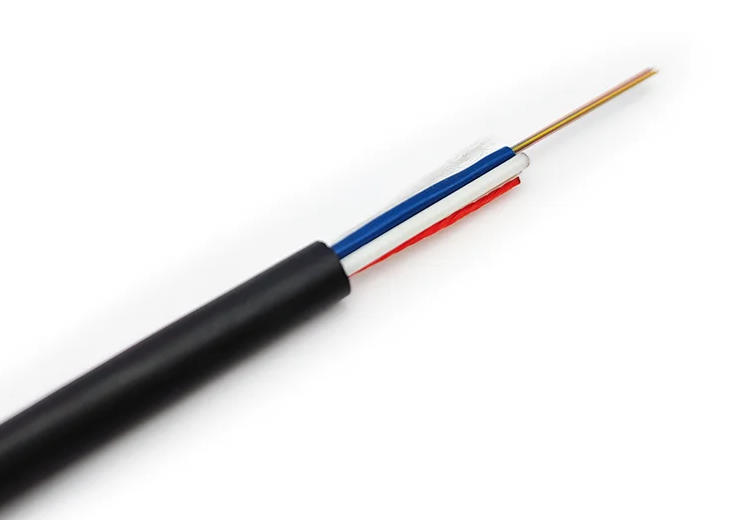
1. What is an ASU Cable? Definition and Core Concept
The term ASU stands for All-dielectric Self-supporting Underground/Aerial. Let’s break down what this means for your network infrastructure:
- All-Dielectric: Unlike armored cables that use steel tape or wires, ASU cables contain zero metal. The strength members are made of FRP (Fiber Reinforced Plastic). This makes the cable non-conductive, immune to electromagnetic interference (EMI), and safe to install near high-voltage power lines.
- Self-Supporting: This is its defining feature. Traditional figure-8 fiber optic cables require a separate messenger wire (steel strand). The ASU cable integrates the support element directly into the jacket, allowing it to be strung between poles like a clothesline—no extra hardware required.
- Compact (Mini): Compared to bulky, layered ADSS cables, the ASU uses a central tube design, making it significantly lighter and smaller in diameter.
2. Structural Anatomy: Why is it Called a “Pin-Type” Cable?
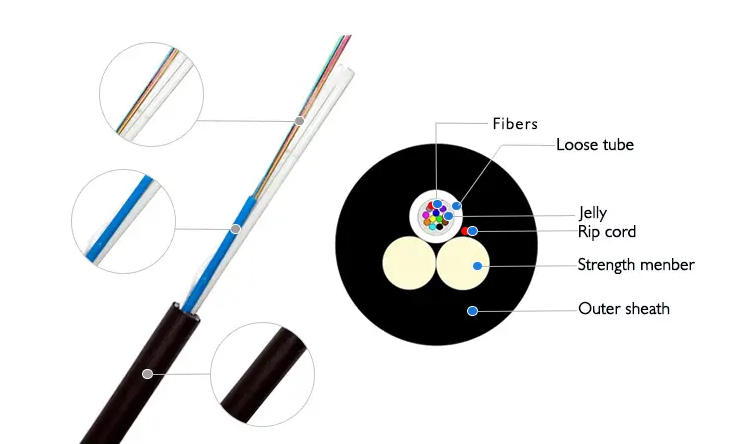
The most recognizable feature of the ASU cable is its cross-section, which resembles the Chinese character “品” (Pin). This “1+2 structure” is the secret to its efficiency.
- Central Loose Tube: At the center lies a PBT (Polybutylene Terephthalate) loose tube containing the optical fibers (typically 2 to 24 cores). It is filled with water-blocking gel or yarn to prevent moisture ingress.
- Dual FRP Strength Members: Flanking the central tube are two solid rods of FRP. These provide the tensile strength needed to support the cable’s weight across spans. They act as the “skeleton” of the cable.
- Outer Sheath: The entire assembly is sheathed in PE (Polyethylene). For deployments near high-voltage lines, an AT (Anti-Tracking) sheath is mandatory to resist electrical arcing and degradation.
This simple yet robust design eliminates the need for expensive Kevlar (Aramid Yarn), drastically reducing manufacturing costs.
3. ASU vs. ADSS: Which One Do You Need?
Many buyers confuse ASU with standard ADSS. While they share the “self-supporting” trait, they serve different masters. Here is a detailed comparison for procurement specialists:
| Feature | ASU Cable (Mini ADSS) | Standard ADSS Cable |
|---|---|---|
| Structure | Central Tube (1+2 Design) | Stranded Loose Tube |
| Span Length | Short Span (80m – 150m) | Long Span (200m – 1000m+) |
| Tensile Strength | Moderate (1.0 kN – 2.5 kN) | High (Up to 20 kN or more) |
| Fiber Count | Low (2 – 24 Cores) | High (24 – 288 Cores) |
| Cost Efficiency | High (Budget Friendly) | Lower (Premium Price) |
| Primary Use | Access Networks, FTTH Drop | Backbone, Long Crossings |
Verdict: If your project involves connecting distribution boxes to homes or covering rural areas with short pole gaps, ASU is the superior choice. If you are crossing rivers or wide highways, you must use standard ADSS.
4. Technical Specifications and Selection Guide
Selecting the right ASU cable requires understanding the relationship between span length and tensile load. Below are typical specifications for a 12-core G.652D single-mode ASU cable.
Typical Parameters Table
| Parameter | ASU 80 (80m Span) | ASU 100 (100m Span) | ASU 120 (120m Span) |
|---|---|---|---|
| Cable Diameter | Approx. 6.8 mm | Approx. 7.2 mm | Approx. 7.8 mm |
| Weight | ~45 kg/km | ~55 kg/km | ~65 kg/km |
| Short Term Tensile (Max Load) | 1,500 N | 1,800 N | 2,400 N |
| Long Term Tensile (Working Load) | 600 N | 800 N | 1,000 N |
| Crush Resistance | 1,000 N/100mm | 1,000 N/100mm | 1,000 N/100mm |
| Operating Temperature | -40°C to +70°C | -40°C to +70°C | -40°C to +70°C |
Pro Tip: Always confirm the wind load and ice load conditions in your region. In areas with heavy ice storms, you may need to upgrade to a higher tensile rating than the span distance alone suggests.
5. Key Advantages and Application Scenarios
Why are telecom operators in Southeast Asia, South America, and Africa increasingly specifying ASU cables?
1. Unbeatable Cost-Effectiveness
By replacing expensive Aramid Yarn (Kevlar) with FRP rods, the material cost is reduced by up to 30%. For massive national broadband projects, this translates to millions of dollars in savings.
2. Rapid Installation (Labor Savings)
Time is money. The self-supporting design allows for “one-pass” installation. Workers do not need to tension a steel messenger wire first. Using simple fittings like J-hooks or tension clamps, an ASU cable can be deployed at speeds of 1-2 kilometers per day per crew.
3. Safety and Reliability
Being dielectric, there is no risk of lightning strikes traveling through the cable to damage equipment. It also prevents galvanic corrosion when running alongside power conductors.
4. Ideal Applications
- FTTH Drop Networks: Connecting poles to multi-dwelling units (MDUs).
- Smart Grid / Power Distribution: Running along low-voltage power lines for smart metering.
- Rural Broadband Initiatives: Providing connectivity to remote villages where trenching is impossible.
- Surveillance Systems: Linking IP cameras across city streets.
6. Procurement Checklist: Avoiding Common Pitfalls
When sourcing ASU cables from manufacturers, ensure you verify these details to guarantee quality:
- FRP Quality: Ensure the FRP rods are rigid and straight. Cheap, low-quality FRP can sag over time, leading to excessive fiber attenuation.
- Sheath Material: Insist on UV-resistant PE. If the cable will run parallel to 10kV or 35kV power lines, specify AT (Anti-Tracking) Sheath to prevent electrical erosion.
- Water Blocking: Check if the cable is gel-filled or dry-block. Gel-filled is cheaper but messy; dry-block is cleaner for splicing but slightly more expensive.
- Certifications: Look for ISO9001, RoHS, and CE compliance. Request a test report (OTDR trace) for each reel to verify fiber attenuation (should be < 0.36 dB/km @ 1310nm).
Conclusion
The ASU Cable is not just a product; it is a strategic tool for cost optimization in modern network deployment. Its lightweight nature, ease of installation, and resistance to environmental factors make it the ideal workhorse for the access layer of the fiber optic network.
As the demand for high-speed internet continues to surge globally, understanding the nuances of Mini ADSS technology will empower you to build faster, stronger, and more affordable networks. Whether you are a contractor, a procurement manager, or a network planner, the OUFU ASU cable deserves a prime spot in your specification sheet.
ASU Cable (Mini ADSS) Frequently Asked Questions (FAQ)
This FAQ section addresses the most common technical questions regarding ASU Fiber Optic Cable, helping you make informed decisions for your FTTH and access network projects.
1. What does “ASU” stand for in ASU Cable?
ASU stands for All-dielectric Self-supporting Underground/Aerial. It signifies that the cable contains no metal (dielectric), can support its own weight (self-supporting), and is suitable for both aerial and duct installations, although it is primarily used for overhead applications.
2. What is the difference between ASU Cable and ADSS Cable?
While both are self-supporting, the difference lies in scale and structure:
- ASU Cable (Mini ADSS): Uses a central tube design with FRP rods. It is designed for short spans (80m–150m) and lower fiber counts (2–24 cores). It is the cost-effective choice for FTTH access networks.
- Standard ADSS: Uses a stranded loose tube design with Aramid Yarn (Kevlar). It is designed for long spans (200m–1000m+) and higher fiber counts. It is used for backbone networks and crossing rivers or valleys.
3. Can ASU Cable be installed alongside high-voltage power lines?
Yes, but with a critical condition. If the ASU cable is installed within 1 meter of power lines (especially 10kV or above), you must specify an AT (Anti-Tracking) sheath. A standard PE sheath will degrade and crack due to electrical arcing (corona discharge). If the cable is on a separate pole away from power lines, a PE sheath is sufficient.
4. What is the maximum span length for an ASU Cable?
The standard maximum span for ASU Cable is 120 meters to 150 meters. Attempting to stretch an ASU cable beyond this limit (e.g., 200m) can cause the cable to sag excessively or break under wind/ice loads, leading to signal loss. For longer distances, you must use a standard ADSS cable.
5. Is ASU Cable the same as Figure-8 Cable (GYTC8S)?
No. This is a common point of confusion.
- GYTC8S (Figure-8): Contains a steel messenger wire (metal). It is heavy and requires grounding.
- ASU Cable: Is all-dielectric (FRP). It is lightweight and requires no grounding.While both look like a “figure-8” shape, the ASU is specifically for environments where metal is prohibited or undesirable.
6. How many fibers can an ASU Cable hold?
Typically, an ASU cable holds between 2 and 24 fibers. Due to its compact central tube design, it is not suitable for high-density fiber counts (like 48 or 96 cores). If you need more than 24 cores, you should consider a standard ADSS or a duct cable.