In the era of 5G, Hyperscale Data Centers, and Artificial Intelligence, fiber optic cable stands as the literal nervous system of the global digital economy. Unlike traditional copper wiring, fiber optic technology leverages the physics of light to transmit data at near-limitless speeds with minimal latency.
This comprehensive guide explores everything from the core physics of optical transmission to the latest innovations in Hollow Core Fiber (HCF), providing a definitive resource for network engineers, procurement specialists, and tech enthusiasts.
1. What is Fiber Optic Cable?
A fiber optic cable is a high-capacity data transmission medium consisting of one or more transparent glass or plastic fibers through which light pulses travel. Each strand, often as thin as a human hair, acts as a waveguide, utilizing the principle of Total Internal Reflection to carry digital information over vast distances.
The Anatomy of an Optical Fiber
To understand how fiber optic cables outperform copper, we must look at their three-layer construction:
Core: The innermost part made of high-purity glass (silica) where light travels.
Cladding: A layer surrounding the core with a lower refractive index, which reflects light back into the core.
Buffer Coating/Jacket: Protective layers that shield the delicate glass from moisture, physical damage, and electromagnetic interference (EMI).
2. How Fiber Optic Cables Work: The Physics of Light
The efficiency of fiber optics is rooted in optics and photonics. Digital data (1s and 0s) is converted into light pulses by a laser or LED.
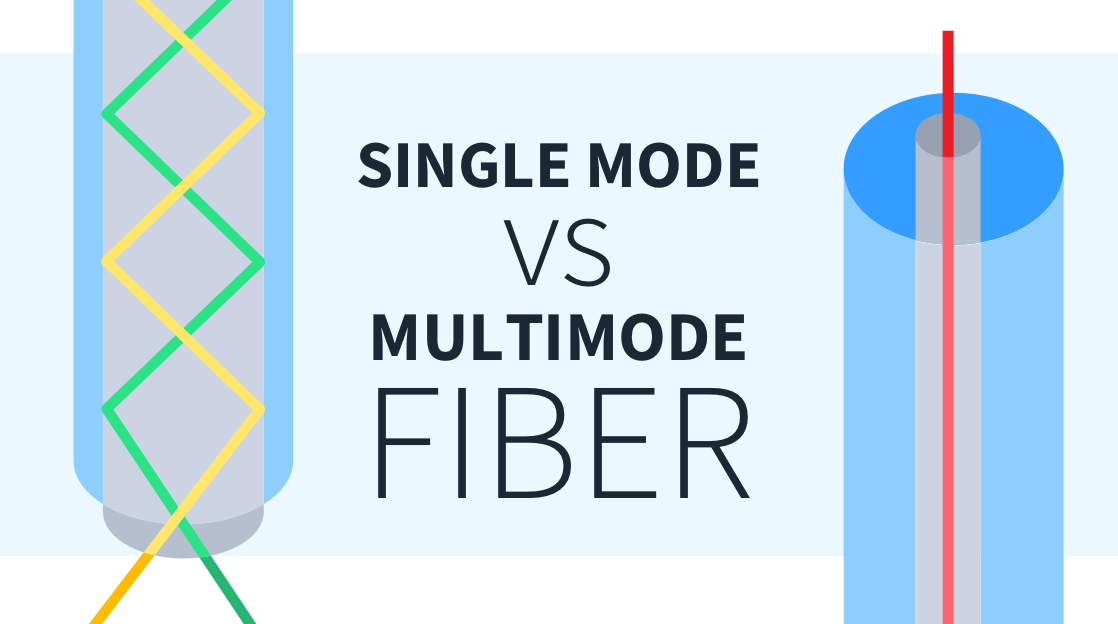
- Total Internal Reflection: When light hits the boundary between the core and cladding at a specific angle (the critical angle), it reflects entirely back into the core, allowing the signal to “zig-zag” through curves in the cable without escaping.
- Low Attenuation: Unlike electrons in copper, photons in high-quality silica glass experience very little resistance, meaning signals can travel over 60 miles (100km) without needing a repeater.
3. Single-mode vs. Multi-mode Fiber: A Comparative Analysis
Table 1: Technical Comparison of Fiber Types
Single-mode Fiber (OS1, OS2)
Single-mode cables have a tiny core that allows only one mode of light to propagate. This eliminates modal dispersion, making it the gold standard for long-distance telecommunications and internet backbones.
Multi-mode Fiber (OM1, OM2, OM3, OM4, OM5)
With a larger core, these cables allow multiple light paths. While this increases dispersion and limits distance, it simplifies the alignment of connectors and allows for cheaper LED-based hardware. OM4 and OM5 are currently the industry standard for high-speed data centers (40G/100G/400G).
4. Key Advantages of Fiber Optic Cables over Copper
Here are the authoritative reasons:
Massive Bandwidth: Fiber can carry terabits of data per second. Copper is physically limited by its frequency range.
Immunity to EMI/RFI: Since fiber uses glass (an insulator) and light, it is completely unaffected by electromagnetic interference from power lines or lightning.
Enhanced Security: It is nearly impossible to “tap” a fiber optic cable without detection, as any breach causes a noticeable loss in light signal.
Lighter and Thinner: Fiber cables take up less space in conduits, allowing for higher density in crowded urban environments.
Future-Proofing: Once fiber is in the ground, upgrading speed usually only requires changing the electronics at the ends, not the cable itself.
5. Specialized Fiber Cable Constructions
Different environments require specific physical protections.
- Armored Fiber Optic Cable: Features a steel or aluminum wrap to protect against rodent bites and physical crushing in industrial settings.
- Aerial Fiber Optic Cable(ADSS & Figure-8 Fiber Optic Cable): Designed to be strung between poles, featuring high tensile strength to withstand wind and ice loads.
- Submarine Fiber Optic Cable: Multi-layered, heavy-duty cables that lie on the ocean floor, forming the backbone of the international internet.
- Tactical Fiber Optic Cable: Ruggedized, flexible cables used in military and broadcast applications where frequent deployment and retrieval are necessary.
6. Industry Applications: Powering the Modern World
Data Centers & AI Clusters
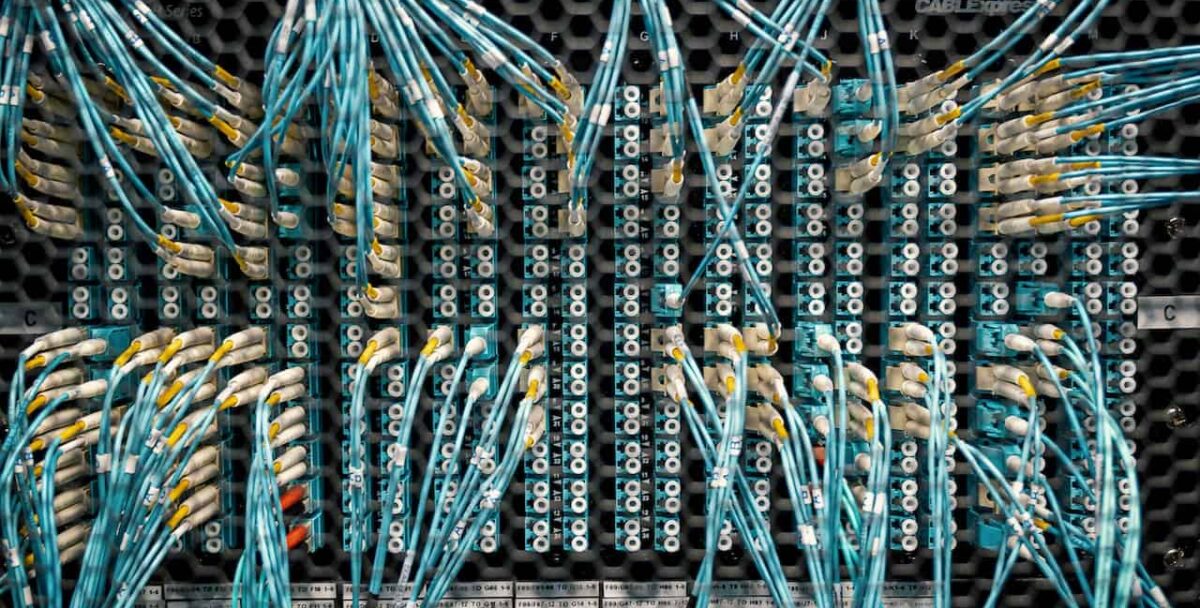
Modern AI training (like LLMs) requires massive GPU clusters to communicate with sub-microsecond latency. OM5 Multi-mode and Single-mode fiber are critical for the InfiniBand and Ethernet fabrics that connect these units.
FTTH (Fiber to the Home)
The shift from DSL and Cable to FTTH (using GPON/XGS-PON technology) has revolutionized remote work, enabling symmetrical gigabit speeds for video conferencing and 8K streaming.
Industrial IoT and Smart Cities
Fiber optics provide the backbone for “Smart Cities,” connecting thousands of IoT sensors, 5G small cells, and traffic management systems with ultra-reliable links.
7. Fiber Optic Cable Installation Best Practices (E-E-A-T)
To establish Experience and Expertise (critical for Google’s E-E-A-T guidelines), follow these rigorous installation standards:
- Mind the Bend Radius: Never exceed the manufacturer’s specified bend radius. Doing so creates “macro-bends” that cause signal loss or permanent glass fractures.
- The “Cleanliness is Godliness” Rule: 90% of fiber failures are caused by contaminated connectors. Use isopropyl alcohol and lint-free wipes, and always inspect end-faces with a fiber scope before plugging in.
- OTDR Testing: After installation, use an Optical Time-Domain Reflectometer (OTDR) to map the entire length of the cable, identifying splices, connectors, and potential stress points.
8. Future Trends: The Next Frontier of Fiber
Hollow Core Fiber (HCF)
Instead of a solid glass core, HCF uses a hollow, air-filled center. Light travels 30% faster in air than in glass, making HCF the “Holy Grail” for high-frequency trading and low-latency AI synchronization.
Space-Division Multiplexing (SDM)
Future cables will feature Multi-core fibers (MCF), where a single strand contains multiple independent cores, effectively multiplying the capacity of a single cable by 10x or more.
AI-Driven Optical Network Management
AI algorithms are now being integrated into optical transceivers to predict cable failures based on subtle changes in light polarization and attenuation before an outage occurs.
9. Conclusion: Why Fiber is the Bedrock of Progress
The fiber optic cable is more than just a wire; it is the fundamental infrastructure that enables every modern convenience, from cloud computing to global financial markets. As we move toward a world of 6G and ubiquitous AI, the demand for higher-quality, lower-latency fiber solutions will only accelerate.
For businesses and governments, investing in high-grade fiber infrastructure is no longer an option—it is a prerequisite for survival in the digital age.
10. Frequently Asked Questions
Q: Which is better, single-mode or multi-mode fiber?
A: It depends on distance. Single-mode is better for long-range (kilometers), while multi-mode is more cost-effective for short-range (under 500 meters) like within a building.
Q: Can fiber optic cables be repaired?
A: Yes, through a process called fusion splicing, where a specialized machine aligns the glass cores and melts them together with an electric arc.
Q: How long does a fiber optic cable last?
A: Most high-quality fiber cables are designed for a 25 to 30-year lifespan, though the glass itself can last much longer if protected from moisture and physical stress.
Q: Does weather affect fiber optic internet?
A: Generally, no. Unlike satellite or fixed wireless, fiber is buried or shielded, making it immune to rain, snow, and wind (unless physical damage occurs to the poles).