Choosing the right Ethernet cable is an important decision when building or upgrading a wired network. CAT5e, CAT6, and CAT6A are three of the most widely used twisted-pair copper network cable categories. Although they look similar and commonly use RJ45 connectors, they differ significantly in bandwidth, transmission speed, 10GbE distance, crosstalk performance, cable construction, PoE capability, installation requirements, and cost.
For a simple home Gigabit network, CAT5e may still be sufficient. CAT6 provides a useful performance upgrade and is often a good choice for offices and modern LANs. For new commercial infrastructure, 10 Gigabit Ethernet, high-density Wi-Fi, and long-term network planning, CAT6A offers the strongest combination of bandwidth and future-proofing.
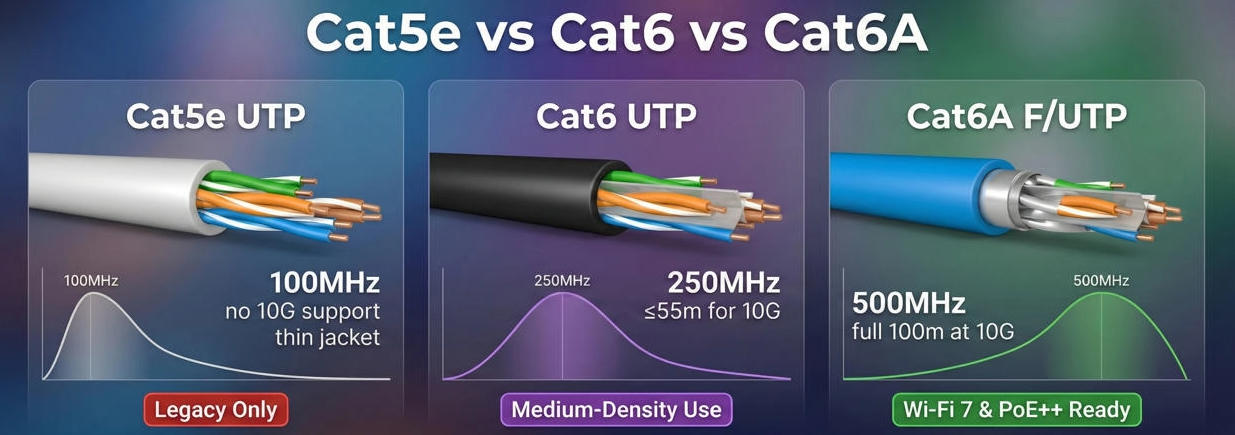
According to commonly referenced Ethernet specifications, CAT5e supports 1 Gbps up to 100 meters, CAT6 can support 10GBASE-T over shorter distances, and CAT6A supports 10GBASE-T over the full 100-meter channel.
1. What Is CAT5e Cable?
CAT5e, or Category 5 Enhanced cable, is an improved version of CAT5 twisted-pair Ethernet cable. It was designed primarily to provide reliable 1000BASE-T Gigabit Ethernet over standard structured-cabling distances.
CAT5e normally contains four twisted copper pairs, giving a total of eight conductors. The twisting of each pair helps reduce electromagnetic interference and crosstalk between conductors.
Key CAT5e specifications
| Parameter | CAT5e |
|---|---|
| Standard bandwidth | 100 MHz |
| Typical maximum Ethernet speed | 1 Gbps |
| 1 Gbps distance | Up to 100 m |
| 10 Gbps | Not normally specified |
| Typical conductor | 24 AWG |
| Construction | 4 twisted pairs |
| Shielding | U/UTP, F/UTP and other configurations |
| Connector | RJ45 |
| Cost | Lowest of the three |
| Best application | Home, basic office and Gigabit LAN |
CAT5e remains useful where the network only requires Gigabit Ethernet and the project prioritizes low cable cost and easy installation. Intel’s Ethernet cabling guide also lists CAT5e for 1000BASE-T up to 100 meters.
Advantages of CAT5e
1. Low cost
CAT5e is generally the most economical choice for copper Ethernet infrastructure.
2. Easy installation
Its smaller diameter and relatively flexible construction make it easy to route through conduits, cable trays, walls and cabinets.
3. Gigabit Ethernet support
For many home and small-business networks, 1 Gbps is sufficient for Internet access, file sharing, printers, surveillance cameras and general office applications.
4. Broad compatibility
CAT5e works with common RJ45 Ethernet equipment and is backward compatible with slower Ethernet technologies.
Limitations of CAT5e
The major limitation is bandwidth and future upgrade potential. CAT5e is rated at 100 MHz and is primarily associated with Gigabit Ethernet. If a network is expected to migrate to 10GbE, CAT5e is generally not the preferred new-installation choice.
2. What Is CAT6 Cable?
CAT6, or Category 6 cable, is a higher-performance twisted-pair copper cable designed with better control of crosstalk and higher-frequency transmission than CAT5e.
CAT6 is typically rated to 250 MHz, compared with 100 MHz for CAT5e. It can support 1 Gbps Ethernet over 100 meters and can support 10GBASE-T over shorter distances, commonly up to 55 meters depending on the channel and installation conditions.
Key CAT6 specifications
| Parameter | CAT6 |
|---|---|
| Standard bandwidth | 250 MHz |
| Typical maximum speed | 1 Gbps / 10 Gbps short reach |
| 1 Gbps distance | Up to 100 m |
| 10 Gbps distance | Up to approximately 55 m |
| Typical conductor | 23 AWG |
| Construction | 4 twisted pairs |
| Crosstalk control | Improved |
| Shielding | U/UTP, F/UTP and others |
| Connector | RJ45 |
| Cost | Medium |
| Best application | Modern offices, LANs, short 10GbE links |
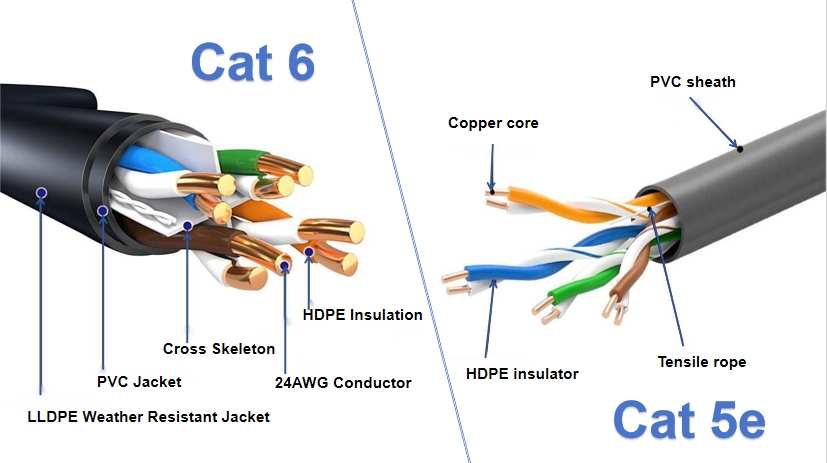
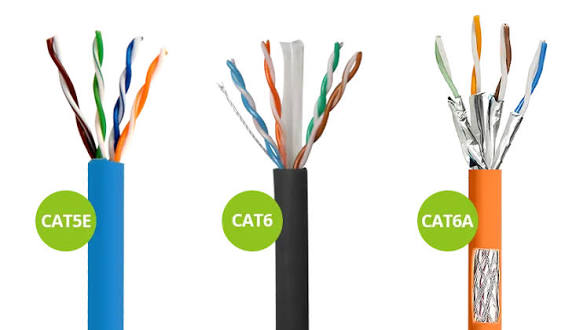
One common physical feature of CAT6 cable is a central separator or spline between twisted pairs. The exact construction varies by manufacturer, but the objective is to increase pair separation and reduce crosstalk.
Advantages of CAT6
Higher bandwidth
CAT6’s 250 MHz bandwidth provides substantially more transmission headroom than CAT5e’s 100 MHz.
Better crosstalk performance
The improved pair geometry and cable construction help maintain signal integrity in environments where multiple Ethernet cables are installed together.
Short-distance 10GbE capability
CAT6 can support 10GBASE-T over suitable shorter channels, with 55 meters being the commonly cited maximum under standard conditions.
Good balance between cost and performance
For many new office installations, CAT6 is a practical middle ground between inexpensive CAT5e and higher-performance CAT6A.
3. What Is CAT6A Cable?
CAT6A, or Category 6 Augmented cable, is an enhanced version of CAT6 designed to provide better high-frequency performance and 10 Gigabit Ethernet over the full 100-meter channel.
CAT6A is normally rated to 500 MHz, twice the nominal bandwidth of CAT6 and five times that of CAT5e.
Key CAT6A specifications
| Parameter | CAT6A |
|---|---|
| Standard bandwidth | 500 MHz |
| Maximum Ethernet speed | 10 Gbps |
| 10 Gbps distance | Up to 100 m |
| Typical conductor | 23 AWG |
| Crosstalk control | Excellent |
| Alien crosstalk | Specifically addressed |
| Shielding | U/UTP, F/UTP, U/FTP, S/FTP |
| Connector | RJ45 commonly used |
| Cost | Highest of the three |
| Best application | Enterprise, data centers, 10GbE and high-density PoE |
Intel’s technical guide identifies CAT6A as capable of 10GBASE-T over 100 meters, compared with approximately 55 meters for CAT6.
Advantages of CAT6A
1. Full 10GbE over 100 meters
This is arguably the most important reason to select CAT6A. If a structured-cabling system needs 10Gbps across a full horizontal-channel distance, CAT6A is the safer specification.
2. Higher bandwidth
The 500 MHz rating provides greater frequency headroom than CAT6 and CAT5e.
3. Better alien-crosstalk performance
CAT6A is designed to control interference between adjacent cables, which becomes increasingly important in dense cable bundles.
4. Better long-term infrastructure investment
Although CAT6A costs more and can be harder to install, it reduces the likelihood that cabling will need to be replaced when network speeds increase.
4. CAT5e vs CAT6 vs CAT6A: Complete Comparison
The following table summarizes the most important differences:
| Feature | CAT5e | CAT6 | CAT6A |
|---|---|---|---|
| Bandwidth | 100 MHz | 250 MHz | 500 MHz |
| 1 Gbps | Up to 100 m | Up to 100 m | Up to 100 m |
| 2.5 Gbps | Possible depending on channel | Supported | Supported |
| 5 Gbps | Limited/application-dependent | Supported | Supported |
| 10 Gbps | Not the normal design target | Up to ~55 m | Up to 100 m |
| Typical conductor | 24 AWG | 23 AWG | 23 AWG |
| Crosstalk protection | Good | Better | Best |
| Alien crosstalk | Limited specification | Less stringent | Specifically addressed |
| Cable diameter | Smaller | Medium | Larger |
| Flexibility | Highest | Medium | Lowest |
| Installation difficulty | Easy | Moderate | More demanding |
| PoE applications | Yes | Yes | Yes |
| Relative cost | $ | $$ | $$$ |
| Best use | Basic Gigabit | Modern LAN | 10GbE/future-proofing |
The commonly referenced bandwidth and transmission-distance differences are consistent across current cabling references: 100 MHz for CAT5e, 250 MHz for CAT6, and 500 MHz for CAT6A, with CAT6A supporting 10GbE to 100 meters.
5. CAT5e vs CAT6 vs CAT6A: Speed Difference
It is important to distinguish bandwidth from network speed.
A cable rated for a higher frequency does not automatically make an Internet connection faster. The actual network speed depends on the cable, connectors, switches, network interface cards, distance, installation quality and other factors.
For example:
- CAT5e → commonly used for 1Gbps
- CAT6 → 1Gbps at 100 m and can support 10Gbps at shorter distances
- CAT6A → designed for 10Gbps up to 100 m
Therefore, upgrading from CAT5e to CAT6 does not automatically turn a 1Gbps Internet connection into a 10Gbps connection.
The network equipment must also support the higher Ethernet speed.
6. Bandwidth: 100 MHz vs 250 MHz vs 500 MHz
Bandwidth is one of the easiest ways to understand the difference.
Standard nominal frequency ratings commonly used to distinguish the three cable categories.
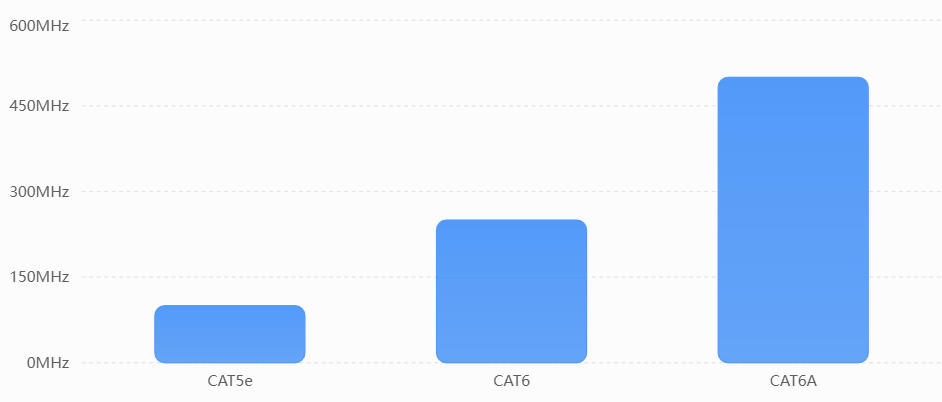
Think of bandwidth as the capacity of a highway.
- CAT5e: 100 MHz
- CAT6: 250 MHz
- CAT6A: 500 MHz
Higher bandwidth provides greater electrical performance headroom, although it should not be interpreted as a direct one-to-one conversion into Internet speed.
7. Crosstalk: An Important Difference
Crosstalk occurs when a signal traveling through one twisted pair interferes with another pair.
There are two important forms:
- NEXT — Near-End Crosstalk
- FEXT — Far-End Crosstalk
There is also alien crosstalk, which refers to interference between neighboring cables rather than pairs inside the same cable.
As Ethernet speeds increase, controlling these interference mechanisms becomes increasingly important.
CAT6 improves pair-to-pair isolation compared with CAT5e, while CAT6A provides stronger performance requirements for high-frequency transmission and alien-crosstalk control.
This is one reason CAT6A is particularly suitable for dense enterprise cable installations.
8. Cable Construction Differences
CAT5e, CAT6 and CAT6A all use four twisted pairs, but their internal construction can be different.
CAT5e
CAT5e generally uses relatively small conductors and does not require the same level of internal pair separation as higher categories.
CAT6
CAT6 commonly uses a cross-shaped spline or separator to increase the physical distance between pairs.
CAT6A
CAT6A generally requires more advanced construction to achieve its higher-frequency performance. Depending on the manufacturer, it may use:
- Larger conductors
- Improved insulation
- Internal separators
- Foil shielding
- Overall shielding
- Special jacket designs
Not every CAT6A cable has to look identical. The exact construction depends on whether it is U/UTP, F/UTP, U/FTP or S/FTP.
9. CAT5e vs CAT6 vs CAT6A for PoE
Power over Ethernet, or PoE, allows network cables to transmit both data and electrical power.
PoE is widely used for:
- IP cameras
- Wi-Fi access points
- VoIP phones
- Access-control systems
- IoT devices
- Network sensors
- LED lighting
CAT5e can support common PoE applications, but CAT6 and CAT6A can provide additional thermal and performance headroom, especially in high-power PoE installations.
The cable specification alone, however, should not be used to promise a particular PoE wattage. The actual capability depends on the IEEE PoE type, cable construction, bundle size, conductor resistance, ambient temperature and installation method.
For high-power PoE and dense cable bundles, CAT6A is often attractive because of its larger conductors and stronger overall performance characteristics.
10. CAT5e vs CAT6 vs CAT6A: Application Comparison
CAT5e Applications
CAT5e is suitable for:
- Home Ethernet networks
- Small offices
- Basic IP surveillance
- VoIP phones
- Printers
- Gigabit Internet
- Existing structured-cabling systems
- Cost-sensitive projects
If the network requirement is simply 1Gbps over up to 100 meters, CAT5e can still be a practical solution.
CAT6 Applications
CAT6 is suitable for:
- Business networks
- Office buildings
- Schools
- Retail stores
- Residential networks
- IP surveillance
- Wi-Fi access points
- Gigabit Ethernet
- Short-distance 10GbE
CAT6 is particularly attractive when a project wants better performance than CAT5e without the additional size and installation complexity of CAT6A.
CAT6A Applications
CAT6A is ideal for:
- Enterprise networks
- Data centers
- High-density Wi-Fi
- 10GbE networks
- High-performance workstations
- Server rooms
- High-power PoE
- New commercial buildings
- Long-term structured cabling
- Large network infrastructure
For a new commercial installation where 10GbE may be required over a full 100-meter channel, CAT6A is generally the strongest choice among these three categories.
11. Which Cable Is Better for Home Networking?
For most home users, CAT5e or CAT6 is sufficient.
If your home Internet service is 1Gbps or less and your internal network does not require 10GbE, CAT5e can provide adequate performance.
However, if you are installing new cable inside walls and want the infrastructure to remain useful for many years, CAT6 is often a better choice because the cost increase can be relatively modest while providing greater bandwidth headroom.
For home servers, NAS systems, high-performance PCs or 10GbE equipment, CAT6A may be worth considering.
12. Which Cable Is Better for Office Networks?
For a new office installation, CAT6 is usually a strong balance between:
Performance + Cost + Installation + Future Upgrade Potential
CAT6A becomes more attractive when the office requires:
- 10GbE over longer horizontal runs
- High-density Wi-Fi
- Large PoE loads
- Dense cable bundles
- Long infrastructure life
- Enterprise-grade network upgrades
CAT5e can still be used for existing Gigabit networks, but for a completely new infrastructure, many buyers prefer CAT6 or CAT6A.
13. CAT6 vs CAT6A: Which One Should You Choose?
This is often the most important decision.
Choose CAT6 if:
- Most connections are 1GbE
- 10GbE runs are short
- Cost is important
- Cable flexibility matters
- Installation space is limited
- The project is a small or medium office
Choose CAT6A if:
- You need 10GbE over 100 m
- You are building a new commercial network
- You expect higher network speeds
- You have high-density Wi-Fi
- You are deploying high-power PoE
- You want maximum future-proofing
A useful rule is:
CAT6 is a cost-effective high-performance option; CAT6A is the better choice when 10GbE and long-term infrastructure are priorities.
14. Installation Considerations
Cable category is only one part of network performance.
A high-category cable can still perform poorly if it is installed incorrectly.
Important installation factors include:
Cable length
Observe the maximum channel length and horizontal-cabling requirements.
Bend radius
Do not sharply bend the cable. Higher-category cables can be physically larger and less flexible.
Pulling tension
Excessive pulling force can deform the twisted pairs and affect electrical performance.
Connector quality
A CAT6A cable terminated with an unsuitable connector can compromise the overall channel.
Pair untwist
Avoid excessive untwisting near the termination point.
Cable bundles
Large bundles can increase heat accumulation, especially with PoE.
Electromagnetic interference
In electrically noisy environments, shielded constructions may be appropriate.
Network performance depends on cable length, termination quality, installation and environmental interference—not just the category printed on the jacket.
15. CAT5e vs CAT6 vs CAT6A: Cost Comparison
In general:
CAT5e < CAT6 < CAT6A
CAT5e is usually the least expensive.
CAT6 costs more because of improved materials, tighter electrical specifications and, in many designs, internal separators.
CAT6A costs more because it requires higher-performance construction and may use larger conductors and additional shielding.
However, buyers should evaluate total installation cost, not just cable price.
For example, CAT6A may have:
- Higher cable cost
- Larger outside diameter
- Larger bend radius
- More difficult routing
- Higher pathway requirements
- Potentially more expensive connectors
Therefore, the best cable is not necessarily the one with the highest category.
16. How to Choose Between CAT5e, CAT6 and CAT6A
A simple decision process can make the selection easier.
Step 1: Determine required network speed
If you only need 1GbE, CAT5e or CAT6 may be sufficient.
If you require 10GbE, consider CAT6 for short runs and CAT6A for full 100-meter coverage.
Step 2: Determine cable distance
Distance is critical.
10GbE + short distance → CAT6 may work
10GbE + up to 100 m → CAT6A is the preferred choice
Step 3: Consider PoE requirements
If the network includes many high-power PoE devices, consider cable gauge, bundle size, temperature and installation conditions.
Step 4: Consider future upgrades
If cable will be installed inside walls, ceilings or underground pathways and replacement will be expensive, choosing CAT6A may provide better long-term value.
Step 5: Consider the installation environment
For high EMI environments, select an appropriate shielded construction and ensure that the entire channel—including connectors and grounding—is designed accordingly.
17. Frequently Asked Questions
Is CAT6 faster than CAT5e?
CAT6 has higher bandwidth and greater performance headroom than CAT5e, but both can support Gigabit Ethernet over 100 meters. CAT6 can additionally support 10GbE over shorter distances under appropriate conditions.
Is CAT6A better than CAT6?
For 10GbE over long distances, yes. CAT6A is designed for 10GBASE-T up to 100 meters, while CAT6’s commonly specified 10GbE reach is approximately 55 meters.
Can I use CAT6 cable with CAT5e equipment?
Yes. Ethernet cabling is designed for backward compatibility. However, the final network performance is limited by the lowest-capability component in the link.
Can CAT6A use RJ45 connectors?
Yes. CAT6A Ethernet installations commonly use RJ45-compatible connectivity, provided the connectors and components meet the required category specifications.
Is CAT5e enough for Gigabit Internet?
Yes. CAT5e is designed for 1000BASE-T Gigabit Ethernet up to 100 meters.
Should I choose CAT6 or CAT6A for a new building?
If the budget and installation space allow it, CAT6A is the stronger long-term choice, particularly when 10GbE, high-density Wi-Fi or high-power PoE may be required.
18. Final Verdict: CAT5e vs CAT6 vs CAT6A
The difference between CAT5e, CAT6 and CAT6A is not simply about choosing the cable with the highest number.
CAT5e is economical and reliable for standard Gigabit Ethernet.
CAT6 provides higher bandwidth, improved crosstalk performance and short-distance 10GbE capability while maintaining a relatively manageable installation cost.
CAT6A provides 500 MHz bandwidth and is designed to deliver 10GbE over the full 100-meter channel, making it particularly suitable for enterprise networks, commercial buildings, data centers, high-density wireless networks and future-oriented infrastructure.
Quick recommendation
| Network Requirement | Recommended Cable |
|---|---|
| Basic home network | CAT5e |
| Gigabit office network | CAT5e / CAT6 |
| New office installation | CAT6 |
| Short-distance 10GbE | CAT6 |
| 10GbE up to 100 m | CAT6A |
| High-density Wi-Fi | CAT6A |
| High-power PoE | CAT6 / CAT6A |
| Long-term commercial infrastructure | CAT6A |
| Lowest initial cable cost | CAT5e |
In short: CAT5e is the budget-friendly Gigabit option, CAT6 is the balanced performance choice, and CAT6A is the preferred solution for 10GbE and long-term network infrastructure.