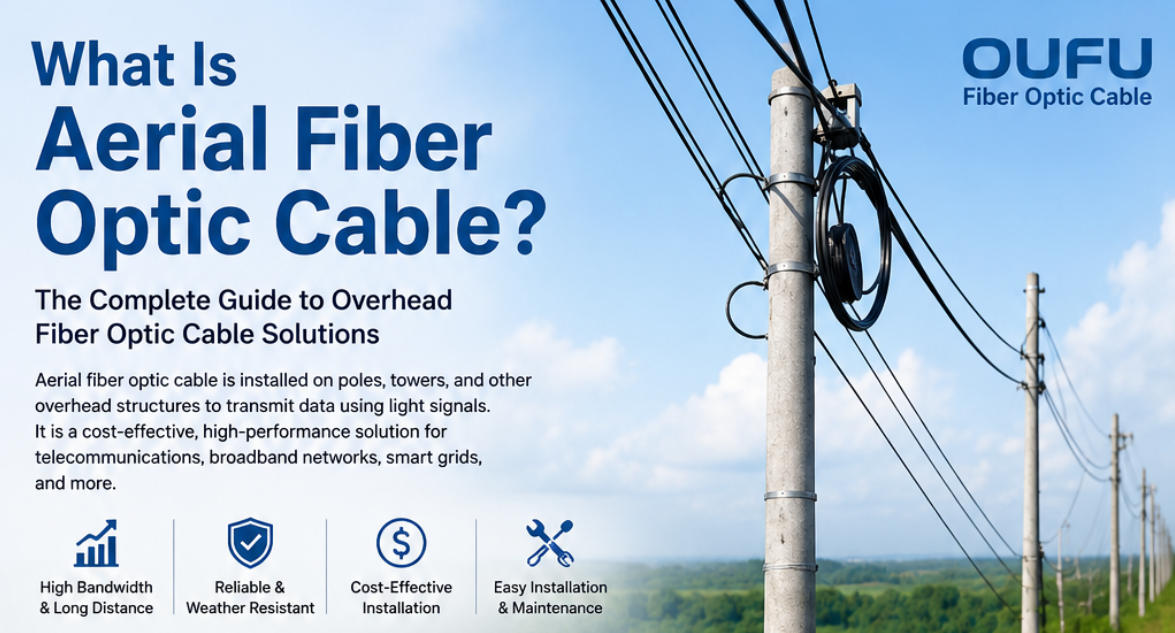
Aerial fiber optic cable is a type of outdoor fiber optic cable designed to be installed above the ground, typically on utility poles, towers, messenger wires, or other overhead support structures. Unlike underground fiber optic cables, aerial cables are exposed to environmental conditions such as wind, rain, snow, ice, ultraviolet radiation, temperature changes, and mechanical vibration. Therefore, their construction must provide reliable optical performance together with sufficient mechanical strength and environmental protection.
Aerial fiber optic cable is widely used for telecommunication networks, FTTH deployments, broadband infrastructure, 5G backhaul, rural connectivity, utility communication networks, power transmission systems, and long-distance fiber optic networks.
Depending on the installation environment and mechanical requirements, common aerial fiber optic cable designs include ADSS cable, OPGW cable, Figure 8 fiber optic cable, messenger-supported fiber cable, and other self-supporting outdoor fiber cables.
What Is Aerial Fiber Optic Cable?
An aerial fiber optic cable is a fiber optic cable specifically engineered for overhead installation.
Instead of being buried underground inside ducts or directly buried in soil, an aerial fiber cable is installed along an overhead route. The cable may be attached directly to poles, suspended from a messenger wire, integrated with a supporting wire, or designed as a completely self-supporting cable.
The most important difference between standard outdoor fiber cable and aerial fiber optic cable is the cable’s ability to withstand mechanical and environmental stresses associated with overhead installation.
A typical aerial fiber cable needs to tolerate:
- Wind loading
- Ice and snow loading
- Cable tension
- Temperature expansion and contraction
- UV exposure
- Rain and humidity
- Lightning and electrical environments
- Vibration
- Long installation spans
- Mechanical impact during installation
For this reason, aerial fiber optic cables generally use high-strength materials such as aramid yarn, FRP, glass yarn, steel messenger wires, or other strength members.
Simple Definition
Aerial fiber optic cable is an outdoor fiber optic cable designed for overhead installation on poles, towers, messenger wires, or other aerial support structures.
This makes aerial fiber cable particularly useful where underground construction is expensive, difficult, or unnecessary.
How Does Aerial Fiber Optic Cable Work?
The optical transmission principle of an aerial fiber cable is the same as other fiber optic cables.
Inside the cable are optical fibers made from glass or other suitable optical materials. Data is transmitted as pulses of light through the fiber core.
A typical fiber consists of:
- Fiber core
- Cladding
- Coating
- Buffer or loose tube
- Strength members
- Outer sheath
The optical fiber carries the signal, while the surrounding cable structure protects the fiber from mechanical and environmental stress.
The cable itself does not generate or amplify the optical signal. Instead, its primary purpose is to protect the optical fibers and maintain stable transmission performance throughout the aerial route.
For long-distance networks, optical amplifiers, repeaters, switches, or other active equipment may be used at appropriate network locations.
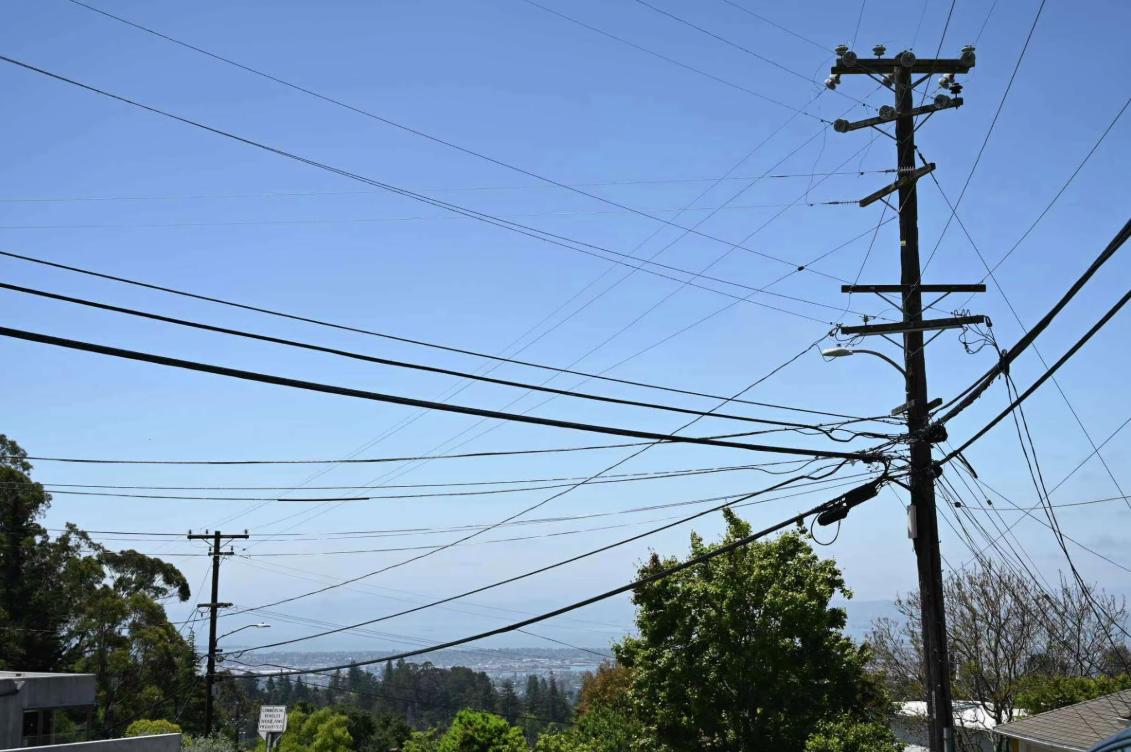
Aerial Fiber Optic Cable Structure
The exact structure depends on the cable type, fiber count, span length, and installation environment.
However, most aerial fiber optic cables include several basic components.
1. Optical Fiber
The optical fiber is the core transmission element.
Common fiber types include:
- G.652D
- G.657A1
- G.657A2
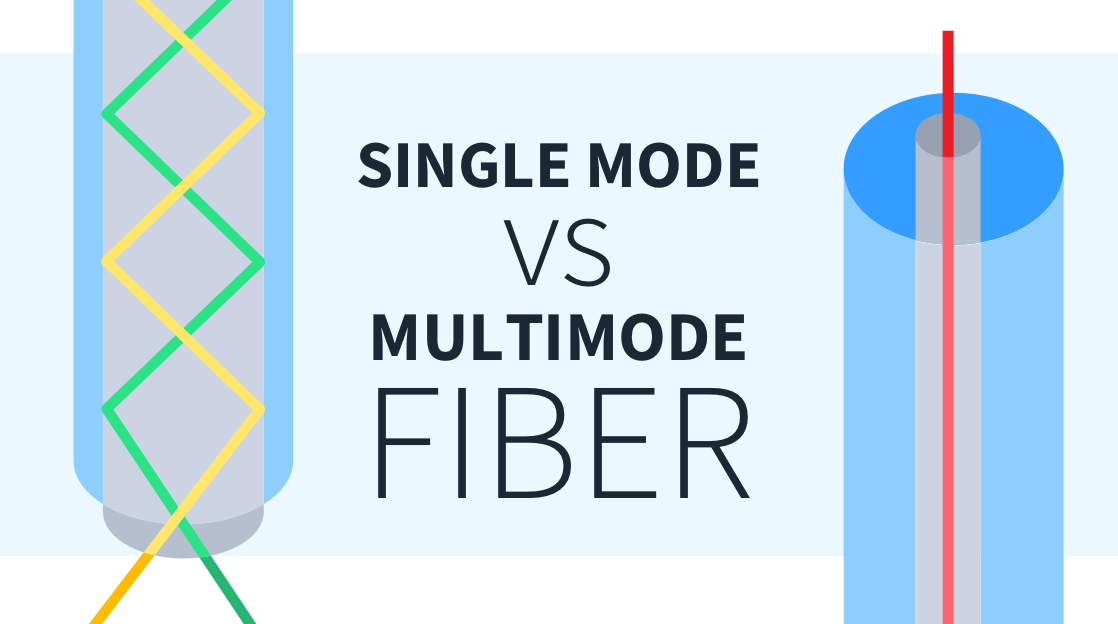
- Single-mode fiber
- Multimode fiber for specific short-distance applications
For long-distance outdoor communication networks, G.652D single-mode fiber is commonly selected.
For FTTH networks requiring frequent bending, G.657A1 or G.657A2 fiber may be preferred.
2. Fiber Buffer or Loose Tube
The fiber may be placed inside loose tubes or other protective structures.
Loose-tube designs provide additional protection against:
- Moisture
- Temperature changes
- Mechanical stress
- Fiber strain
In many outdoor aerial cables, fibers are placed inside loose tubes filled with water-blocking material.
3. Central Strength Member
A central strength member helps maintain the mechanical stability of the cable.
Common materials include:
- FRP
- GFRP
- Steel
- Other reinforced materials
FRP is particularly useful in all-dielectric cables because it provides mechanical strength without conducting electricity.
4. Water-Blocking Materials
Outdoor aerial cables may incorporate water-blocking yarn, gel, tape, or other moisture-resistant materials.
These materials help prevent water from migrating along the cable.
This is especially important in regions with:
- Heavy rainfall
- Tropical climates
- High humidity
- Seasonal storms
5. Outer Sheath
The outer sheath protects the internal components from the surrounding environment.
Common sheath materials include:
- PE
- HDPE
- MDPE
- LSZH compounds for selected applications
For aerial outdoor applications, the sheath should provide good resistance to UV radiation, moisture, temperature changes, and mechanical damage.
Main Types of Aerial Fiber Optic Cable
There is no single aerial fiber optic cable design suitable for every installation.
The most common types include ADSS, OPGW, Figure 8 fiber cable, and messenger-supported aerial fiber cable.
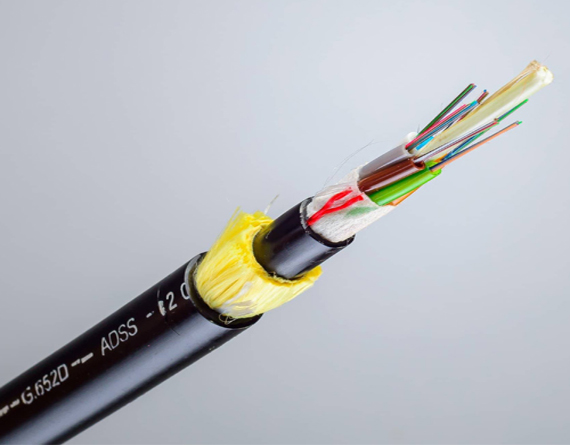
1. ADSS Cable
ADSS stands for All-Dielectric Self-Supporting.
ADSS cable is one of the most widely used aerial fiber optic cable designs.
As the name suggests, it does not require a separate metallic messenger wire to support the cable. It uses non-metallic strength members to withstand mechanical loads.
This makes ADSS cable particularly suitable for installation on:
- Power utility poles
- Transmission towers
- Distribution poles
- Railway communication routes
- Telecommunications infrastructure
Advantages of ADSS Cable
ADSS cable offers several important advantages:
- No metallic messenger required
- Lightweight construction
- Electrical insulation
- Suitable for power corridors
- Good mechanical strength
- Easy aerial installation
- Available in different span lengths
- Suitable for high-voltage environments when properly engineered
ADSS is often selected when fiber optic communication infrastructure needs to be installed close to electrical power lines.
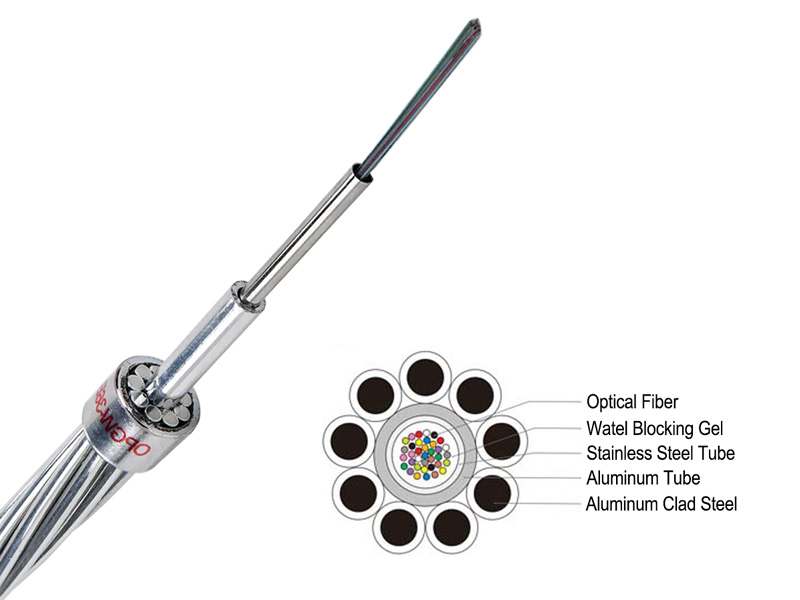
2. OPGW Cable
OPGW stands for Optical Ground Wire.
OPGW is designed specifically for electrical power transmission systems.
Unlike ADSS, OPGW combines two functions:
- Ground wire
- Fiber optic communication cable
The optical fibers are incorporated into the cable structure while the cable performs the electrical grounding and lightning protection function of the overhead transmission line.
Typical OPGW Applications
OPGW is widely used in:
- High-voltage transmission lines
- Power grid communication
- Smart grid systems
- Utility monitoring
- SCADA communication
- Power system protection
The major difference between ADSS and OPGW is that ADSS is a separate self-supporting communication cable, while OPGW is integrated into the transmission-line grounding system.
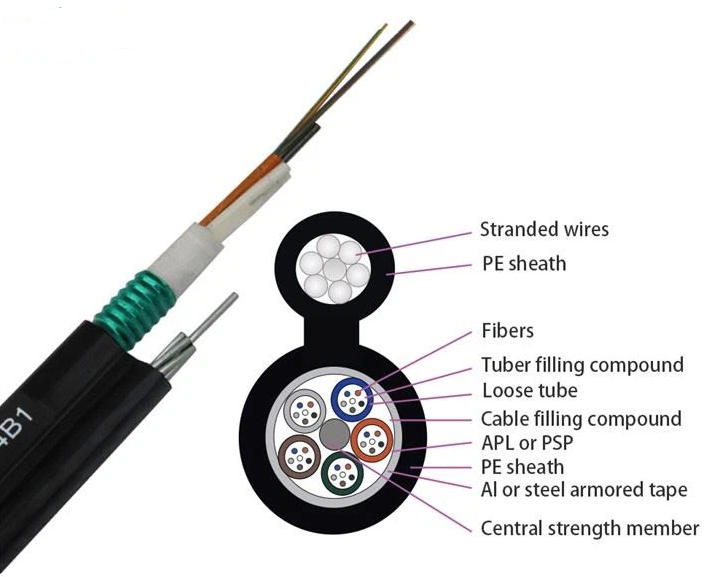
3. Figure 8 Fiber Optic Cable
Figure 8 fiber optic cable is another common aerial cable design.
It typically consists of:
- Optical fiber cable section
- Supporting messenger wire
- Connecting web
The cross-sectional appearance resembles the number 8, which gives the cable its name.
The integrated messenger wire provides mechanical support, making the cable suitable for overhead installation.
Typical Applications
Figure 8 cable is commonly used for:
- Access networks
- FTTH networks
- Rural broadband
- Distribution networks
- Pole-to-pole installations
- Short and medium aerial spans
It is often an economical choice for telecom networks where an existing supporting structure is available or where an integrated messenger is preferred.
4. Messenger-Supported Aerial Fiber Cable
Some aerial fiber optic cables are installed using a separate messenger wire.
The optical cable is attached to the messenger using suitable clamps, lashing wire, or other hardware.
This design provides flexibility because the messenger system can be engineered according to the required span and mechanical load.
ADSS vs OPGW vs Figure 8 Fiber Optic Cable
Choosing between aerial cable designs depends primarily on the infrastructure and installation environment.
| Feature | ADSS | OPGW | Figure 8 |
|---|---|---|---|
| Full Name | All-Dielectric Self-Supporting | Optical Ground Wire | Figure 8 Fiber Cable |
| Messenger | No | Integrated metallic structure | Usually integrated |
| Dielectric | Yes | No | Depends on design |
| Power-Line Application | Excellent | Excellent | Limited |
| Telecom Pole Networks | Excellent | Not normally used | Excellent |
| Electrical Conductivity | Non-conductive | Conductive | Depends on design |
| Installation | Poles/towers | Transmission towers | Utility poles |
| Main Advantage | Self-supporting and dielectric | Communication + grounding | Simple and economical |
| Typical Use | Power and telecom | Power transmission | Access and distribution |
Which One Should You Choose?
Choose ADSS when you need a non-metallic, self-supporting cable for aerial installation.
Choose OPGW when the cable must also function as the overhead ground wire of a power transmission line.
Choose Figure 8 cable when an integrated messenger-supported design is suitable for a telecommunications or access network.
Advantages of Aerial Fiber Optic Cable
Aerial installation offers several advantages over underground deployment.
1. Lower Installation Cost
One of the biggest advantages is the potential reduction in civil construction costs.
Underground fiber deployment may require:
- Excavation
- Trenching
- Duct installation
- Road restoration
- Traffic management
- Permits
- Specialized construction equipment
Aerial installation can often use existing utility poles or other overhead infrastructure.
This can significantly reduce deployment time and construction complexity.
2. Faster Deployment
Aerial fiber networks can generally be installed faster than underground systems because extensive excavation is not required.
This is especially useful for:
- Rural broadband projects
- Emergency network expansion
- Temporary communication infrastructure
- Rapid FTTH deployment
- Developing regions
3. Easy Maintenance
Aerial cables are visible and accessible.
When a problem occurs, technicians can often inspect:
- Cable condition
- Pole attachments
- Sag
- Hardware
- Splices
- Connectors
This can simplify fault identification and maintenance.
4. Suitable for Difficult Terrain
Aerial fiber optic cable can be especially useful in locations where underground construction is difficult.
Examples include:
- Rocky terrain
- Mountainous regions
- Wetlands
- Forest areas
- Rural areas
- Areas with high construction costs
5. High Fiber Capacity
Aerial cables can be manufactured with different fiber counts.
Typical configurations may include:
- 12 fibers
- 24 fibers
- 48 fibers
- 72 fibers
- 96 fibers
- 144 fibers
- 288 fibers
- Higher fiber counts for backbone networks
The correct fiber count should be selected according to current requirements and future network expansion.
Applications of Aerial Fiber Optic Cable
Aerial fiber optic cable is used in many communication and utility infrastructure projects.
Telecommunications Networks
Telecom operators use aerial fiber cables to connect:
- Central offices
- Distribution points
- Network cabinets
- Cell sites
- Business customers
- Residential areas
FTTH Networks
Aerial deployment is common in fiber-to-the-home networks, especially in suburban and rural areas.
Aerial fiber can provide broadband connectivity without requiring extensive underground construction.
Common applications include:
- Pole-to-home connections
- Pole-to-pole distribution
- Fiber access networks
- Rural FTTH
- FTTB and FTTC networks
5G Backhaul
5G networks require high-capacity fiber infrastructure.
Aerial fiber optic cables can connect:
- 5G base stations
- Small cells
- Edge facilities
- Aggregation points
- Data centers
The cable design must be selected according to span length, environmental conditions, and available infrastructure.
Rural Broadband
Aerial fiber is particularly useful for rural broadband deployment.
In areas where population density is low, the cost of underground construction can be relatively high compared with the number of customers served.
Using existing utility poles can make aerial deployment more economically attractive.
Power Utility Communication
Utility companies use fiber optic cables for:
- SCADA systems
- Smart grids
- Substation communication
- Protection systems
- Video monitoring
- Voice communication
- Network management
ADSS and OPGW are especially common in power-related applications.
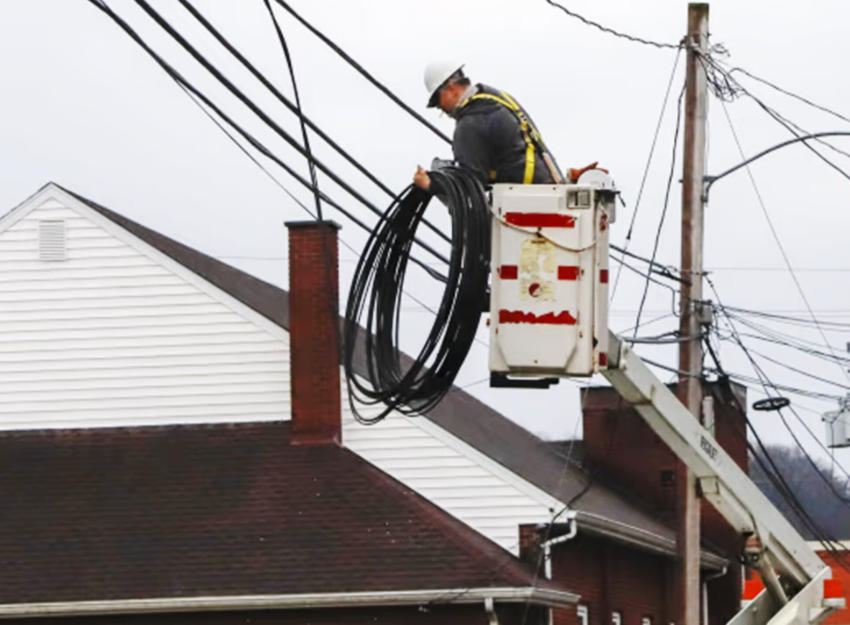
Aerial Fiber Optic Cable Installation
Proper installation is essential for achieving reliable long-term performance.
A typical aerial fiber installation includes the following steps.
Step 1: Route Survey
Before installation, engineers should inspect the route.
Important parameters include:
- Pole locations
- Pole height
- Span length
- Existing cables
- Road crossings
- Building clearance
- Power-line proximity
- Wind conditions
- Ice loading
- Maximum and minimum temperatures
Step 2: Cable Selection
The cable should be selected based on the actual environmental and mechanical conditions.
Important parameters include:
- Fiber count
- Fiber type
- Maximum span
- Rated tensile strength
- Cable diameter
- Cable weight
- Sag
- Wind loading
- Ice loading
- Operating temperature
- UV resistance
Step 3: Install Cable Hardware
Appropriate hardware may include:
- Suspension clamps
- Dead-end clamps
- Anchoring hardware
- Pole brackets
- Vibration dampers
- Downlead clamps
- Grounding accessories where applicable
Hardware selection should match the cable design and pole structure.
Step 4: Cable Stringing
The cable is pulled or strung along the planned route.
During installation, excessive pulling tension must be avoided.
The cable manufacturer’s recommended:
- Maximum pulling tension
- Minimum bending radius
- Installation temperature
- Handling method
should always be followed.
Step 5: Control Sag
Aerial fiber cables cannot simply be installed as tightly as possible.
Proper sag is necessary because the cable must accommodate:
- Temperature changes
- Wind
- Ice
- Mechanical loading
Insufficient sag can increase mechanical stress, while excessive sag can create clearance and safety problems.
Step 6: Fiber Splicing and Testing
After installation, fibers are spliced and tested.
Typical tests include:
- Optical loss testing
- OTDR testing
- Continuity testing
- End-face inspection
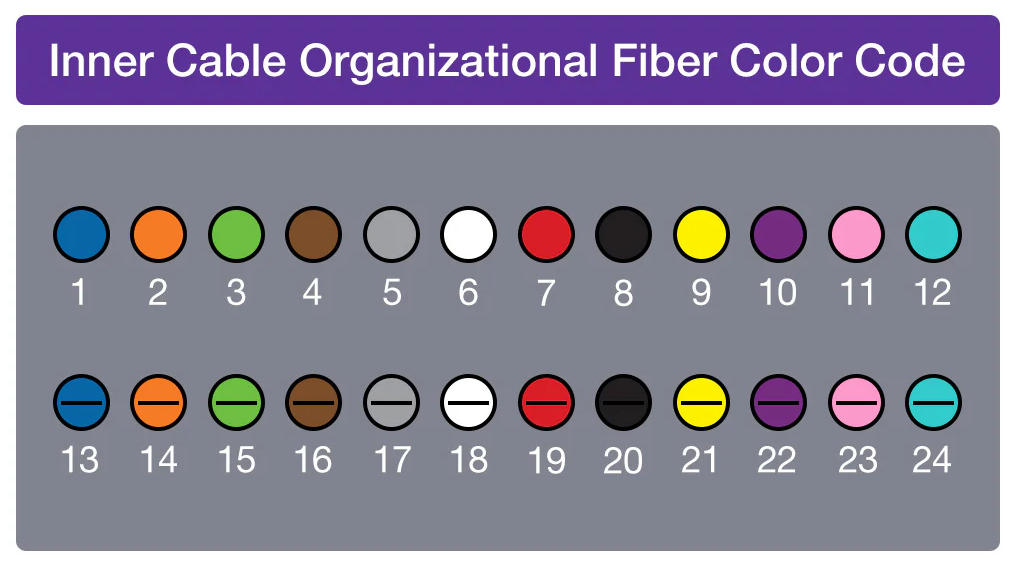
- Fiber identification
Testing helps confirm that the installed cable meets the required optical performance.
What Factors Affect Aerial Fiber Cable Price?
The price of aerial fiber optic cable varies significantly depending on specifications and project conditions.
Key factors include:
Fiber Count
A 12-core cable generally costs less per meter than a high-capacity 144-core or 288-core cable.
Cable Structure
ADSS, OPGW, Figure 8, and messenger-supported cables have different material and manufacturing costs.
Span Length
Long-span ADSS cable requires stronger mechanical construction, which can increase the cable cost.
Fiber Type
Different fiber grades and specifications can influence the final price.
Sheath Material
PE, HDPE, LSZH, and specialized sheath compounds may have different costs.
Order Quantity
Large-volume orders typically have a lower unit price than small orders.
Customization
Custom cable construction, printing, packaging, fiber counts, and special mechanical requirements can affect pricing.
For this reason, buyers should request a quotation based on the complete technical specification, rather than comparing only the price per kilometer.
How to Choose the Right Aerial Fiber Optic Cable?
When purchasing aerial fiber cable, consider the following factors.
1. Determine the Installation Environment
First identify whether the cable will be installed:
- On telecom poles
- Near power lines
- On transmission towers
- Across roads
- In rural areas
- In coastal environments
- In high-wind regions
The environment determines the appropriate cable structure.
2. Calculate Span Length
Span length is one of the most important factors.
A short-span network may use a lighter cable design, while long spans require stronger mechanical performance.
For ADSS cables, engineers should consider the required span class and environmental loading.
3. Select Fiber Count
Choose enough fibers for both current network requirements and future expansion.
For example:
- 12–24 cores: Small access networks
- 24–48 cores: Distribution networks
- 48–96 cores: Larger access or aggregation networks
- 96–144+ cores: Backbone and high-capacity networks
These are general planning examples; actual fiber count should be determined by the network design.
4. Select Fiber Type
For conventional long-distance outdoor communication, G.652D is widely used.
For FTTH applications requiring better bending performance, G.657A1 or G.657A2 may be more appropriate.
5. Check Mechanical Requirements
The cable should be evaluated for:
- Rated tensile strength
- Maximum span
- Wind load
- Ice load
- Sag-tension characteristics
- Minimum bending radius
These specifications are especially important for ADSS installations.
Aerial Fiber Optic Cable vs Underground Fiber Optic Cable
Aerial and underground cables are both important solutions for outdoor fiber networks.
| Factor | Aerial Fiber Cable | Underground Fiber Cable |
|---|---|---|
| Installation | Overhead | Underground |
| Civil Work | Usually lower | Usually higher |
| Deployment Speed | Fast | Slower |
| Maintenance Access | Easier | More difficult |
| Environmental Exposure | Higher | Lower |
| Pole Infrastructure | Required | Not required |
| Construction Cost | Often lower | Often higher |
| Suitable Areas | Rural, suburban, utility routes | Urban, high-security areas |
Which Is Better?
Neither solution is universally better.
Aerial fiber optic cable is often preferred when low deployment cost, rapid installation, and existing pole infrastructure are important.
Underground fiber optic cable may be preferred where aesthetics, physical protection, urban regulations, or right-of-way requirements make aerial deployment unsuitable.
In many modern networks, both methods are used together.
Common Standards and Specifications
The exact standards required depend on the country, operator, and project.
Depending on the cable type, specifications may address:
- Optical fiber performance
- Mechanical strength
- Environmental resistance
- Tensile performance
- Temperature cycling
- Water penetration
- UV resistance
- Aging performance
For ADSS cable, engineers may also evaluate span-specific mechanical characteristics and electrical environment requirements.
A professional cable manufacturer should be able to provide technical datasheets, test reports, drawings, and customized specifications for project evaluation.
Why Use Aerial Fiber Optic Cable for Network Expansion?
The biggest reason to choose aerial fiber is deployment efficiency.
When suitable poles already exist, aerial construction can reduce the amount of civil engineering required.
This provides several practical benefits:
Lower infrastructure cost → faster deployment → easier maintenance → flexible network expansion.
For operators expanding broadband into rural or suburban areas, these advantages can be particularly important.
Aerial fiber also provides a practical solution for upgrading existing copper or low-capacity communication infrastructure to modern fiber networks.
Aerial Fiber Optic Cable for Different Climates
Environmental conditions should always be considered when selecting an aerial cable.
Hot and Tropical Regions
The cable should have good:
- UV resistance
- Temperature stability
- Moisture resistance
- Aging resistance
This is important in tropical regions with strong sunlight and heavy rainfall.
Cold Regions
Engineers should consider:
- Low-temperature performance
- Ice loading
- Temperature cycling
- Cable contraction
High-Wind Areas
Mechanical design becomes especially important.
The cable should be evaluated for:
- Wind pressure
- Maximum span
- Sag
- Tensile strength
- Pole loading
Coastal Areas
High humidity and salt exposure may require appropriate materials and hardware to improve long-term durability.
Frequently Asked Questions About Aerial Fiber Optic Cable
What is aerial fiber optic cable?
Aerial fiber optic cable is an outdoor optical fiber cable designed to be installed above the ground on poles, towers, messenger wires, or other overhead structures.
What is the most common aerial fiber optic cable?
ADSS cable is one of the most widely used aerial fiber optic cable designs, particularly for telecommunications and utility networks.
Is ADSS cable an aerial fiber optic cable?
Yes. ADSS is a specialized type of aerial fiber optic cable. It is all-dielectric and self-supporting, meaning it does not require a separate metallic messenger wire.
What is the difference between aerial and underground fiber optic cable?
Aerial fiber is installed overhead, while underground fiber is installed in ducts, conduits, or directly buried. Aerial installation is often faster and less expensive, while underground installation generally provides better physical protection and lower visual impact.
Can aerial fiber optic cable be used near power lines?
Yes. Specialized cables such as ADSS are designed for aerial installation near electrical infrastructure. However, the cable design, placement, electrical environment, clearances, and installation method must be engineered appropriately.
How long does aerial fiber optic cable last?
The service life depends on cable design, materials, installation quality, environmental exposure, and maintenance. A properly designed and installed outdoor aerial cable can provide reliable network service for many years.
What fiber count is available for aerial fiber cable?
Aerial cables can be manufactured in a wide range of fiber counts, including 12, 24, 48, 72, 96, 144, 288, and other customized configurations.
What is Figure 8 fiber optic cable?
Figure 8 fiber optic cable is an aerial cable that combines an optical fiber cable section with an integrated messenger/support wire. Its cross-sectional shape resembles the number eight.
Is aerial fiber cable waterproof?
Outdoor aerial fiber cables are generally designed with moisture-resistant or water-blocking structures. However, the exact water-blocking performance depends on the cable construction and specification.
How is aerial fiber optic cable installed?
Aerial fiber cable is normally installed using suspension clamps, dead-end clamps, brackets, messenger systems, or other suitable hardware. Installation requires careful control of pulling tension, bending radius, sag, clearance, and mechanical loading.
How much does aerial fiber optic cable cost?
There is no single fixed price. Aerial fiber cable cost depends on fiber count, cable structure, span length, fiber type, sheath material, mechanical requirements, order quantity, and customization.
Conclusion: Is Aerial Fiber Optic Cable Right for Your Project?
Aerial fiber optic cable is a cost-effective and practical solution for deploying high-speed fiber networks above ground. It can significantly reduce civil construction requirements while enabling rapid network deployment and relatively easy maintenance.
Among the available designs, ADSS cable is a strong choice for self-supporting, non-metallic aerial installations. OPGW cable is designed for power transmission lines where optical communication and grounding functions are combined. Figure 8 fiber optic cable is widely used for telecom access and distribution networks where an integrated messenger structure is preferred.
The right aerial fiber optic cable should not be selected based on price alone. Buyers should evaluate fiber count, fiber type, span length, tensile strength, wind and ice loading, installation environment, UV resistance, cable weight, sag characteristics, and applicable standards.
For telecommunications operators, utility companies, broadband contractors, and network integrators, choosing the correct aerial cable design can improve installation efficiency, reduce infrastructure costs, and support reliable long-term fiber network performance.
If you are sourcing aerial fiber optic cable for a specific project, provide the fiber count, required span, fiber type, installation environment, cable length, and application. A professional manufacturer can then recommend the appropriate ADSS, Figure 8, OPGW, or other aerial fiber cable construction and provide a project-specific quotation and technical datasheet.
Quick Reference: Aerial Fiber Optic Cable
| Item | Description |
|---|---|
| Product | Aerial Fiber Optic Cable |
| Installation | Overhead / Aerial |
| Main Applications | Telecom, FTTH, 5G, Utility, Broadband |
| Common Types | ADSS, OPGW, Figure 8, Messenger-Supported |
| Fiber Type | G.652D, G.657A1, G.657A2 and others |
| Fiber Count | 12–288+ cores |
| Support | Self-supporting or messenger-supported |
| Sheath | PE / HDPE / LSZH and customized options |
| Main Requirements | Tensile strength, span, wind, ice, UV resistance |
| Key Benefit | Fast and cost-effective outdoor deployment |