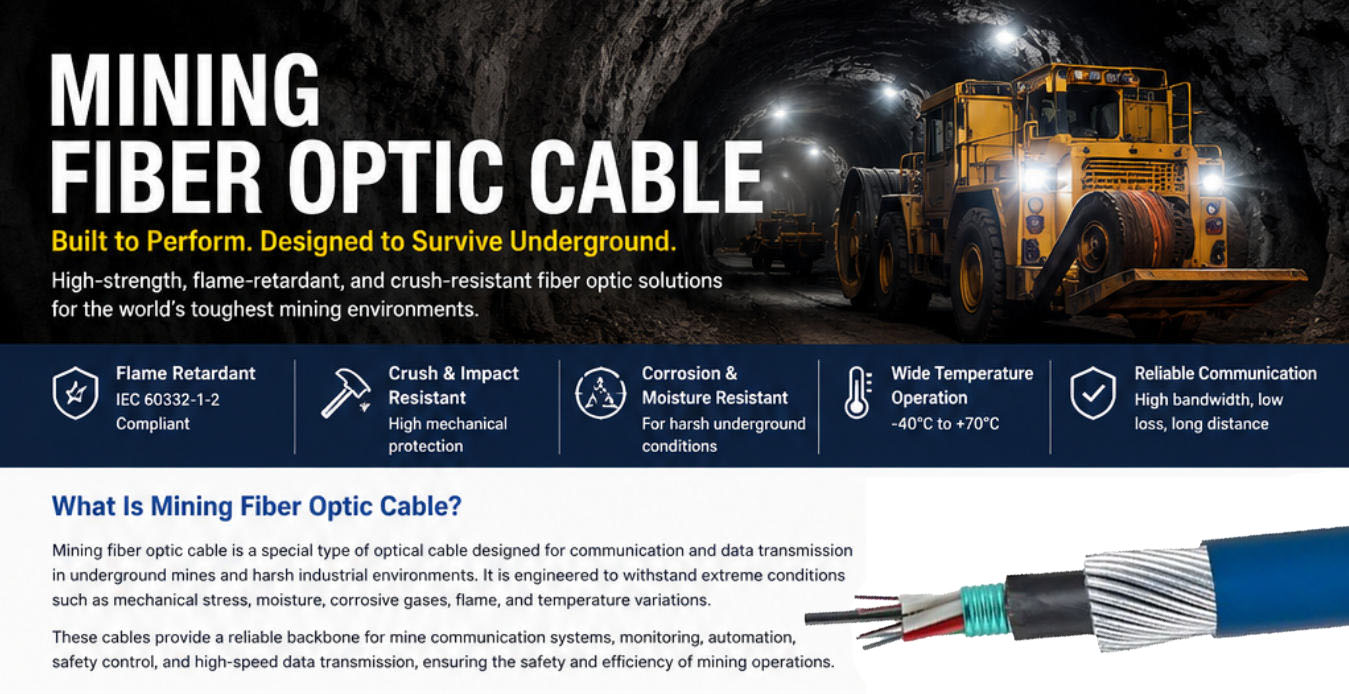
Mining fiber optic cable is a specially designed fiber optic cable used to provide high-speed, reliable, and interference-resistant communication networks in mining environments.
Unlike ordinary fiber optic cables, mining cables are designed to withstand demanding conditions such as mechanical impact, vibration, moisture, dust, temperature variations, tension, crushing, and potential fire hazards.
A mining fiber optic cable typically contains optical fibers protected by one or more layers of strength members, water-blocking materials, armor or protective components, and an outer jacket. Depending on the application, the cable may also use a flame retardant, low-smoke, halogen-free, or other specialized sheath material.
Mining fiber optic cables can be installed in:
- Underground mines
- Mine shafts
- Tunnels
- Mining galleries
- Coal mines
- Metal and mineral mines
- Open-pit mining operations
- Processing plants
- Mine transportation systems
- Conveyor systems
- Mining control rooms
- Industrial automation networks
The primary purpose is to transmit data, voice, video, monitoring signals, and control information over long distances with high reliability.
Simple Definition
Mining fiber optic cable is a ruggedized optical communication cable engineered for the harsh physical, environmental, and safety requirements of mining applications.
This definition is particularly important for underground applications because cable failure can interrupt communication, monitoring, automation, and emergency response systems.
Why Is Fiber Optic Cable Important for Mining?
Modern mines generate enormous amounts of data.
Mining companies increasingly use:
- CCTV surveillance
- Industrial Ethernet
- Remote equipment monitoring
- Autonomous vehicles
- Mine ventilation monitoring
- Gas detection systems
- Personnel tracking
- Environmental monitoring
- Machine automation
- Voice communication
- Video communication
- SCADA systems
- Industrial IoT
- Real-time production management
All these systems require reliable data transmission.
Copper communication cables can be affected by electromagnetic interference and electrical limitations. Fiber optic cable uses light instead of electrical current to transmit information, making it highly suitable for electrically noisy industrial environments.
A fiber optic network can provide high bandwidth over long distances while remaining lightweight and electrically non-conductive.
This makes fiber particularly valuable in large mining operations where communication networks may extend several kilometers underground or between surface facilities.
What Makes Mining Fiber Optic Cable Different?
A standard outdoor fiber optic cable may be suitable for telecommunications networks, but mining environments can introduce much greater mechanical and safety challenges.
A mining cable may need to withstand:
- Crushing
- Impact
- Pulling tension
- Bending
- Abrasion
- Vibration
- Water penetration
- Mud and dust
- Temperature changes
- Chemical exposure
- Equipment movement
- Fire risks
Therefore, mining fiber optic cable is generally designed with additional mechanical and environmental protection.
The exact construction depends on the mine, installation method, cable specification, applicable standards, and customer requirements.
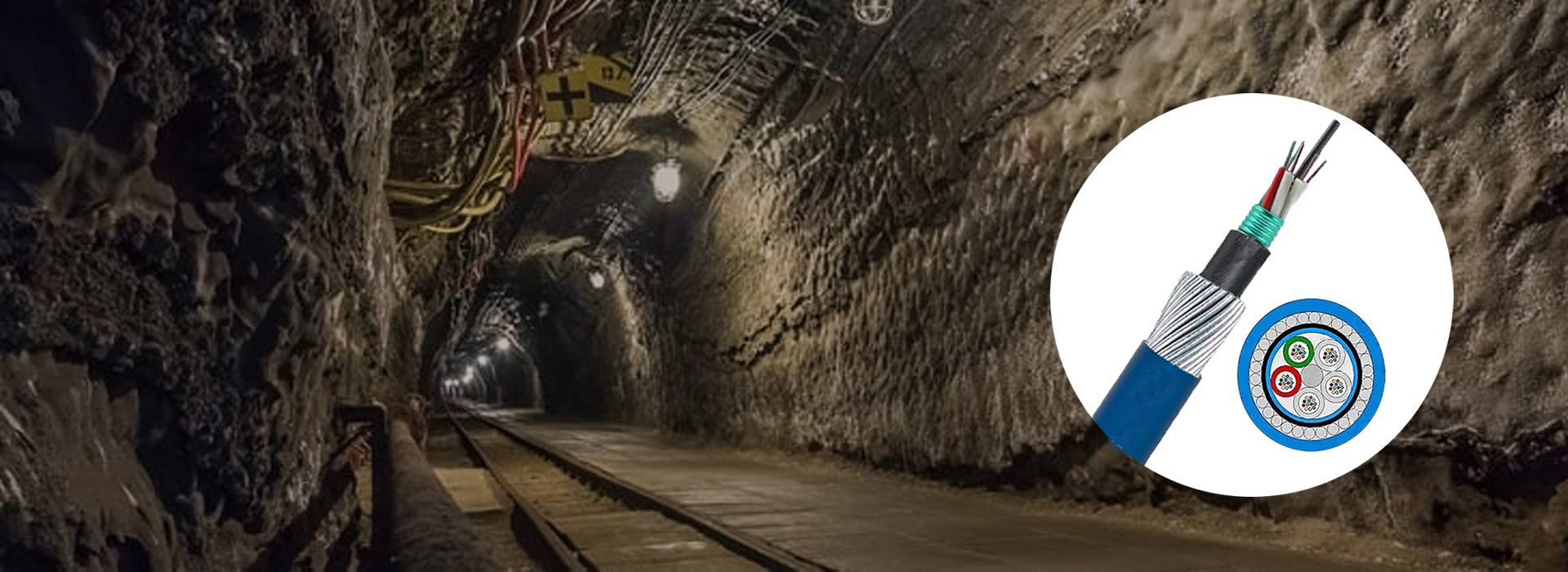
Mining Fiber Optic Cable Structure
The construction of a mining fiber optic cable varies by application, but a typical design may include several important layers.
1. Optical Fiber
The optical fiber is the core transmission medium.
Common fiber options include:
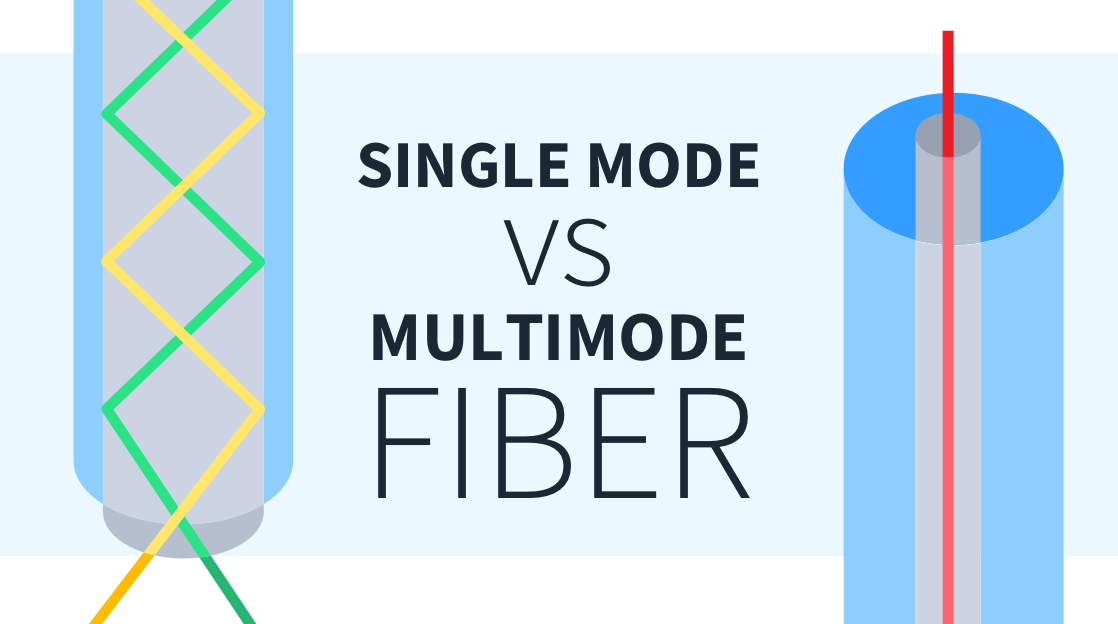
- Single-mode fiber
- Multimode fiber
For long-distance underground communication networks, single-mode fiber is commonly preferred because it supports high bandwidth and long transmission distances.
Common single-mode fiber categories may include G.652D and bend-insensitive G.657 fiber, depending on the network architecture.
2. Fiber Protection
The optical fibers need protection against mechanical stress and environmental conditions.
Fibers may be placed inside:
- Loose tubes
- Tight-buffered structures
- Central tubes
- Multi-tube structures
Loose-tube designs are widely used in outdoor and industrial fiber optic cables because they can provide additional protection from environmental stress.
3. Strength Members
Strength members help the cable withstand tensile forces during installation and operation.
Typical materials include:
- FRP
- Aramid yarn
- Steel strength members
- Other reinforced materials
FRP, or Fiber Reinforced Plastic, is particularly useful when electrical non-conductivity is required.
4. Water Blocking
Water penetration can seriously affect long-term cable reliability.
Mining environments can contain:
- Groundwater
- Condensation
- Wet tunnels
- Mud
- Water spray
- Drainage systems
Therefore, mining cable designs may incorporate water-blocking yarn, water-blocking tape, gel, or other moisture-resistant structures.
The specific design should be selected according to the expected environmental conditions.
5. Armor or Mechanical Protection
Where cables may experience impact, crushing, rodents, equipment contact, or other mechanical hazards, additional protection may be required.
Possible protection systems include:
- Steel tape armor
- Steel wire armor
- Non-metallic armor
- Reinforced outer jackets
The choice depends on the installation environment.
For example, a fixed cable installed in a protected tunnel may require a different structure from a cable exposed to mining machinery or severe mechanical stress.
6. Outer Jacket
The outer jacket protects the cable from the surrounding environment.
Depending on the application, the jacket may be manufactured from specialized materials such as:
- HDPE
- MDPE
- LSZH compounds
- Flame-retardant compounds
- Industrial-grade polymer materials
For underground mining applications, flame retardant mining cable is an important consideration.
What Is an Underground Mining Cable?
An underground mining cable is a communication or power cable specifically designed for installation and operation in underground mining environments.
When referring specifically to fiber optics, an underground mining fiber optic cable is engineered to operate in conditions where cables may encounter:
- Narrow tunnels
- Sharp rocks
- Heavy equipment
- High humidity
- Water
- Dust
- Vibration
- Mechanical impact
- Difficult installation routes
- Limited maintenance access
Underground mining networks often require a combination of high data capacity and strong mechanical protection.
The cable may be installed along:
- Mine shafts
- Tunnel walls
- Roofs
- Cable trays
- Service passages
- Conveyor routes
- Equipment areas
The correct installation method depends on mine design and local safety requirements.
Why Flame Retardant Mining Cable Matters
Fire safety is one of the most important considerations in underground mining.
An underground mine may have limited ventilation and restricted evacuation routes. A cable fire can therefore create additional risks through flame propagation and smoke generation.
For this reason, flame retardant mining cable is often specified for appropriate underground applications.
A flame-retardant cable is designed to reduce the ability of fire to propagate along the cable under specified test conditions.
Depending on the required specification, customers may also consider:
- Low smoke
- Halogen-free materials
- Reduced flame propagation
- Toxicity characteristics
- Fire resistance
- Mechanical protection
However, these terms are not interchangeable.
Flame Retardant vs Fire Resistant
Flame retardant generally refers to a cable’s ability to resist or limit flame propagation.
Fire resistant generally refers to maintaining specified functionality under defined fire conditions for a specified period.
Therefore, buyers should not assume that every flame-retardant mining cable is automatically fire-resistant.
The required performance should always be confirmed against the applicable project specification and test standard.
Mining Fiber Optic Cable for South Africa Mining
South Africa mining is an important application market for rugged industrial and underground communication systems.
South Africa has extensive mining activities involving minerals such as:
- Gold
- Platinum
- Coal
- Iron ore
- Manganese
- Chrome
- Diamonds
- Other mineral resources
Many mining operations involve large-scale infrastructure, deep underground workings, processing facilities, and extensive communication networks.
This creates demand for reliable communication systems capable of operating in harsh environments.
For South Africa mining projects, fiber optic cable selection may need to consider:
- Underground installation conditions
- Mechanical protection
- Fire safety
- Flame retardancy
- Water resistance
- Temperature
- Cable routing
- Shaft installation
- Long-distance transmission
- Local project specifications
- Applicable South African and international standards
A supplier should not simply recommend a generic outdoor fiber cable based on fiber count. The complete installation environment needs to be evaluated.
Why Fiber Optics Are Valuable in South African Mines
Large mining sites can cover significant distances.
Fiber optic cable can provide:
- Long-distance transmission
- High bandwidth
- Immunity to electromagnetic interference
- Electrical isolation
- Lightweight construction
- High network capacity
- Support for video and industrial data
- Compatibility with modern Ethernet systems
This makes fiber an effective backbone technology for many modern mining communication networks.
Main Applications of Mining Fiber Optic Cable
Mining fiber optic cable can support a wide range of communication and monitoring systems.
1. Underground Communication Networks
Fiber optic cables can connect underground working areas with surface communication rooms.
They may serve as the backbone for:
- Data networks
- Voice systems
- Video systems
- Monitoring systems
2. CCTV and Video Surveillance
Mining companies increasingly deploy cameras to monitor:
- Tunnel entrances
- Conveyor systems
- Equipment
- Loading areas
- Processing facilities
- Underground working zones
High-definition video generates significant data traffic, making fiber optic networks particularly suitable.
3. SCADA Systems
SCADA systems allow operators to monitor and control industrial processes.
Fiber optic networks can connect:
- Sensors
- PLCs
- Control systems
- Remote terminals
- Central control rooms
Reliable communication is essential because network interruptions can affect monitoring and operational efficiency.
4. Industrial Ethernet
Modern mines increasingly use Ethernet-based communication.
Mining fiber optic cables can support:
- Gigabit Ethernet
- 10 Gigabit Ethernet
- Industrial Ethernet
- Data center connections
- Network switches
- Remote equipment
The actual achievable transmission rate depends on the fiber type, transceivers, network equipment, and system design.
5. Mine Automation
Automation is becoming increasingly important in modern mining.
Fiber optic networks can support communication for:
- Automated drilling
- Remote-controlled equipment
- Autonomous vehicles
- Conveyor monitoring
- Production systems
- Remote machinery
A stable high-bandwidth network provides the communication foundation required by these systems.
6. Environmental Monitoring
Mines may monitor:
- Temperature
- Humidity
- Gas concentration
- Air quality
- Water levels
- Ventilation
- Structural conditions
Fiber optic networks can transport information from distributed monitoring points to centralized control systems.
7. Personnel Tracking
Modern mining operations may use communication and positioning systems to monitor personnel locations.
Fiber optic backbones can connect tracking infrastructure to central systems.
This can improve operational visibility and support emergency response procedures.
Mining Fiber Optic Cable vs Standard Outdoor Fiber Cable
The two cable categories may appear similar, but their design priorities can be different.
| Feature | Mining Fiber Optic Cable | Standard Outdoor Fiber Cable |
|---|---|---|
| Main application | Mining and industrial environments | Telecom and outdoor networks |
| Mechanical protection | Often enhanced | Application-dependent |
| Fire requirements | Often more demanding | Depends on installation |
| Flame retardancy | Frequently specified | Depends on cable type |
| Moisture protection | Important | Common |
| Impact resistance | Often important | Moderate to high depending on design |
| EMI immunity | Excellent | Excellent |
| Underground use | Designed for appropriate mining environments | Only when suitable for the environment |
| Industrial automation | Excellent | Possible |
| Mining machinery environment | Specialized designs available | Not always suitable |
The key point is that not every outdoor fiber optic cable should be automatically classified as a mining cable.
Mining projects should specify the required mechanical, environmental, and fire-performance characteristics before selecting a cable.
Mining Cable Fiber Count: How Many Fibers Are Needed?
Mining fiber optic cables are available in different fiber counts.
Typical configurations may include:
- 2 fibers
- 4 fibers
- 6 fibers
- 8 fibers
- 12 fibers
- 24 fibers
- 48 fibers
- 72 fibers
- 96 fibers
- Higher counts for backbone networks
The correct fiber count depends on the network.
For example, a small monitoring link may require only a few fibers, while a mine-wide backbone may need many fibers for:
- Current network traffic
- Redundancy
- Future expansion
- Separate systems
- Spare capacity
Why Spare Fibers Matter
It is often useful to include spare fibers in a mining network.
Mining infrastructure can remain operational for many years, while communication requirements can increase over time.
Installing additional fiber capacity during the original construction may be more practical than replacing the cable later.
Single-Mode vs Multimode Fiber for Mining
Single-Mode Fiber
Single-mode fiber is generally suitable for long-distance communication.
Advantages include:
- Long transmission distance
- High bandwidth
- Low attenuation
- Excellent backbone performance
- Suitable for large mining sites
It is often a strong choice for mine-wide backbone networks.
Multimode Fiber
Multimode fiber can be suitable for shorter distances, particularly within buildings, control rooms, equipment rooms, or localized networks.
The choice should be based on:
- Transmission distance
- Network equipment
- Required bandwidth
- Existing infrastructure
- Future expansion
For long underground routes, single-mode fiber is commonly preferred.
Key Advantages of Mining Fiber Optic Cable
1. High Bandwidth
Fiber optic cable can carry large volumes of data.
This makes it suitable for modern applications such as:
- HD video
- Industrial Ethernet
- Automation
- SCADA
- IoT
- Real-time monitoring
2. Long Transmission Distance
Fiber supports communication over much longer distances than many copper-based systems without requiring the same type of electrical signal regeneration.
This is valuable in large mines.
3. Electromagnetic Interference Immunity
Mining environments may contain powerful electrical equipment.
Motors, generators, transformers, welding equipment, and other machinery can create electromagnetic interference.
Optical fiber transmits information using light and is therefore inherently immune to electromagnetic interference.
4. Electrical Isolation
Fiber optic cable is non-conductive when constructed entirely with dielectric materials.
This can be beneficial in environments where electrical isolation is important.
However, armored or metallic cable constructions can change this characteristic, so the complete cable design must be checked.
5. Lightweight
Fiber optic cable can provide substantial communication capacity without the weight of equivalent copper cabling.
This can simplify long-distance installation.
6. High Reliability
A properly designed and installed mining cable can provide reliable communication in demanding environments.
The cable structure, installation method, connectors, splices, and network equipment all contribute to overall reliability.
How to Choose Mining Fiber Optic Cable
Selecting the correct cable requires more than choosing fiber count.
Consider the following factors.
1. Installation Environment
Determine whether the cable will be installed:
- Underground
- Above ground
- Inside shafts
- Along tunnels
- In cable trays
- Near moving equipment
- Near conveyors
- In wet areas
2. Mechanical Protection
Assess the risk of:
- Impact
- Crushing
- Pulling
- Abrasion
- Bending
- Vibration
Higher mechanical risks may require reinforced construction.
3. Fire Performance
For underground applications, determine whether the project requires:
- Flame retardant
- Low smoke
- Halogen-free
- Fire resistant
- Specific flame propagation performance
Do not select the cable based solely on the phrase “flame retardant.”
Always verify the actual test requirements.
4. Water Resistance
If groundwater or flooding is possible, select a suitable water-blocking structure.
5. Fiber Type
Select single-mode or multimode according to the transmission system.
For long-distance mine backbones, single-mode fiber is often preferred.
6. Fiber Count
Calculate the number of active connections and add appropriate spare capacity.
7. Cable Diameter and Weight
Cable diameter and weight affect:
- Installation
- Transportation
- Pulling tension
- Tray capacity
- Mounting hardware
8. Minimum Bend Radius
The cable’s minimum bend radius must be respected during installation.
Excessive bending can increase attenuation or damage the cable.
How Is Underground Mining Fiber Cable Installed?
Installation procedures vary according to the mine design.
Common installation methods include:
Cable Tray Installation
Cable trays provide an organized route along tunnels and industrial areas.
Wall or Roof Mounting
Cables can be fixed to tunnel walls or roof structures using suitable supports.
Shaft Installation
Vertical shafts require careful consideration of:
- Cable weight
- Tensile load
- Fixing points
- Vertical drop length
- Dynamic movement
Direct Routing
In some locations, cable may be routed through dedicated protective systems or conduits.
Regardless of the installation method, installers should follow the cable manufacturer’s pulling tension, bend radius, temperature, and handling requirements.
Common Problems with Mining Fiber Optic Cable
Even a high-quality cable can fail if installation is poor.
Common problems include:
Excessive Pulling Tension
Applying too much pulling force can damage the fiber or cable structure.
Excessive Bending
Sharp bends can cause optical loss and mechanical damage.
Poor Cable Fixing
Insufficient support can result in sagging, vibration, or mechanical stress.
Water Ingress
Improper sealing can allow water to enter cable systems.
Incorrect Connectors
Poor-quality connectors or dirty end faces can cause high insertion loss.
Insufficient Fire Performance
Using a general-purpose cable in an environment requiring specialized flame performance can create compliance and safety problems.
Mining Fiber Optic Cable Standards and Certification
There is no single universal specification that applies to every mining fiber optic cable worldwide.
Requirements can vary according to:
- Country
- Mine type
- Cable location
- Project owner
- Installation method
- Local mining regulations
- Fire requirements
- Customer specifications
For projects in South Africa mining, for example, buyers should confirm the applicable South African regulatory and project requirements rather than assuming that a generic international cable specification is sufficient.
Depending on the project, buyers may also require compliance with relevant IEC, ISO, EN, ASTM, or national standards.
The supplier should provide appropriate technical documentation and test reports when requested.
Mining Fiber Optic Cable for Coal Mines
Coal mines can present particularly demanding safety requirements.
Potential hazards include:
- Combustible materials
- Dust
- Methane
- Limited ventilation
- Restricted underground access
Consequently, cable selection should carefully consider:
- Flame propagation
- Smoke characteristics
- Mechanical protection
- Water resistance
- Installation method
- Applicable mining regulations
A flame retardant mining cable can be an important part of an appropriately designed underground communication system, but cable fire performance should always be evaluated as part of the overall mine safety system.
Mining Fiber Optic Cable for Gold and Metal Mines
Gold, platinum, copper, iron ore, manganese, and other metal mining operations can also require extensive communication infrastructure.
Applications may include:
- Underground Ethernet
- CCTV
- Equipment monitoring
- Mine automation
- SCADA
- Voice communication
- Fiber backbone networks
Large underground mines may combine multiple cable types to meet different installation requirements.
For example, a project may use ruggedized cable for exposed underground routes and standard indoor fiber cables inside protected control rooms.
How Much Does Mining Fiber Optic Cable Cost?
Mining fiber optic cable prices vary significantly.
The final price depends on:
- Fiber count
- Fiber type
- Cable construction
- Armor
- Jacket material
- Flame-retardant requirements
- Mechanical strength
- Water-blocking design
- Cable diameter
- Order quantity
- Custom specifications
- Testing and certification
- Packaging
- Transportation
Therefore, there is no single universal price for “mining fiber optic cable.”
For a project quotation, buyers should provide:
- Required fiber count
- Fiber type
- Required cable length
- Installation environment
- Underground or surface application
- Required flame performance
- Mechanical protection requirements
- Applicable standards
- Destination country
- Required delivery time
A professional cable manufacturer can then recommend an appropriate construction and provide a project-specific quotation.
Mining Fiber Optic Cable Manufacturer: What Should Buyers Check?
When purchasing mining fiber optic cable from an international manufacturer, buyers should evaluate more than price.
Important factors include:
Technical Capability
Can the manufacturer customize:
- Fiber count?
- Jacket material?
- Armor?
- Strength member?
- Water blocking?
- Flame-retardant construction?
Production Capacity
Large mining projects may require substantial cable quantities.
The manufacturer should have adequate production capacity and quality control.
Testing
Ask for relevant:
- Factory test reports
- Optical performance data
- Mechanical test results
- Flame test results
- Material documentation
Packaging
Mining cable can be shipped over long distances.
Strong cable drums and appropriate packaging help protect the cable during transportation.
Export Experience
For international projects, experience with export documentation, packaging, logistics, and customer technical communication can reduce project risk.
Future Trends in Mining Fiber Optic Cable
Mining communication networks are evolving rapidly.
Several trends are driving demand for higher-performance fiber infrastructure.
Smart Mining
Smart mining integrates sensors, automation, analytics, and connected equipment.
Fiber optic networks provide the high-capacity backbone required by these systems.
Autonomous Mining Equipment
Autonomous trucks, drilling systems, and other equipment require reliable communication.
Real-Time Monitoring
More sensors and cameras mean more data.
Fiber provides the bandwidth required to transport this information.
Industrial IoT
Connected mining equipment can generate large amounts of operational data.
Fiber networks help connect these systems to centralized data platforms.
Higher Network Speeds
As mines adopt higher-speed Ethernet, communication infrastructure must also evolve.
This makes scalable fiber optic backbone systems increasingly important.
Mining Fiber Optic Cable vs Underground Mining Cable: Are They the Same?
The terms are related but should not always be treated as identical.
Mining fiber optic cable specifically describes optical communication cable designed for mining applications.
Underground mining cable is a broader term that can include both fiber optic communication cables and electrical/power cables used underground.
Therefore:
All underground mining fiber optic cables can be considered underground mining cables, but not all underground mining cables are fiber optic cables.
This distinction is useful when searching for products or preparing technical specifications.
Why Choose a Specialized Mining Cable Instead of Standard Fiber Cable?
A specialized mining cable can be designed around the actual risks of the mining environment.
Compared with a general-purpose cable, an appropriately specified mining cable may provide:
- Better mechanical protection
- Improved flame performance
- Better environmental resistance
- Better suitability for underground installation
- Greater reliability in demanding areas
- Compatibility with mining-specific installation requirements
However, “specialized” does not automatically mean “better for every application.”
The correct cable is the one whose design matches the actual installation conditions.
Mining Fiber Optic Cable FAQ
1. What is mining fiber optic cable?
Mining fiber optic cable is a rugged optical communication cable designed for mining environments, including underground mines, tunnels, shafts, processing plants, and other industrial locations.
2. What is an underground mining cable?
An underground mining cable is a cable designed for underground mining applications. It may be a fiber optic communication cable, power cable, control cable, or another specialized cable.
3. What is flame retardant mining cable?
Flame retardant mining cable is designed to limit flame propagation under specified test conditions. It is commonly considered for applications where underground fire safety is an important requirement.
4. Can ordinary outdoor fiber optic cable be used underground?
It depends on the specific environment and cable specification. A standard outdoor cable should not automatically be assumed to meet underground mining requirements.
5. Why is fiber optic cable used in mines?
Fiber optic cable provides high bandwidth, long-distance transmission, electromagnetic interference immunity, and electrical isolation, making it suitable for many mining communication networks.
6. Is fiber optic cable suitable for South Africa mining?
Yes. Fiber optic technology can be highly suitable for South African mining communication networks, provided the cable construction, fire performance, mechanical protection, and certification meet the project’s applicable requirements.
7. What fiber count should I choose for a mining project?
The fiber count depends on the number of communication systems, network topology, redundancy requirements, and future expansion plans. Common configurations range from a few fibers to 96 fibers or more.
8. Is single-mode fiber suitable for underground mining?
Yes. Single-mode fiber is often a strong choice for long-distance underground communication and mine backbone networks.
9. Does mining fiber optic cable need armor?
Not always. Armor should be selected according to mechanical risks, installation location, and project specifications.
10. Can mining fiber optic cable support CCTV?
Yes. Fiber optic cable is widely suitable for transporting high-bandwidth video traffic from mining CCTV systems.
11. Does mining fiber optic cable support industrial Ethernet?
Yes. With suitable fiber, transceivers, switches, and network design, fiber optic cable can support high-speed industrial Ethernet networks.
12. How do I choose a mining fiber optic cable manufacturer?
Compare technical capability, cable construction, testing, quality control, customization capability, production capacity, certifications, export experience, and total project cost rather than comparing price alone.
Conclusion: What Is Mining Fiber Optic Cable?
Mining fiber optic cable is a specialized optical communication cable engineered to provide reliable data transmission in demanding mining environments.
Compared with ordinary telecommunications cable, mining applications can require stronger mechanical protection, enhanced environmental resistance, and specific fire-performance characteristics.
For underground mining cable applications, factors such as impact, crushing, moisture, vibration, bending, installation method, and fire safety should be considered.
For South Africa mining, cable selection should also take into account the project’s applicable local regulations, technical specifications, installation conditions, and certification requirements.
Where underground fire safety is important, flame retardant mining cable can help limit flame propagation when properly specified and tested for the intended application.
The most important principle is simple:
The best mining fiber optic cable is not simply the cable with the highest specification. It is the cable whose optical, mechanical, environmental, and fire-performance characteristics match the actual mining environment.
As mining operations move toward smart mining, industrial IoT, autonomous equipment, high-definition surveillance, and real-time monitoring, reliable fiber optic infrastructure will become increasingly important.
For mining companies, EPC contractors, system integrators, and telecommunications suppliers, choosing the correct mining fiber optic cable at the beginning of a project can improve network reliability, reduce maintenance risks, and provide sufficient capacity for future expansion.