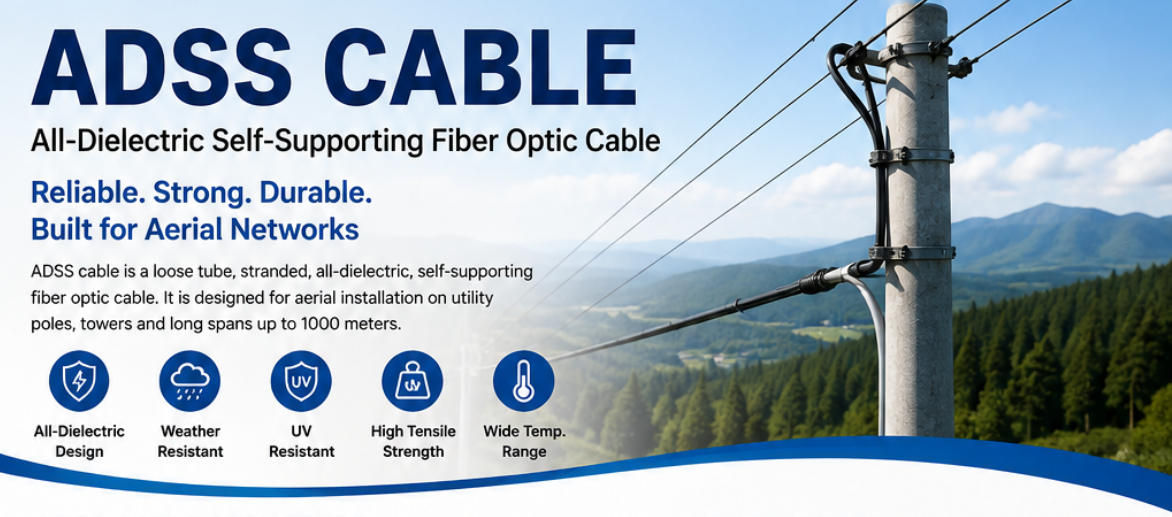
ADSS cable is an all-dielectric, self-supporting aerial fiber optic cable that can be installed overhead without a separate messenger wire.
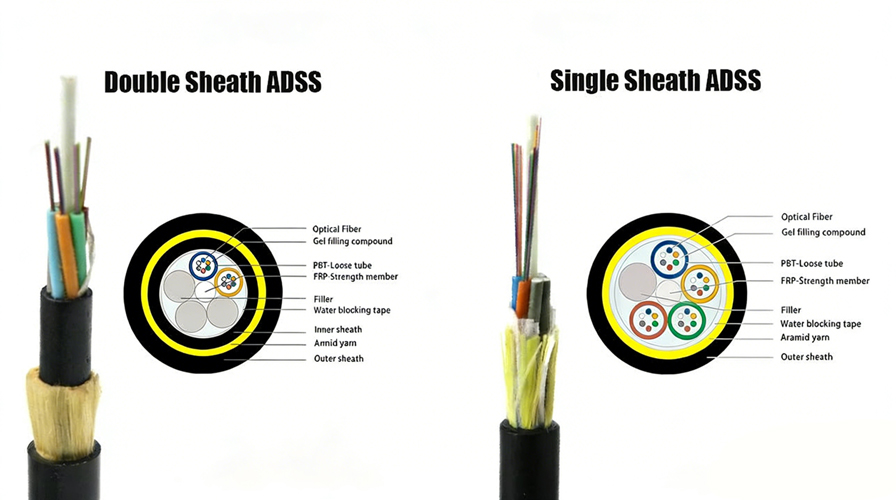
Unlike traditional aerial cables that may require a metallic support wire, ADSS cable incorporates its own strength system into the cable structure. The cable normally contains optical fibers, loose tubes, central or stranded strength members, fillers, aramid yarn, and an outer PE sheath.
The term ADSS describes three important characteristics:
- All-Dielectric: The cable contains no electrically conductive metallic components.
- Self-Supporting: The cable can span between poles or towers without a separate support wire.
- Aerial: It is primarily designed for overhead installation.
These characteristics make ADSS cable particularly suitable for communication networks installed along electricity distribution and transmission infrastructure.
1. What Does ADSS Stand For?
ADSS stands for:
A — All
D — Dielectric
S — Self
S — Supporting
Therefore, ADSS = All-Dielectric Self-Supporting.
Each word describes an important design feature.
All-Dielectric
“All-dielectric” means the cable is constructed without metallic components that could conduct electricity.
This is particularly important when fiber optic cables are installed near high-voltage electrical infrastructure. Because the cable itself is non-conductive, it does not require electrical grounding like a metallic cable.
Self-Supporting
ADSS cable contains its own mechanical strength system. It does not need a separate steel messenger wire to carry the cable’s weight.
The strength elements, typically aramid yarn or other non-metallic materials, provide the tensile strength required for aerial spans.
Aerial Installation
ADSS cable is designed for overhead deployment. It can be attached to:
- Utility poles
- Electricity poles
- Transmission towers
- Distribution poles
- Communication poles
- Other aerial support structures
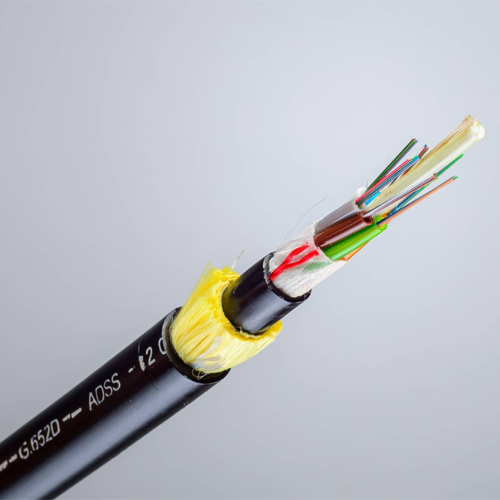
2. How Is ADSS Fiber Optic Cable Constructed?
The exact construction of an ADSS cable depends on the manufacturer, fiber count, span length, environmental conditions, and mechanical requirements.
A typical ADSS cable consists of several layers.
2.1 Optical Fibers
The optical fibers are the core transmission medium.
Common fiber options include:
- G.652D single-mode fiber
- G.657A1 fiber
- G.657A2 fiber
- Other ITU-T compliant optical fiber types
For long-distance outdoor networks, G.652D is commonly selected because of its low attenuation and suitability for transmission systems.
For access networks requiring greater bending performance, G.657 fibers may be considered.
2.2 Loose Tubes
Optical fibers are normally placed inside loose tubes.
The loose-tube structure protects the fibers from:
- Mechanical stress
- Moisture
- Temperature changes
- Installation tension
- Environmental movement
The fibers are generally not tightly bonded to the tube. This provides additional protection against changes in cable length caused by temperature variations.
2.3 Central Strength Member
Depending on the cable design, ADSS may use a central strength member made from FRP (Fiber Reinforced Plastic) or another suitable non-metallic material.
The central strength member provides mechanical support and helps maintain cable geometry during installation and operation.
Because FRP is dielectric, it maintains the electrical insulation characteristics of ADSS cable.
2.4 Stranded Core
For higher fiber counts, multiple loose tubes can be stranded around the central strength member.
The stranded core can accommodate a larger number of optical fibers while maintaining mechanical stability.
Common configurations include:
- 2–12 fibers
- 24 fibers
- 36 fibers
- 48 fibers
- 72 fibers
- 96 fibers
- 144 fibers
- 288 fibers
Actual fiber-count availability depends on the cable manufacturer and design.
2.5 Water-Blocking Materials
Outdoor ADSS cable needs protection against moisture penetration.
Depending on the design, manufacturers may use:
- Water-blocking yarn
- Water-blocking tape
- Water-blocking gel
- Dry water-blocking technology
The purpose is to reduce the risk of water migration along the cable core.
2.6 Aramid Yarn
Aramid yarn is an important strength component in many ADSS cable designs.
It provides:
- High tensile strength
- Low weight
- Flexibility
- Non-conductive performance
- Mechanical reinforcement
The quantity and arrangement of aramid yarn can be adjusted according to the required span length and installation conditions.
2.7 Outer Sheath
The outer sheath protects the cable from the external environment.
Typical sheath materials include polyethylene (PE) or specially formulated materials suitable for outdoor aerial applications.
The sheath provides protection against:
- UV radiation
- Rain
- Wind
- Temperature changes
- Mechanical abrasion
- Environmental aging
For areas exposed to severe electrical fields, sheath design and material selection are particularly important.
3. How Does ADSS Cable Work?
ADSS cable transmits information using light rather than electrical current.
The basic transmission process is:
Electrical data → Optical transmitter → Light signal → Optical fiber → Optical receiver → Electrical data
Inside the fiber, information is transmitted as pulses of light.
Because the optical fiber is made from glass and does not carry electrical current, ADSS cable provides several advantages over conventional copper communication cables, especially for high-speed and long-distance networks.
The self-supporting structure allows the cable to remain suspended between support points while its internal strength system carries mechanical loads.
4. Main Advantages of ADSS Cable
ADSS cable has become popular for aerial fiber networks because it combines optical performance with mechanical and electrical advantages.
4.1 No Separate Messenger Wire
One of the biggest advantages of ADSS cable is its self-supporting construction.
A traditional aerial fiber cable may require a messenger wire, while ADSS does not.
This can simplify:
- Installation
- Material procurement
- Pole loading calculations
- Maintenance
- Network expansion
It can also reduce the number of components required for an aerial installation.
4.2 Completely Non-Metallic
ADSS cable contains no metallic strength member.
This provides excellent electrical insulation.
As a result, ADSS is suitable for installations near:
- Power distribution lines
- Transmission lines
- Electrical substations
- Utility poles
- High-voltage infrastructure
However, “non-metallic” does not mean that installation design can ignore electrical-field effects. Appropriate cable selection, separation, sheath design, and hardware installation remain important.
4.3 High Tensile Strength
ADSS cables are designed to withstand mechanical loads associated with aerial installation.
The required strength depends on:
- Span length
- Cable weight
- Wind load
- Ice load
- Temperature
- Installation tension
- Sag requirements
Long-span ADSS designs typically require stronger mechanical construction than short-span designs.
4.4 Lightweight Construction
Compared with some metallic aerial cable structures, ADSS can offer a relatively lightweight solution.
Lower cable weight can help reduce mechanical loading on existing poles and supporting structures.
This can be particularly useful when upgrading an existing utility infrastructure.
4.5 Easy Aerial Installation
ADSS does not require a separate messenger wire, which can simplify deployment.
Depending on the project, installation may use:
- Suspension clamps
- Dead-end clamps
- Pole brackets
- Down-lead clamps
- Joint closures
- Other ADSS-specific hardware
Correct hardware selection is essential for maintaining cable performance.
4.6 Good Environmental Resistance
Outdoor ADSS cable is designed to operate in demanding environmental conditions.
A properly specified cable can provide resistance to:
- UV exposure
- Rain
- Wind
- Temperature cycling
- Moisture
- Mechanical stress
For extreme climates, the cable should be specifically designed according to local environmental loading requirements.
5. ADSS Cable Span Length
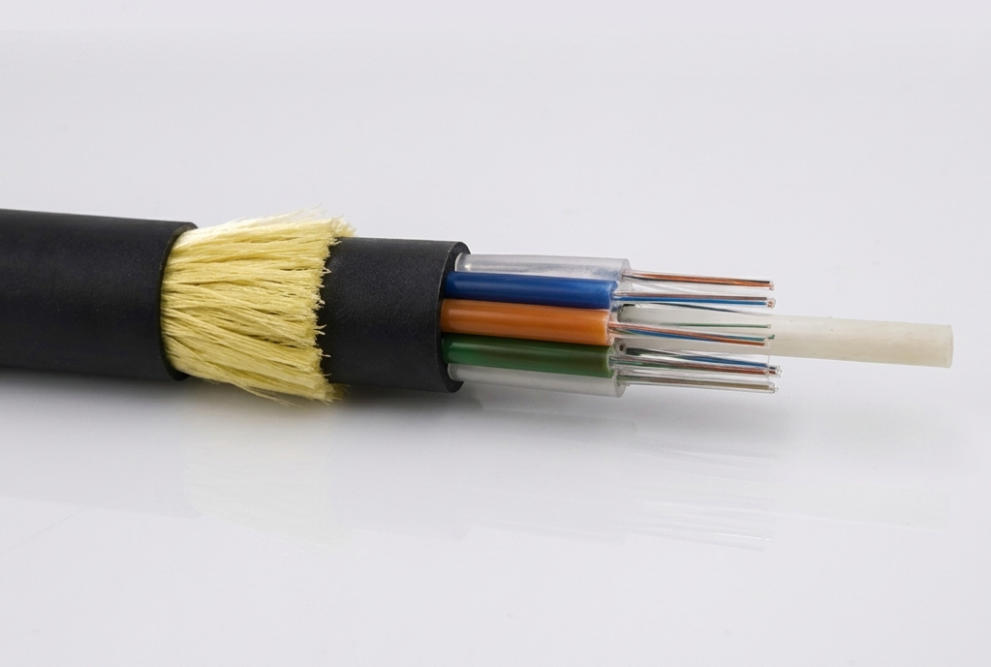
Span length is one of the most important parameters when selecting ADSS cable.
The span is the distance between two adjacent support points.
For example:
Pole A → 80 m span → Pole B
or:
Tower A → 150 m span → Tower B
Typical ADSS products may be designed for different span classes, such as:
- Short-span ADSS
- Medium-span ADSS
- Long-span ADSS
- Extra-long-span ADSS
A common commercial specification may indicate values such as 80 m, 100 m, 120 m, 150 m, 200 m, or more, but the actual permissible span must be determined from the cable’s mechanical design and local environmental conditions.
A longer span generally requires greater tensile strength and careful sag-tension engineering.
6. ADSS Cable Fiber Counts
ADSS cable is available in a wide range of fiber counts.
Common options include:
| Fiber Count | Typical Application |
|---|---|
| 2–12 Core | Small access networks |
| 24 Core | FTTH and access networks |
| 36 Core | Distribution networks |
| 48 Core | Broadband and telecom |
| 72 Core | Medium-capacity networks |
| 96 Core | High-capacity access/distribution |
| 144 Core | Backbone and metropolitan networks |
| 288 Core | High-density communication networks |
The correct fiber count should be selected according to both current requirements and expected network expansion.
Choosing a slightly higher fiber count can sometimes reduce the need for future cable replacement.
7. ADSS Cable Applications
ADSS cable is used in many outdoor communication environments.
7.1 FTTH Networks
ADSS can be used as part of aerial fiber infrastructure supporting FTTH deployment.
It can connect:
Core Network → Distribution Network → Access Network → Customer Premises
For residential areas where aerial utility poles already exist, ADSS can provide an efficient fiber deployment method.
7.2 Telecommunications Networks
Telecom operators use ADSS for:
- Metropolitan networks
- Regional networks
- Access networks
- Backhaul networks
- Broadband infrastructure
Its aerial construction is particularly useful where underground duct installation is expensive or difficult.
7.3 Power Utility Communication Networks
ADSS is widely associated with utility infrastructure because of its dielectric construction.
It can be installed on utility poles and along electrical corridors for:
- SCADA communication
- Utility data networks
- Substation communication
- Distribution automation
- Grid monitoring
- Protection communication
7.4 Rural Broadband
In rural areas, aerial deployment can be more economical than trenching.
ADSS can use existing pole infrastructure to extend broadband services over long distances.
This can reduce civil engineering requirements compared with underground installation.
7.5 Campus and Industrial Networks
ADSS can also be used between buildings, industrial facilities, and other sites where aerial fiber installation is practical.
8. ADSS Cable vs OPGW
ADSS and OPGW are both commonly associated with power communication networks, but they are designed for different installation locations.
| Feature | ADSS | OPGW |
|---|---|---|
| Full Name | All-Dielectric Self-Supporting | Optical Ground Wire |
| Installation | Below/along power infrastructure | On transmission line ground-wire position |
| Metallic Components | No | Yes |
| Electrical Conductivity | Non-conductive | Conductive |
| Separate Messenger | No | No |
| Main Strength Material | Aramid/FRP/non-metallic | Metallic strands |
| Typical Use | Utility poles and aerial telecom | High-voltage transmission lines |
| Ground Wire Function | No | Yes |
ADSS is generally selected when a non-metallic self-supporting aerial communication cable is required, while OPGW is designed to replace or integrate with the overhead ground wire of a transmission system.
9. ADSS Cable vs ASU Cable
ADSS and ASU are both non-metallic outdoor fiber optic cables, but their mechanical designs and typical applications are different.
| Feature | ADSS | ASU |
|---|---|---|
| Aerial Installation | Yes | Yes |
| Self-Supporting | Yes | Yes, depending on design |
| Metallic Components | No | No |
| Typical Span | Short to long span | Often short/medium span |
| Strength Structure | Aramid/FRP system | Compact dielectric structure |
| Main Applications | Utility aerial networks | Access and distribution networks |
| Cable Size | Generally larger | Generally compact |
ADSS is usually preferred when the project requires a mechanically engineered self-supporting aerial cable for specific span and environmental conditions.
ASU is often attractive when a compact, lightweight aerial cable is required for access or distribution networks.
10. ADSS Cable vs GYTA/GYTS
GYTA and GYTS are widely used outdoor loose-tube fiber optic cables, but they are not equivalent to ADSS.
| Feature | ADSS | GYTA | GYTS |
|---|---|---|---|
| Aerial Self-Supporting | Yes | No | No |
| Metallic Strength | No | Yes/depending construction | Yes/depending construction |
| Typical Installation | Aerial | Duct/direct burial/aerial with support | Duct/direct burial |
| Separate Support | Not normally required | Often required for aerial use | Often required |
| Electrical Insulation | Excellent | Depends on construction | Depends on construction |
If a cable must be directly suspended between poles without a separate messenger, ADSS is usually the more appropriate cable type.
11. How to Choose the Right ADSS Cable
Choosing an ADSS cable should not be based only on fiber count.
The following parameters should be evaluated.
1. Fiber Count
Determine the number of fibers required for the current network and future expansion.
2. Fiber Type
Select the appropriate optical fiber, such as G.652D or G.657A1/A2, according to network requirements.
3. Span Length
Specify the maximum distance between support points.
4. Maximum Working Tension
The cable must withstand the required installation and operating loads.
5. Sag
Sag must be evaluated based on span, temperature, cable weight, and mechanical characteristics.
6. Wind Load
Wind pressure can significantly affect aerial cable loading.
7. Ice Load
For cold regions, ice accumulation can dramatically increase cable loading.
8. Temperature Range
Specify the expected minimum and maximum operating temperature.
9. UV Resistance
Outdoor cable should use suitable sheath materials for long-term sunlight exposure.
10. Electrical Environment
For installations near high-voltage infrastructure, the cable’s electrical-field environment must be considered when selecting the sheath and cable design.
12. ADSS Cable Installation
Correct installation is essential to achieve the expected service life of an ADSS network.
A typical installation process includes:
Step 1: Survey the Route
Determine:
- Pole locations
- Span lengths
- Crossing points
- Existing utilities
- Terrain
- Wind exposure
- Potential obstacles
Step 2: Confirm Cable Specification
Verify:
- Fiber count
- Span rating
- Cable diameter
- Cable weight
- Maximum tensile strength
- Minimum bend radius
- Environmental requirements
Step 3: Select ADSS Hardware
Typical hardware includes:
- Suspension clamps
- Dead-end clamps
- Tension clamps
- Pole brackets
- Cable storage accessories
- Down-lead clamps
Step 4: Install the Cable
The cable should be handled according to the manufacturer’s recommended installation tension and bend radius.
Step 5: Set Sag
Sag must be adjusted according to the engineering design and environmental conditions.
Step 6: Inspect the Installation
Check:
- Cable tension
- Sag
- Clamp position
- Bend radius
- Pole clearance
- Cable sheath condition
- Fiber attenuation
13. ADSS Cable Price
The price of ADSS cable varies considerably because it is a customized engineered product.
Important factors include:
- Fiber count
- Fiber type
- Span length
- Cable diameter
- Tensile strength
- Sheath material
- Water-blocking construction
- Aramid yarn quantity
- Production quantity
- Certification requirements
- Packaging
- Shipping destination
For example, a short-span 24-core ADSS cable will normally have a different cost structure from a long-span 144-core ADSS cable.
Therefore, asking only for the price per kilometer is often insufficient.
For an accurate quotation, buyers should provide:
Fiber Count + Fiber Type + Span Length + Cable Length + Installation Environment + Required Standard + Destination
14. Why Buy ADSS Cable Directly From a Factory?
For telecom contractors, distributors, system integrators, and network operators, purchasing directly from an ADSS cable manufacturer can provide several advantages.
Factory Direct Pricing
Direct sourcing can reduce intermediary costs and make customized specifications easier to manage.
Customized Specifications
An experienced manufacturer can configure:
- Fiber count
- Fiber type
- Span rating
- Sheath material
- Cable structure
- Printing
- Packaging
- Drum length
Production Capacity
Large projects may require hundreds or thousands of kilometers of cable. Factory production capacity and delivery planning therefore become important purchasing considerations.
Quality Control
A professional fiber optic cable factory should perform relevant tests throughout production, including optical, dimensional, mechanical, and environmental checks according to the applicable standards and project requirements.
15. ADSS Cable Standards
ADSS cable specifications may reference international standards such as:
- ITU-T optical fiber recommendations
- IEC standards
- ASTM standards where applicable
- Local telecommunications standards
- Utility company specifications
- Customer-specific technical specifications
The exact standard combination depends on the target market and project.
When requesting a quotation, international buyers should specify whether they require particular standards, certifications, test reports, or utility acceptance requirements.
16. Common ADSS Cable Problems
Although ADSS is a robust aerial cable, improper engineering or installation can lead to problems.
Common issues include:
Excessive Sag
Possible causes include incorrect span design, excessive loading, temperature effects, or improper installation tension.
Sheath Damage
This can result from improper clamps, excessive pulling tension, sharp objects, or poor installation practices.
Excessive Tension
Over-tensioning the cable during installation can increase stress on optical fibers and cable components.
Incorrect Hardware
ADSS requires hardware specifically matched to cable diameter, span, tension, and installation conditions.
Insufficient Electrical Consideration
Even though ADSS is dielectric, installation near high-voltage conductors requires appropriate engineering evaluation.
17. How Long Does ADSS Cable Last?
The expected service life of an ADSS cable depends on:
- Cable design
- Raw material quality
- UV exposure
- Temperature
- Wind
- Ice
- Mechanical loading
- Installation quality
- Electrical environment
- Maintenance
A properly designed and installed outdoor ADSS cable can be engineered for a long service life, often on the order of several decades under appropriate conditions.
However, buyers should avoid treating a generic service-life number as universal. The expected lifetime should be evaluated against the project’s actual environmental and mechanical conditions.
18. What Makes a Good ADSS Cable Manufacturer?
When selecting an ADSS cable supplier, consider more than the lowest price.
A reliable manufacturer should be able to provide:
- Detailed technical datasheets
- Fiber specifications
- Mechanical specifications
- Span ratings
- Test reports
- Factory quality-control procedures
- Cable samples
- Customized designs
- Production capacity
- Export experience
- Appropriate packaging
- Technical support
For large infrastructure projects, the supplier’s ability to consistently produce the same cable specification can be just as important as the initial quotation.
19. Frequently Asked Questions About ADSS Cable
What is ADSS cable used for?
ADSS cable is mainly used for aerial fiber optic communication networks. Common applications include telecommunications, broadband, FTTH, utility communication networks, rural broadband, and aerial backbone networks.
Is ADSS cable self-supporting?
Yes. ADSS stands for All-Dielectric Self-Supporting, meaning the cable is designed to support itself between aerial structures without a separate messenger wire.
Is ADSS cable suitable for high-voltage areas?
ADSS is specifically designed for aerial communication applications where electrical insulation is important. However, the cable must be properly selected and installed according to the electrical-field environment and applicable engineering requirements.
Does ADSS cable contain metal?
A true ADSS cable is all-dielectric and does not use metallic conductive components as part of its cable structure.
What is the maximum span of ADSS cable?
There is no single maximum span for all ADSS cables. The permissible span depends on cable design, tensile strength, cable weight, wind load, ice load, temperature, sag requirements, and local installation conditions.
What fiber counts are available for ADSS?
ADSS cables are commonly manufactured in configurations ranging from low fiber counts such as 2 or 4 fibers to high counts such as 144 or 288 fibers, depending on the manufacturer’s design and application.
Is ADSS better than OPGW?
Neither is universally better. ADSS is generally suitable for self-supporting aerial communication installations, while OPGW is designed to combine optical communication with the overhead ground-wire function of transmission lines.
Can ADSS cable be installed on existing poles?
Yes. One of the major advantages of ADSS is that it can often be installed on existing utility or communication poles, provided that structural loading, clearances, span conditions, and appropriate hardware are evaluated.
What is the difference between ADSS and aerial fiber optic cable?
ADSS is a specific type of aerial fiber optic cable. The key difference is that ADSS is designed to be self-supporting and all-dielectric, whereas some other aerial fiber cables require a separate messenger wire.
How do I get an ADSS cable quotation?
Provide the supplier with the required fiber count, fiber type, span length, cable length, operating environment, standards, and destination country. These parameters allow the manufacturer to recommend an appropriate construction and provide a more accurate quotation.
20. Conclusion: Is ADSS Cable Right for Your Project?
ADSS cable is one of the most practical solutions for self-supporting aerial fiber optic networks. Its all-dielectric construction eliminates the need for a separate metallic messenger wire, while its internal strength system allows the cable to withstand the mechanical requirements of overhead installation.
The main benefits of ADSS include:
- Self-supporting aerial installation
- All-dielectric construction
- No metallic components
- High tensile strength
- Lightweight structure
- Good environmental resistance
- Suitable for utility infrastructure
- Flexible fiber-count options
- Efficient deployment for aerial networks
However, selecting the right ADSS cable requires more than choosing a fiber count. Span length, wind load, ice load, temperature, sag, tensile strength, electrical environment, cable structure, and installation hardware must all be considered.
For telecom operators, utility companies, broadband contractors, distributors, and system integrators, a properly engineered ADSS solution can provide a reliable and scalable foundation for modern aerial fiber optic networks.
In short: ADSS cable is a self-supporting, non-metallic aerial fiber optic cable designed to deliver high-capacity optical communication while simplifying overhead network deployment.