Underwater Fiber Optic Cable is a specialized optical communication cable designed to transmit high-speed data through underwater environments such as oceans, seas, rivers, lakes, reservoirs, offshore areas, and coastal networks. Unlike standard terrestrial fiber optic cables, underwater cables must withstand water pressure, moisture, corrosion, mechanical stress, abrasion, marine activity, and installation forces.
According to the latest ITU-T G.978 recommendation, optical fiber submarine cables are designed to protect optical fibers against water pressure, longitudinal water propagation, chemical aggression, hydrogen contamination, and mechanical stress throughout their design life. The recommendation covers repeatered, repeaterless, and dedicated sensing submarine cable systems for both shallow and deep water applications.
For network operators, telecom companies, offshore projects, data centers, utility companies, and system integrators, choosing the correct underwater fiber optic cable requires considering water depth, installation method, mechanical protection, transmission distance, fiber count, environmental conditions, and project cost.
What Is Underwater Fiber Optic Cable?
An underwater fiber optic cable is an optical fiber cable specifically engineered for installation below the water surface.
The basic function is similar to other fiber optic cables: optical fibers transmit information using light rather than electrical signals. However, the cable construction is substantially different because underwater environments introduce additional risks.
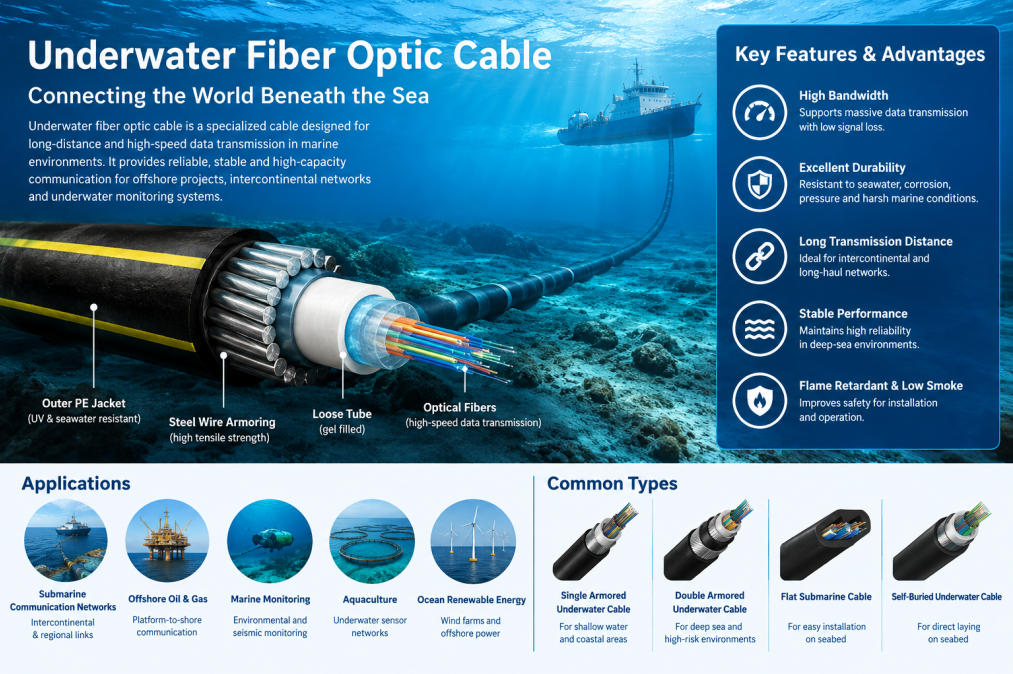
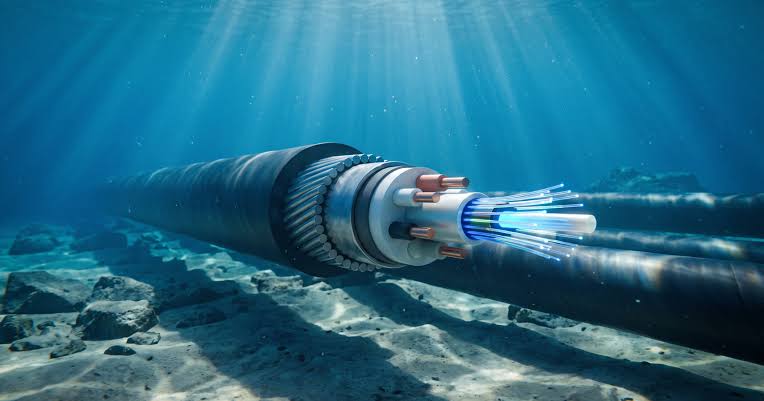
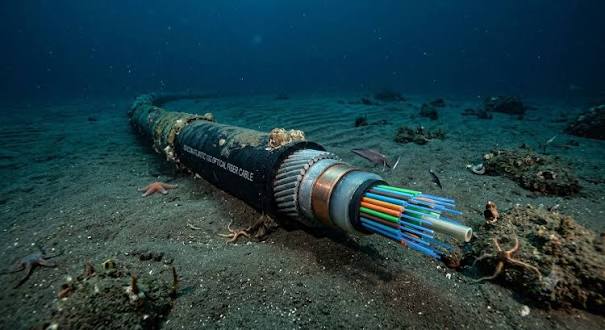
A typical underwater fiber optic cable may include:
- Optical fibers
- Fiber coating
- Buffer tube or fiber protection layer
- Water-blocking materials
- Strength members
- Metallic or non-metallic protective layers
- Armoring
- Outer polyethylene sheath
- Optional electrical conductor for certain submarine systems
The exact structure depends on whether the cable is intended for a river crossing, lake crossing, shallow coastal water, offshore communication network, or deep-sea telecommunications system.
ITU-T distinguishes several underwater cable categories, including repeatered submarine cable, repeaterless submarine cable, and marinized terrestrial cable (MTC). Marinized terrestrial cables are generally intended for less aggressive shallow-water environments such as lakes and rivers.
Key Features of Underwater Fiber Optic Cable
1. Excellent Water Resistance
The first requirement of an underwater cable is protection against water penetration.
Water can migrate longitudinally through a cable and eventually reach optical components if the cable is poorly designed. Therefore, underwater cables commonly use water-blocking materials, sealed structures, and protective sheaths.
A properly engineered submarine cable is designed to prevent water-related degradation over its intended service life.
2. High Mechanical Strength
Underwater cables can experience significant tensile loads during cable deployment, recovery, repair, and installation.
The cable therefore needs sufficient tensile strength and controlled elongation to prevent excessive stress on the optical fibers.
Important mechanical parameters include:
- Cable Breaking Load (CBL)
- Nominal Transient Tensile Strength (NTTS)
- Nominal Operating Tensile Strength (NOTS)
- Nominal Permanent Tensile Strength (NPTS)
- Minimum Bending Radius
These parameters are particularly important when selecting cable for long-distance submarine installation.
3. Armored Protection
Shallow-water cables are exposed to anchors, fishing activity, rocks, abrasion, marine equipment, and other mechanical hazards.
For this reason, underwater cables can use different levels of armor protection.
The ITU-T classification includes:
- LW – Lightweight Cable
- LWP – Lightweight Protected Cable
- SA – Single Armored Cable
- DA – Double Armored Cable
- RA – Rock Armored Cable
These structures provide different levels of mechanical protection according to installation conditions and water depth.
4. Corrosion and Environmental Resistance
Seawater is highly corrosive. Underwater cables must therefore use materials and structures capable of maintaining performance in a marine environment.
In addition to corrosion, designers need to consider:
- Hydrogen contamination
- Water pressure
- Temperature variation
- Chemical exposure
- Marine organisms
- Abrasion
- Cable movement
- External mechanical impact
This makes underwater cable construction significantly more demanding than conventional indoor or outdoor terrestrial fiber cables.
5. High Transmission Capacity
Fiber optics provide very high bandwidth with low attenuation and immunity to electromagnetic interference.
For long-distance submarine communication, fiber optic cables can support high-capacity transmission systems using technologies such as WDM and DWDM.
ITU-T G.977 addresses optically amplified submarine systems and includes single-wavelength, WDM, and DWDM implementations.
6. Long Service Life
Underwater communication infrastructure is expensive to install and difficult to repair. Consequently, cable reliability and service life are critical considerations.
A submarine cable must be designed not only to transmit optical signals but also to survive laying, burial, recovery, repair, and long-term underwater operation.
Main Advantages of Underwater Fiber Optic Cable
High-Speed Data Transmission
The most important advantage is the ability to transport enormous amounts of information over long distances.
Underwater fiber networks can carry:
- Internet traffic
- Cloud services
- Video
- Voice
- Enterprise data
- Financial data
- Data center traffic
- Government communications
- Offshore monitoring data
This makes fiber optic technology the preferred solution for high-capacity underwater communication infrastructure.
Low Signal Loss
Compared with copper communication cables, optical fiber provides significantly lower transmission loss over long distances.
This is especially important for submarine networks connecting islands, countries, offshore platforms, and coastal data centers.
Immunity to Electromagnetic Interference
Optical fiber transmits information using light instead of electrical current. Therefore, it is not affected by electromagnetic interference in the same way as copper cables.
This is valuable around:
- Offshore power facilities
- Industrial equipment
- Subsea electrical systems
- Power transmission infrastructure
Strong Environmental Protection
A properly designed underwater cable can resist multiple environmental stresses simultaneously.
This combination of optical performance and mechanical protection makes underwater fiber cable suitable for demanding marine applications.
Flexible Protection Levels
One major advantage of submarine cable technology is that protection can be selected according to the installation environment.
For example, a lightweight cable may be sufficient for relatively safe deep-water sections, while armored cable is more appropriate for shallow-water areas exposed to human activities.
According to ITU-T G.978, typical application depths are approximately greater than 1,000 m for LW/LWP cables, greater than 20–1,500 m for SA cables, 0–100 m for DA cables, and 0–20 m for RA cables. Actual project selection should always follow the engineering design and environmental risk assessment rather than depth alone.
Underwater Fiber Optic Cable Applications
1. Submarine Telecommunications
One of the most important applications is long-distance international telecommunications.
Submarine fiber optic networks connect:
- Countries
- Continents
- Islands
- Coastal cities
- Internet exchange points
- Data centers
These networks form a critical part of the global Internet infrastructure.
2. River and Lake Crossings
Not every underwater cable is designed for deep ocean deployment.
Fiber cables are frequently installed across:
- Rivers
- Lakes
- Reservoirs
- Canals
- Harbors
For these relatively short-distance applications, a marinized terrestrial cable may provide an economical solution when environmental conditions are not highly aggressive. ITU-T describes MTC as an underwater optical cable based on a conventional terrestrial multi-fiber cable core, protected for marine environments and intended for unrepeatered applications in non-aggressive shallow waters.
3. Offshore Oil and Gas
Underwater fiber optic cable can connect offshore platforms with:
- Onshore control centers
- Offshore platforms
- Subsea equipment
- Monitoring systems
- Data centers
Fiber enables high-speed communication for real-time monitoring and remote operations.
4. Offshore Wind Farms
As offshore wind farms become larger and farther from shore, reliable communication networks become increasingly important.
Fiber optic cables can provide communication links between:
- Wind turbines
- Offshore substations
- Control platforms
- Onshore facilities
5. Subsea Monitoring and Sensing
Modern submarine cable systems can also support scientific sensing.
The latest ITU-T G.978 recommendation explicitly includes dedicated sensing submarine optical cable systems.
Potential applications include:
- Seismic monitoring
- Oceanographic research
- Infrastructure monitoring
- Temperature sensing
- Environmental monitoring
6. Island and Coastal Networks
Underwater fiber optic cable provides an efficient way to connect islands with mainland networks.
Compared with satellite communication, submarine fiber can provide much higher capacity and lower latency for large-volume data transmission.
Underwater Fiber Optic Cable Structure
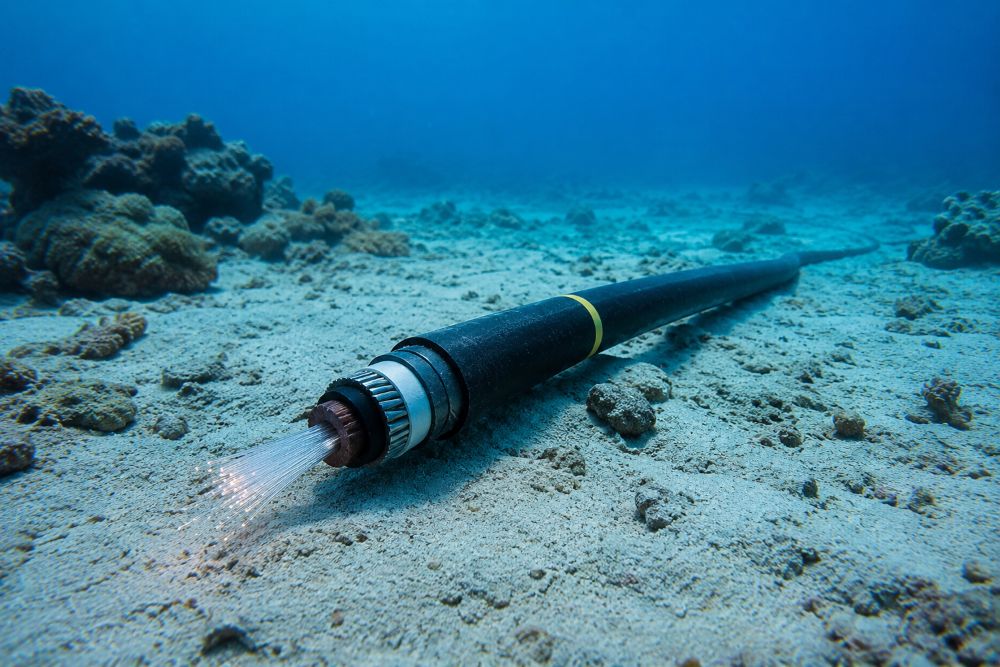
A typical underwater fiber optic cable may be constructed from several functional layers.
Optical Fiber
The optical fiber is the core transmission medium. Depending on the project, single-mode fibers such as G.652D or bend-insensitive G.657 fibers may be considered.
Fiber Protection
The fibers require protection against bending, tensile stress, moisture, and environmental influences.
Strength Member
Strength members help the cable withstand installation and mechanical loads.
Water-Blocking Layer
Water-blocking materials reduce the risk of longitudinal water penetration.
Metallic Protection
Depending on the design, metallic layers may provide additional mechanical protection and, in some submarine systems, an electrical power path.
Armor
Armor protects the cable against external mechanical damage.
Outer Sheath
The outer sheath provides additional protection against abrasion, moisture, chemicals, and environmental exposure.
The final structure should be selected according to the installation environment rather than simply maximizing the number of protective layers.
Underwater Fiber Optic Cable Types
Lightweight Submarine Cable – LW
LW cable is designed for environments where additional mechanical protection is not normally required.
It is commonly associated with deep-water sections where risks from fishing and anchoring are relatively low.
Lightweight Protected Cable – LWP
LWP provides additional protection compared with LW cable while maintaining relatively low weight.
Single Armored Cable – SA
Single-armored cable provides enhanced mechanical protection and is commonly used in areas where the cable may need to be laid or buried in more demanding environments.
Double Armored Cable – DA
Double-armored cable provides greater mechanical protection and is suitable for particularly demanding shallow-water environments.
Rock Armored Cable – RA
Rock-armored cable provides very high protection for areas with significant external mechanical hazards.
The exact selection should be based on the cable route, seabed conditions, water depth, installation technique, and expected external hazards.
Underwater Fiber Optic Cable vs Other Fiber Optic Cables
| Cable Type | Main Environment | Water Resistance | Mechanical Protection | Typical Application |
|---|---|---|---|---|
| Underwater Fiber Optic Cable | Rivers, lakes, offshore, submarine | Excellent | Medium to extremely high | Underwater communication |
| Submarine Fiber Optic Cable | Ocean and deep water | Excellent | High to extremely high | Long-distance telecom |
| Armored Fiber Optic Cable | Underground/outdoor | Good | High | Direct burial, industrial networks |
| ADSS Cable | Aerial | Not designed for immersion | High tensile strength | Power transmission corridors |
| GYTA/GYTS | Outdoor terrestrial | Good | Medium | Duct and aerial networks |
| FTTH Drop Cable | Indoor/outdoor access | Limited | Low to medium | FTTH last-mile connections |
| Marinized Terrestrial Cable | Rivers/lakes/shallow water | High | Application-dependent | Short underwater crossings |
The most important distinction is that underwater fiber optic cable is designed around marine environmental risks, whereas conventional outdoor cables are primarily designed for terrestrial conditions.
Underwater Cable vs ADSS Cable
ADSS (All-Dielectric Self-Supporting) cable is optimized for aerial installation, especially along utility and power transmission corridors.
It is lightweight, all-dielectric, and designed to withstand aerial tensile and environmental loads.
Underwater fiber cable, by contrast, must address water pressure, water ingress, seabed abrasion, marine activity, and underwater installation forces.
Therefore:
ADSS = aerial network solution
Underwater Fiber Cable = underwater network solution
Using ADSS simply because it is lightweight is generally inappropriate for demanding submarine applications.
Underwater Cable vs Armored Direct-Burial Cable
Armored direct-burial fiber optic cable is primarily designed for terrestrial underground installation.
Its armor protects against:
- Soil pressure
- Rodents
- Construction activities
- Pulling forces
- Mechanical impact
However, underwater cables require additional consideration of long-term water exposure, marine corrosion, hydrostatic pressure, seabed conditions, and specialized laying and recovery procedures.
For a simple short river crossing, a suitable marinized terrestrial cable may be economical. For aggressive marine environments, a purpose-designed submarine cable is normally more appropriate.
Underwater Cable vs Submarine Cable
The terms underwater fiber optic cable and submarine fiber optic cable are sometimes used interchangeably in commercial searches, but technically they can cover different application ranges.
“Underwater fiber optic cable” is a broad commercial term covering cables used in rivers, lakes, offshore environments, and submarine networks.
“Optical fiber submarine cable” generally refers to cable designed specifically for submarine cable systems.
ITU-T G.972 defines repeatered and repeaterless submarine cables as specialized underwater optical fiber cables that are tested for installation and repair under demanding submarine conditions.
Therefore, when purchasing cable, customers should specify the actual application rather than relying only on the product name.
How to Choose the Right Underwater Fiber Optic Cable
Before ordering, buyers should evaluate at least eight factors.
1. Water Depth
Determine whether the cable will operate in:
- River water
- Lake water
- Coastal water
- Shallow sea
- Deep sea
Water depth directly influences mechanical and environmental requirements.
2. Installation Method
Consider whether the cable will be:
- Laid on the seabed
- Buried
- Pulled through a river
- Installed near a shoreline
- Recovered for future maintenance
3. Mechanical Risk
Assess:
- Fishing activity
- Ship traffic
- Anchors
- Rocks
- Seabed movement
- Marine construction
Higher risk generally requires stronger protection.
4. Transmission Distance
Short underwater links may use repeaterless solutions, while very long submarine systems can require repeaters and specialized power-feeding arrangements.
5. Fiber Count
Typical project requirements may range from a small number of fibers to high-count configurations.
The correct fiber count depends on:
- Current traffic
- Future expansion
- Network redundancy
- Number of connected systems
6. Fiber Type
Single-mode fiber is normally selected for long-distance communication. Fiber specifications should match the transmission equipment and system design.
7. Armoring
Do not automatically select the strongest armor. Excessive armoring can increase cable diameter, weight, installation complexity, and cost.
The better approach is to select the minimum protection level that safely meets the route requirements.
8. Standards and Testing
For professional submarine projects, buyers should request detailed technical documentation covering optical, mechanical, environmental, and electrical characteristics.
ITU-T G.978 specifically addresses these characteristics for optical fiber submarine cables.
Underwater Fiber Optic Cable Installation
Underwater cable installation is more complex than conventional terrestrial cable installation.
A typical project may involve:
- Route survey
- Seabed investigation
- Cable engineering
- Cable manufacturing
- Factory testing
- Cable loading
- Cable laying
- Cable burial where required
- Shore-end installation
- Jointing and termination
- Optical testing
- System commissioning
For major submarine systems, specialized cable ships and subsea equipment may be required. ITU-T G.971 discusses implementation aspects of optical fiber submarine cable systems, including installation, repair, and associated subsea equipment.
Underwater Fiber Optic Cable Cost Factors
There is no single universal price for underwater fiber optic cable.
The cost depends on:
- Fiber count
- Cable construction
- Armor type
- Water depth
- Required tensile strength
- Cable diameter
- Material selection
- Cable length
- Testing requirements
- Installation method
- Project quantity
- Custom specifications
A lightweight cable for a protected deep-water route can have a very different cost structure from a heavily armored cable designed for shallow coastal waters.
For buyers, comparing price per kilometer alone can therefore be misleading. A better comparison includes cable structure, mechanical performance, fiber specifications, testing, packaging, and installation requirements.
Why Choose a Professional Underwater Fiber Optic Cable Manufacturer?
For underwater projects, cable quality has a direct relationship with network reliability.
A qualified manufacturer should be able to provide:
- Customized fiber counts
- Customized cable structures
- Optical performance testing
- Mechanical testing
- Water penetration testing
- Tensile testing
- Bending testing
- Detailed technical datasheets
- Factory inspection support
- Export packaging
- Project-based engineering support
For large projects, manufacturers should also understand the relationship between cable design, installation method, route conditions, and long-term reliability.
Frequently Asked Questions
What is an underwater fiber optic cable?
An underwater fiber optic cable is an optical cable specially designed to transmit data while installed beneath water. It provides protection against water, mechanical stress, corrosion, abrasion, and other underwater hazards.
What is the difference between underwater and submarine fiber optic cable?
Underwater fiber optic cable is a broad term that can include river, lake, offshore, and submarine applications. Submarine fiber optic cable generally refers to cables designed for specialized submarine communication systems.
Can standard outdoor fiber optic cable be used underwater?
Not necessarily. Standard outdoor cable may tolerate moisture or temporary water exposure, but permanent underwater installation requires a cable structure designed for the specific environmental and mechanical conditions.
How deep can underwater fiber optic cable be installed?
There is no single maximum depth. Different cable constructions are designed for different environments. ITU-T G.978 categorizes submarine cables according to protection level and provides typical depth ranges for LW/LWP, SA, DA, and RA designs.
Is underwater fiber optic cable armored?
Many underwater cables use armor, particularly in shallow or high-risk areas. However, lightweight submarine cable designs may be appropriate where additional protection is unnecessary.
Can underwater fiber optic cable be used for river crossings?
Yes. River crossings are an important application. For relatively non-aggressive shallow-water environments, marinized terrestrial cable can be an economical solution.
How many fibers can an underwater cable contain?
Fiber count depends on the project. Low-count cables can be used for simple links, while high-count submarine systems can support large-scale telecommunications networks.
What fiber is used in underwater cables?
Single-mode optical fiber is commonly used for long-distance communication. The exact fiber type should be selected according to transmission distance, optical system requirements, bending requirements, and applicable standards.
Does underwater fiber optic cable need a repeater?
Not always. Repeaterless submarine systems are available for suitable distances and optical budgets. Very long submarine systems may use repeaters and other specialized subsea equipment.
What is the best underwater fiber optic cable?
There is no universal “best” cable. The optimal cable depends on water depth, route conditions, installation method, mechanical hazards, transmission distance, fiber count, and project budget.
Conclusion
Underwater Fiber Optic Cable is a specialized communication solution engineered for reliable optical transmission in underwater environments. Its major advantages include high bandwidth, low attenuation, electromagnetic immunity, water resistance, strong mechanical protection, and adaptability to different underwater conditions.
For simple river and lake crossings, marinized terrestrial cable can offer a cost-effective option. For higher-risk coastal routes, single-armored or double-armored cable provides greater mechanical protection. For deep-water telecommunications, lightweight submarine cable can reduce unnecessary weight while maintaining the required optical and mechanical performance.
The key to selecting the right cable is not simply choosing the strongest or most expensive design. Instead, cable structure should be matched to water depth, route hazards, installation method, transmission distance, fiber count, environmental conditions, and required service life.
For international buyers searching for underwater fiber optic cable, underwater optical cable, submarine fiber optic cable, underwater communication cable, marine fiber optic cable, river crossing fiber optic cable, lake crossing fiber cable, or armored submarine cable, understanding these differences can significantly improve product selection and project reliability.
Modern submarine cable standards continue to evolve. The latest ITU-T G.978 recommendation covers repeatered, repeaterless, and dedicated sensing submarine cable applications, demonstrating that underwater fiber infrastructure is expanding beyond traditional telecommunications into sensing and other specialized applications.