MPO stands for Multi-fiber Push-On, a multi-fiber optical connector technology designed to terminate multiple optical fibers within a single connector. Unlike conventional LC or SC patch cords, which normally connect one or two fibers per connector, an MPO patch cord can integrate multiple fibers into one compact interface. This makes it particularly suitable for high-density data center cabling, parallel optical transmission, pre-terminated systems, and high-speed network architectures. The MPO interface is standardized under IEC 61754-7.
1. What Is an MPO Patch Cord?
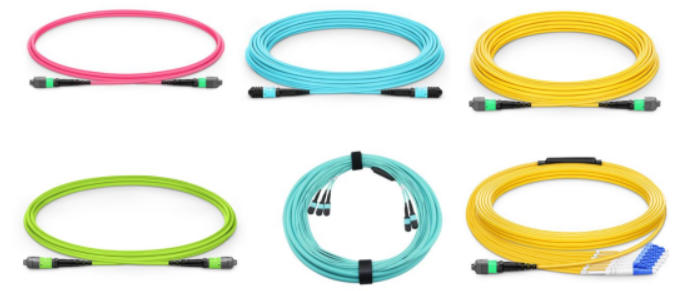
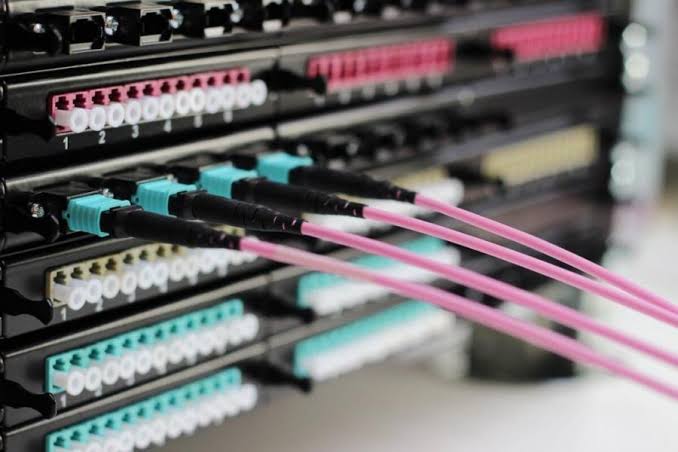
An MPO patch cord is a factory-terminated fiber optic cable equipped with MPO connectors, usually at one or both ends, for connecting multiple optical fibers through a single compact interface.
The connector uses a precision MT ferrule to align multiple fiber cores simultaneously. Common configurations include 8-fiber, 12-fiber, 16-fiber, and 24-fiber designs, while specialized assemblies can support higher fiber counts through appropriate configurations.
A typical MPO patch cord may be constructed with:
- MPO-to-MPO connectors
- MPO-to-LC breakout/harness assemblies
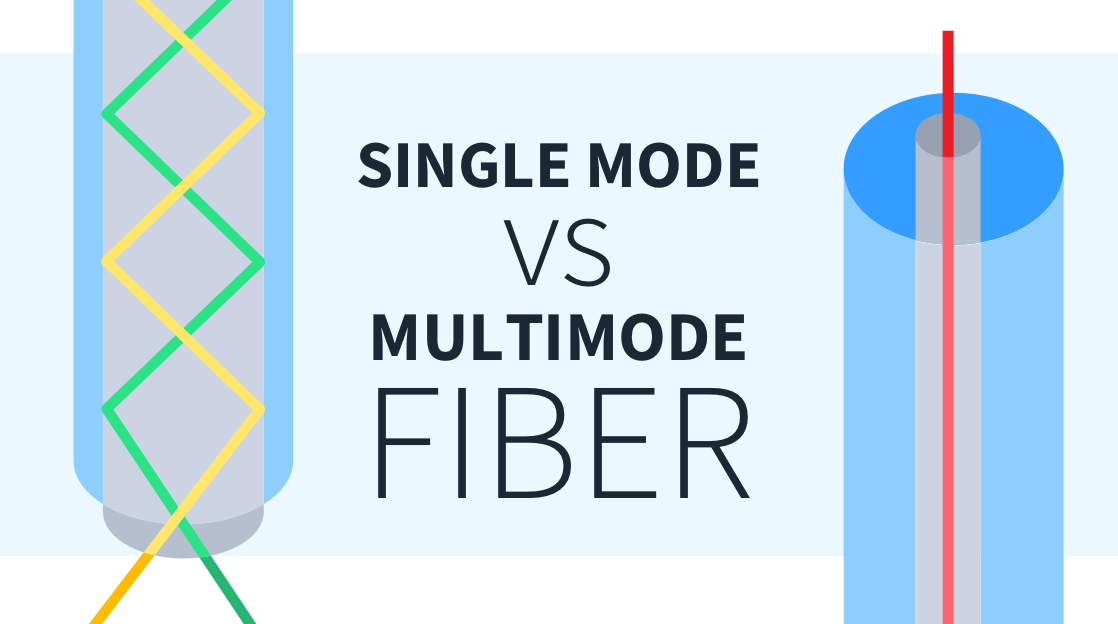
- Single-mode OS2 fiber
- Multimode OM3, OM4, or OM5 fiber
- UPC or APC end-face configurations where applicable
- LSZH, PVC, plenum, or other jacket options depending on installation requirements
It is important to distinguish an MPO patch cord from an MPO trunk cable.
An MPO patch cord is generally used for shorter interconnections, such as connections inside racks, cabinets, patch panels, cassettes, or between active equipment and structured cabling. An MPO trunk cable is normally designed as a longer pre-terminated backbone assembly connecting different panels or zones.
MPO Patch Cord vs. MPO Trunk Cable
| Feature | MPO Patch Cord | MPO Trunk Cable |
|---|---|---|
| Main purpose | Equipment/interconnection | Backbone cabling |
| Typical location | Rack, cabinet, panel | Rack-to-rack or zone-to-zone |
| Length | Usually short | Usually longer |
| Connector | MPO or MPO breakout | Usually MPO at both ends |
| Flexibility | High | Optimized for structured installation |
| Main advantage | Fast equipment connection | High-density backbone deployment |
Understanding this distinction is important when selecting an MPO fiber cable for a data center project.
2. How Does an MPO Patch Cord Work?
The fundamental advantage of MPO technology is that multiple fibers are terminated and connected simultaneously.
Instead of installing multiple individual duplex fiber patch cords, an MPO connector can provide a multi-fiber connection through one physical interface.
For example, an MPO-12 connection can carry 12 optical fibers. Depending on the transceiver and network architecture, these fibers may be used for transmit and receive lanes in parallel optical applications or distributed through breakout assemblies.
This architecture is particularly valuable as network speeds increase.
Modern data center architectures increasingly use parallel optical technologies for high-speed connections. MPO connectors are widely associated with 40G, 100G and higher-speed applications, while LC remains extremely common for conventional duplex optical interfaces.
The basic signal path can be represented as:
Switch → MPO Transceiver → MPO Patch Cord → MPO Cassette/Trunk → MPO/LC Breakout → Server or Network Equipment
This modular structure allows network designers to build standardized cabling systems that can be upgraded without completely replacing the physical infrastructure.
3. Major Advantages of MPO Patch Cords
3.1 Extremely High Fiber Density
The most obvious advantage of MPO is its high fiber density.
A conventional LC duplex patch cord normally handles two fibers. An MPO connector can accommodate significantly more fibers in a single interface.
This can dramatically reduce the number of individual cables required in high-density environments.
For example, Fluke Networks describes a data center example where connecting two 48-port patch panels using duplex cabling could require 48 individual cables, while MPO-12 connections at the rear could reduce the number of cables to eight, or MPO-24 connections to four.
The result is:
- Less cable congestion
- Better rack organization
- Higher port density
- Reduced pathway requirements
- Easier cable management
3.2 Faster Installation
Traditional LC or SC cabling requires technicians to connect individual fibers or duplex pairs one by one.
MPO technology allows multiple fibers to be connected simultaneously.
This makes pre-terminated MPO systems particularly attractive for large-scale data center construction, where hundreds or thousands of optical connections may need to be installed.
Instead of repeatedly installing individual connections, technicians can deploy modular MPO trunk, cassette, and patching systems.
Therefore, MPO can reduce installation time and make project deployment more predictable.
3.3 Space Saving
Rack space is expensive in modern data centers.
As network speeds increase, the number of optical ports also increases. Using hundreds of individual LC patch cords can quickly create cable congestion around switches and patch panels.
MPO’s multi-fiber architecture reduces the number of physical cables needed.
This makes MPO especially useful for:
- High-density server racks
- Spine-leaf data center architectures
- AI computing clusters
- Cloud data centers
- Colocation facilities
- High-density patch panels
3.4 Supports High-Speed Parallel Optics
Another major advantage is compatibility with parallel optical transmission.
High-speed Ethernet technologies can divide data transmission across multiple optical lanes. MPO connectors provide a practical physical interface for these multi-fiber architectures.
For example, MPO is commonly associated with high-speed data center applications involving 40G, 100G, 400G and newer high-density optical architectures.
However, buyers should not assume that “MPO automatically means 400G or 800G.” The actual transmission speed depends on the transceiver, fiber type, optical standard, lane configuration, distance, and complete link architecture.
3.5 Modular and Scalable
MPO cabling works particularly well with a modular structured cabling architecture.
A typical system may include:
MPO Trunk → MPO Cassette → LC Patch Cord → Switch/Server
or:
MPO Transceiver → MPO Patch Cord → MPO Trunk → MPO Cassette
This modular approach allows data center operators to change equipment while retaining much of the underlying cabling infrastructure.
That makes MPO particularly attractive for organizations planning future network upgrades.
3.6 Factory-Terminated Quality
MPO assemblies are normally factory terminated and tested.
Compared with field termination, factory termination can provide better consistency in connector geometry, polishing, fiber alignment, insertion loss, and return loss.
For large projects, pre-terminated assemblies can also simplify quality control because cable assemblies can be tested before delivery and installation.
4. MPO Patch Cord Applications
4.1 Data Centers
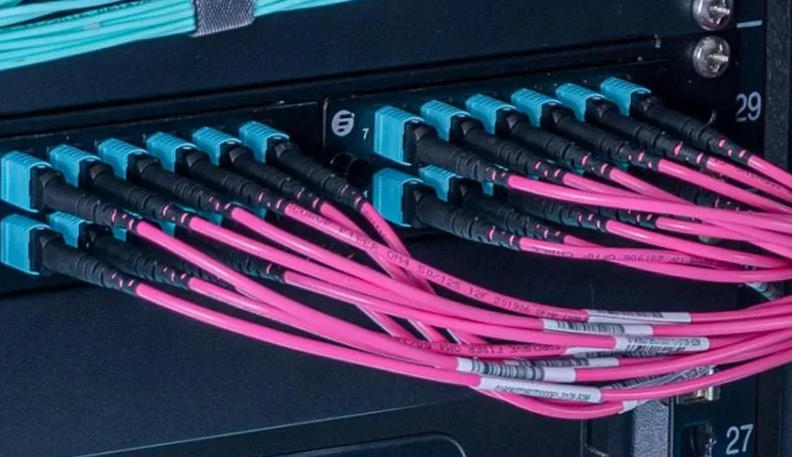
The data center is one of the most important applications for MPO patch cords.
They are commonly used for:
- Server connectivity
- Switch-to-switch connections
- Spine-leaf architectures
- High-density patch panels
- Structured cabling
- Network migration
- Parallel optical links
MPO is particularly valuable where rack density is high and cable management is becoming a significant operational problem.
4.2 40G/100G/400G Network Systems
High-speed optical transceivers increasingly require multi-fiber interfaces.
MPO patch cords can provide the physical fiber connectivity required by many parallel optical applications.
However, the exact MPO configuration must match the transceiver.
Important factors include:
- Fiber count
- Connector type
- Polarity
- Gender
- Fiber mode
- Insertion loss
- Optical lane mapping
A mismatch in any of these parameters can cause link failure.
4.3 AI and High-Performance Computing
AI training clusters and high-performance computing environments can require extremely high bandwidth between servers, switches, and storage systems.
These environments can contain thousands of high-speed optical connections.
Because MPO supports high-density multi-fiber connectivity, it is well suited to environments where bandwidth density and rack-space efficiency are critical.
4.4 5G and Telecom Networks
MPO technology can also be used in telecom and 5G infrastructure, especially where multiple optical channels need to be aggregated within a compact cabling architecture.
Pre-terminated multi-fiber assemblies can simplify installation and improve scalability in high-density equipment environments.
4.5 Structured Fiber Optic Cabling
MPO is particularly useful in structured cabling systems because it can connect high-density trunks with modular cassettes and breakout assemblies.
For example:
MPO trunk → MPO cassette → LC duplex → switch
This approach combines the density of MPO with the compatibility and flexibility of LC.
5. MPO vs. LC Patch Cord
LC is one of the most widely used fiber optic connector types in modern networking.
The major difference is fiber density.
| Feature | MPO Patch Cord | LC Patch Cord |
| Fiber capacity | Multi-fiber | Usually 1 or 2 fibers |
| Density | Very high | High |
| Installation | Fast for many fibers | Simple for individual links |
| Testing | More complex | Relatively simple |
| Polarity | Requires careful planning | Easier |
| Typical application | Data centers/high-speed networks | General networking |
| Equipment compatibility | Multi-fiber/QSFP-type architectures | SFP/SFP+/SFP28 and LC interfaces |
| Cable management | Excellent for high density | Easy at low/moderate density |
| Scalability | Excellent | Good |
LC remains an excellent choice when the equipment uses duplex LC interfaces or when the network consists mainly of individual point-to-point connections.
MPO becomes more attractive when fiber density, parallel optics, and scalability are major priorities.
Importantly, MPO does not replace LC.
In many data centers, both technologies work together.
6. MPO vs. SC Patch Cord
SC connectors are larger than LC connectors and use a push-pull coupling mechanism.
SC patch cords are widely used in:
- FTTH
- Telecom networks
- Fiber distribution systems
- Legacy installations
- General-purpose optical connections
Compared with SC, MPO provides significantly higher fiber density.
| Feature | MPO | SC |
| Connector size | Compact multi-fiber | Larger single-fiber |
| Fiber count | Multiple | Normally one |
| Density | Extremely high | Low/moderate |
| Main advantage | High-density connectivity | Simple and robust connection |
| Typical environment | Data center | FTTH/telecom |
| Polarity management | More complicated | Simple |
For a single optical connection, SC can be simpler and more economical.
For hundreds or thousands of optical channels, MPO provides much greater density.
7. MPO vs. FC Patch Cord
FC connectors use a threaded coupling mechanism and are known for mechanical stability.
They are commonly encountered in:
- Telecom
- Test equipment
- Industrial environments
- Legacy single-mode networks
MPO is fundamentally different because its primary objective is multi-fiber density, while FC emphasizes a secure single-fiber connection.
Therefore:
FC = mechanical stability and individual fiber connection
MPO = multi-fiber density and high-speed structured cabling
8. MPO vs. ST Patch Cord
ST connectors use a bayonet-style coupling mechanism and are commonly associated with older multimode networks and some industrial applications.
Compared with ST, MPO provides:
- Higher fiber density
- Smaller footprint per fiber
- Better suitability for modern data centers
- Faster multi-fiber deployment
- Better support for high-density architectures
ST remains useful in certain legacy or industrial systems, but it is generally not the first choice for new high-density data center infrastructure.
9. MPO Patch Cord Fiber Types
MPO patch cords can be manufactured using different fiber types.
OS2 Single-Mode MPO
OS2 is suitable for longer-distance optical transmission and is widely used in telecom, data center backbone, and inter-building applications.
Typical characteristics include:
- 9/125 μm fiber
- Long transmission distance
- 1310/1550 nm operation
- Suitable for high-speed single-mode systems
OM3 Multimode MPO
OM3 is commonly used for shorter-distance data center applications.
OM4 Multimode MPO
OM4 provides higher bandwidth than OM3 and is widely used for high-speed data center connections.
OM5 Multimode MPO
OM5 is designed for wideband multimode applications and can support certain short-wavelength division multiplexing architectures.
The choice between OS2, OM3, OM4 and OM5 should be based on the transceiver, transmission distance, network standard, and future upgrade requirements rather than simply selecting the newest fiber category.
10. Critical MPO Specifications to Consider
Choosing an MPO patch cord requires more than selecting the connector and cable length.
Fiber Count
Common configurations include:
- 8 fibers
- 12 fibers
- 16 fibers
- 24 fibers
The correct fiber count must match the optical equipment and lane architecture.
Polarity
Polarity is one of the most important MPO considerations.
An MPO system must ensure that the correct transmit fiber reaches the corresponding receive fiber.
Incorrect polarity can result in:
- Link failure
- Reversed optical channels
- Incorrect lane mapping
- Troubleshooting difficulties
MPO systems may use different polarity methods, so polarity should always be confirmed before ordering.
Gender
MPO connectors may be male or female depending on the application.
A male connector normally contains guide pins, while a female connector does not. The connector gender must match the mating interface.
Insertion Loss
Insertion loss directly affects the optical power budget.
For high-speed links, low-loss MPO assemblies can provide additional system margin.
Return Loss
Return loss is particularly important in systems sensitive to optical reflections.
Fiber Mode
The patch cord must match the optical system:
- OS2
- OM3
- OM4
- OM5
Cable Jacket
Depending on the installation environment, available options may include:
- PVC
- LSZH
- OFNR
- OFNP
- Other application-specific jackets
11. Common MPO Patch Cord Problems
Although MPO has many advantages, it also introduces several considerations that are less critical with conventional LC patch cords.
11.1 Incorrect Polarity
This is one of the most common MPO deployment errors.
Before installation, verify the polarity method and fiber mapping.
11.2 Incorrect Gender
A male MPO connector cannot simply be connected to every MPO interface.
The mating interface must be checked in advance.
11.3 Dirty End Faces
Because one MPO connector contains multiple fiber cores, contamination can affect multiple optical channels simultaneously.
Therefore, inspection and cleaning are essential.
11.4 Wrong Fiber Count
A 12-fiber MPO cable should not automatically be substituted for a 24-fiber assembly simply because the connector looks similar.
The fiber count must match the system architecture.
11.5 Excessive Insertion Loss
High insertion loss can reduce available optical link margin, especially in high-speed networks with multiple connectors, cassettes, and adapters.
12. How to Choose the Right MPO Patch Cord
A practical selection process can follow these steps:
Step 1: Identify the optical transceiver.
Determine whether the equipment uses LC, MPO-12, MPO-16, or another interface.
Step 2: Determine the fiber type.
Choose OS2, OM3, OM4, or OM5 according to the optical system.
Step 3: Confirm fiber count.
Make sure the MPO fiber count matches the equipment and lane configuration.
Step 4: Confirm polarity.
Do not order an MPO cable without confirming the required polarity.
Step 5: Confirm gender.
Check whether the system requires male or female MPO connectors.
Step 6: Check insertion loss.
For high-speed links, low-loss assemblies may provide valuable optical margin.
Step 7: Select the appropriate jacket.
Choose the cable jacket according to indoor, data center, plenum, riser, or other installation requirements.
Step 8: Confirm cable length.
Avoid excessively long patch cords because unnecessary cable can increase congestion.
13. MPO Patch Cord vs. Traditional Patch Cords: Which Is Better?
There is no universal answer.
The best connector depends on the network architecture.
Choose MPO when you need:
- Very high fiber density
- Parallel optical transmission
- High-speed data center connectivity
- Modular structured cabling
- Fast deployment
- Future scalability
- Reduced cable congestion
Choose LC when you need:
- Individual duplex connections
- Broad equipment compatibility
- Simple installation
- Easy troubleshooting
- SFP/SFP+/SFP28 connectivity
Choose SC when you need:
- Simple push-pull operation
- FTTH or telecom connectivity
- Compatibility with existing SC infrastructure
Choose FC when:
- Threaded mechanical coupling is important
- The system is industrial, test-oriented, or legacy telecom infrastructure
Choose ST primarily when:
- Existing equipment requires ST
- You are maintaining a legacy or specialized installation
Therefore, the question should not be “Is MPO better than LC?”
The better question is:
“Which connector architecture best matches my fiber count, transceiver, transmission speed, link distance, density requirements, and future upgrade plan?”
14. MPO Patch Cord and the Future of High-Density Networks
The evolution of network speeds is making fiber density increasingly important.
As organizations move from 10G and 25G toward 100G, 400G and beyond, the physical cabling system must accommodate more optical lanes without allowing cable volume to grow uncontrollably.
This is one reason MPO/MTP technology has become an important part of modern data center structured cabling.
MPO provides a foundation for modular systems consisting of:
MPO Trunks + MPO Cassettes + MPO Patch Cords + Breakout Harnesses + LC Patch Cords
Such architectures allow network operators to combine high-density backbone connections with conventional LC equipment interfaces.
This hybrid approach can provide an effective balance between density, flexibility, compatibility, and scalability.
15. Frequently Asked Questions About MPO Patch Cords
What does MPO stand for?
MPO stands for Multi-fiber Push-On. It is a multi-fiber optical connector designed to terminate multiple optical fibers in one connector.
What is an MPO patch cord used for?
MPO patch cords are primarily used for high-density optical interconnections, data centers, parallel optical transmission, structured cabling, and high-speed network applications.
What is the difference between MPO and MTP?
MPO is the standardized multi-fiber connector interface, while MTP® is a specific enhanced MPO connector product developed by US Conec. In practical network discussions, MTP and MPO are often used together, but they are not technically identical terms.
Is MPO better than LC?
Not universally. MPO is better for high-density multi-fiber and parallel-optics applications, while LC is generally more convenient for individual duplex connections.
Can MPO be used for single-mode fiber?
Yes. MPO assemblies can be manufactured using single-mode OS2 fiber as well as multimode OM3, OM4 and OM5 fiber.
Is MPO suitable for 400G?
MPO can be used in many 400G architectures, but the exact connector, fiber count, polarity, transceiver and optical lane configuration must be matched to the specific 400G standard.
Why is MPO polarity important?
Because one MPO connector contains multiple fibers, each fiber must be mapped correctly between transmit and receive channels. Incorrect polarity can prevent a high-speed optical link from operating correctly.
Conclusion
MPO patch cord is a high-density multi-fiber optical interconnection solution designed for modern data center and high-speed networking environments. Its core advantages include high fiber density, compact design, rapid deployment, reduced cable congestion, support for parallel optics, and strong scalability.
Compared with LC, SC, FC and ST patch cords, MPO is particularly valuable when a network contains a large number of optical channels and requires efficient use of rack and pathway space.
However, MPO also requires more careful engineering. Fiber count, polarity, connector gender, fiber type, insertion loss, transceiver compatibility and optical lane mapping must all be verified before deployment.
For a simple duplex connection, LC may remain the better choice. For FTTH or conventional telecom applications, SC may be more appropriate. But for high-density data centers, parallel optical transmission, AI infrastructure and scalable structured cabling, MPO provides a powerful solution.
The most important principle is simple:
Choose the MPO patch cord based on the complete optical link—not simply the connector shape.
A properly designed MPO system can help network operators build a cabling infrastructure that is denser, faster to deploy, easier to scale, and better prepared for future high-speed networking requirements.