When choosing a fiber optic cable, Ethernet cable, communication cable, or other structured cabling product, the cable jacket is one of the most important specifications to consider. The jacket protects the internal components from moisture, abrasion, chemicals, sunlight, mechanical damage, and environmental stress.
Among the most common cable jacket materials are LSZH, PVC, and PE. Although they may look similar from the outside, they have significant differences in fire performance, smoke generation, environmental resistance, flexibility, cost, and application.
So, what is the difference between LSZH vs PVC vs PE cable jackets?
In simple terms:
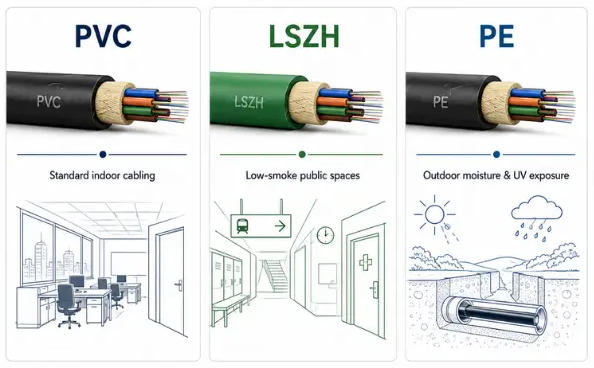
- LSZH is mainly selected for low-smoke and halogen-free fire performance.
- PVC is a cost-effective and flexible choice for many general indoor applications.
- PE is widely used for outdoor cables because of its excellent moisture, weather, and UV resistance.
There is no single jacket material that is best for every application. The correct choice depends on whether the cable will be installed indoors or outdoors, whether fire safety is critical, what environmental conditions exist, and what standards the project requires.
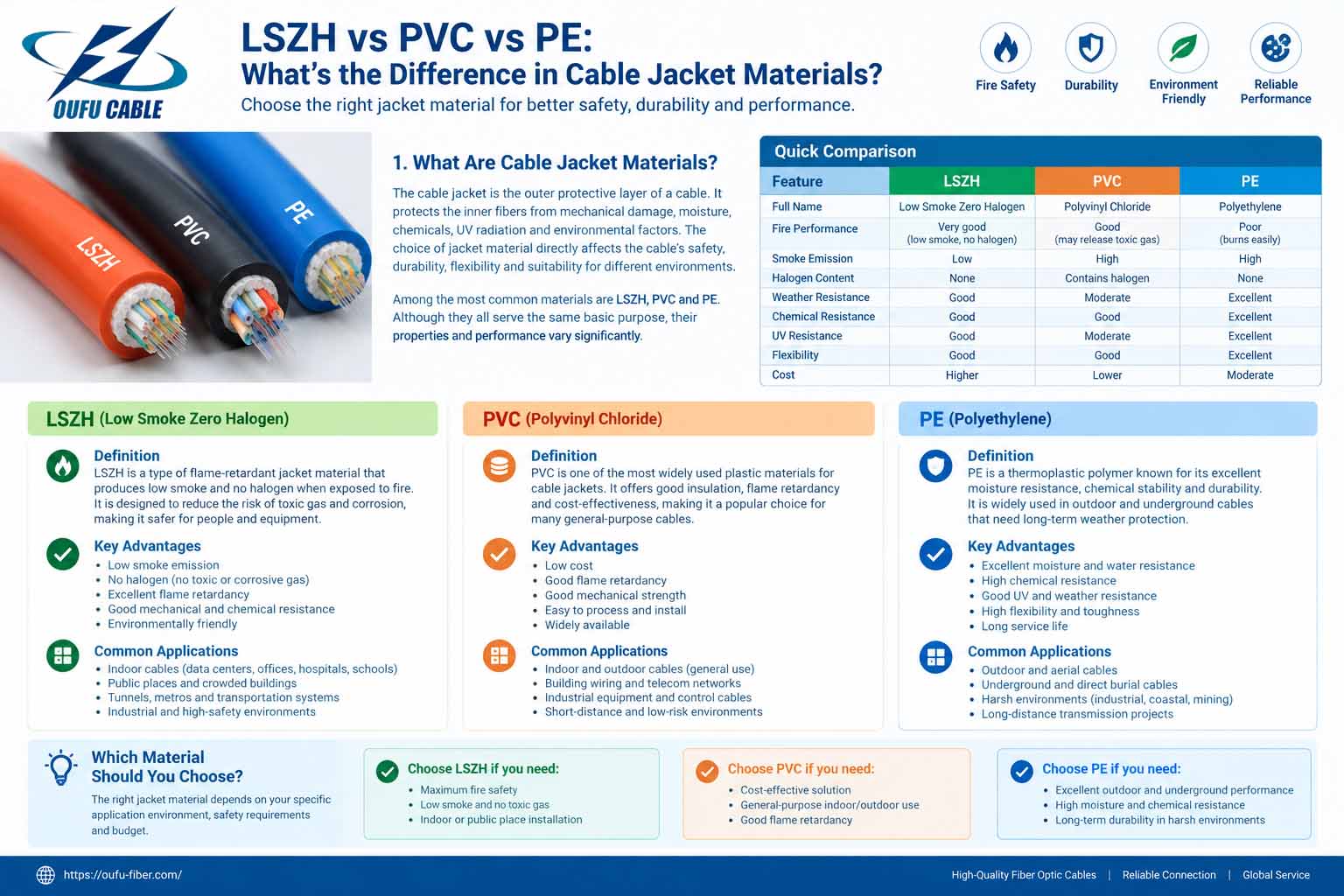
1. What Is a Cable Jacket?
A cable jacket, also called a cable sheath or outer sheath, is the protective outer layer surrounding a cable.
Depending on the cable construction, the jacket may surround optical fibers, buffer tubes, strength members, electrical conductors, shielding layers, armor, or other internal components.
The primary functions of a cable jacket include:
- Protecting the cable from mechanical damage
- Preventing moisture penetration
- Improving resistance to abrasion
- Providing protection against chemicals
- Protecting against sunlight and UV radiation
- Improving environmental durability
- Providing specific fire-performance characteristics
- Increasing the expected service life of the cable
For fiber optic cables, jacket selection is particularly important because the optical fibers themselves are sensitive to excessive mechanical stress, moisture, and environmental conditions.
A cable jacket should therefore be selected according to the installation environment rather than simply the cable price.
2. What Is LSZH Cable Jacket?
LSZH stands for Low Smoke Zero Halogen.
LSZH is not necessarily one single polymer. It describes a family of halogen-free cable compounds designed to produce low levels of smoke and very low levels of halogen acid gases when exposed to fire.
Many LSZH compounds are based on polyolefin-type materials combined with flame-retardant mineral fillers.
The main objective of an LSZH jacket is not simply to prevent a cable from burning. Its key advantage is to reduce the amount of smoke and corrosive halogen-containing gases generated during combustion. IEC 60754 and IEC 61034 are among the standards commonly associated with halogen-gas and smoke-performance testing.
Main advantages of LSZH
1. Low smoke generation
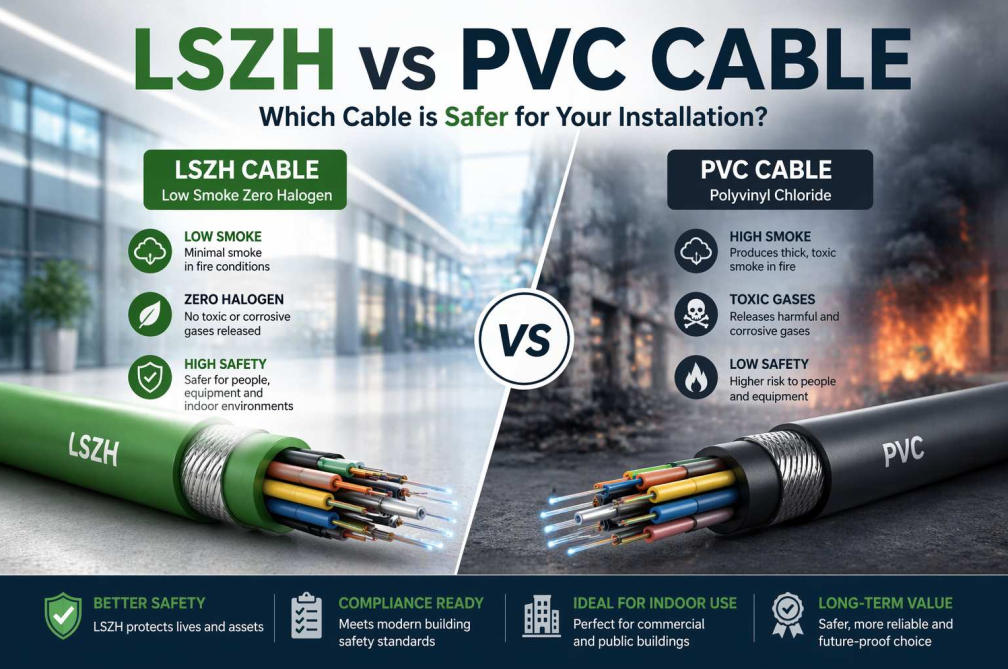
LSZH cable jackets are designed to generate significantly less smoke than conventional PVC during fire conditions.
Lower smoke levels can help maintain visibility in enclosed areas and support evacuation.
2. Halogen-free construction
LSZH compounds are designed without halogenated materials that generate corrosive halogen acid gases during combustion.
3. Better suited to enclosed spaces
LSZH is commonly considered for:
- Data centers
- Server rooms
- Telecommunications rooms
- Hospitals
- Schools
- Airports
- Railway systems
- Subway and metro tunnels
- Public buildings
- Industrial control rooms
- Other enclosed or occupied areas
4. Reduced risk to sensitive equipment
Corrosive combustion gases can damage electronic equipment and infrastructure. For this reason, LSZH can be particularly valuable in high-density communication and data environments.
Limitations of LSZH
LSZH should not automatically be considered the best material for every application.
Depending on the formulation, LSZH may have:
- Higher material cost
- Different flexibility characteristics compared with PVC
- More demanding processing requirements
- Lower UV/weather resistance than outdoor PE compounds
- Different low-temperature installation characteristics
Therefore, an LSZH label alone does not define the complete performance of a cable. The specific product datasheet and test certifications should always be checked.
3. What Is PVC Cable Jacket?
PVC stands for Polyvinyl Chloride.
PVC has been one of the most widely used cable jacket materials for decades because it offers a good balance between cost, flexibility, processability, mechanical protection, and general chemical resistance.
PVC is commonly used for indoor communication cables, Ethernet cables, control cables, electrical cables, patch cords, and other general-purpose cable products.
Advantages of PVC cable jackets
1. Lower cost
One of the biggest advantages of PVC is its relatively low material and manufacturing cost.
For price-sensitive projects, PVC can provide an economical solution.
2. Good flexibility
PVC cable jackets can be formulated to provide good flexibility, making them convenient for installation and routing.
3. Good general mechanical protection
PVC provides reasonable resistance to abrasion and everyday mechanical stress.
4. Easy manufacturing
PVC has a long history of cable manufacturing, so suppliers can produce a wide range of PVC-jacketed cable designs.
5. Wide availability
PVC cables are available in many constructions, sizes, colors, and performance grades.
Limitations of PVC
The major concern with PVC is its behavior during combustion.
Because PVC contains chlorine, burning PVC can generate hydrogen chloride and dense smoke. These combustion products can be corrosive and can create additional concerns in enclosed spaces.
Therefore, PVC may be suitable for general indoor applications where the applicable fire code permits it, but it may not be the preferred choice for environments where low smoke and halogen-free performance are specifically required.
4. What Is PE Cable Jacket?
PE stands for Polyethylene.
PE is one of the most common jacket materials for outdoor communication and fiber optic cables.
It is especially popular for:
- Outdoor fiber optic cable
- Aerial fiber optic cable
- Direct burial fiber cable
- Duct fiber optic cable
- Underground communication cable
- Outdoor Ethernet cable
- Telecom cables
- Utility communication networks
The major strength of PE is environmental durability.
Advantages of PE cable jackets
1. Excellent moisture resistance
PE has very low water absorption, making it highly suitable for wet environments.
2. Excellent outdoor performance
PE is widely used for cables exposed to outdoor environmental conditions.
3. Good UV resistance
Properly formulated black PE jackets, often using carbon black, can provide strong resistance to long-term sunlight exposure.
4. Good chemical resistance
PE generally provides good resistance to many common environmental chemicals.
5. Excellent choice for underground applications
PE is frequently used in direct-burial and duct cable constructions where moisture and environmental durability are major concerns.
For optical cables, PE is widely regarded as a standard outdoor sheath material.
Limitations of PE
The main weakness of PE is fire performance.
PE is combustible and is generally not selected for applications where stringent indoor flame and smoke requirements apply.
This means that a PE-jacketed outdoor cable should not simply be brought indoors without checking whether the cable construction and local installation requirements permit it.
5. LSZH vs PVC vs PE: Quick Comparison
| Property | LSZH | PVC | PE |
|---|---|---|---|
| Full name | Low Smoke Zero Halogen | Polyvinyl Chloride | Polyethylene |
| Main advantage | Low smoke and halogen-free fire behavior | Low cost and flexibility | Outdoor durability |
| Smoke during fire | Low | Relatively high | Can burn readily |
| Halogen | Zero/halogen-free formulation | Contains chlorine | Halogen-free |
| Flame performance | Designed for low-smoke/fire applications | Depends on formulation/rating | Generally poor without special formulation |
| UV resistance | Product dependent | Generally limited | Excellent in outdoor-grade formulations |
| Water resistance | Good, formulation dependent | Good | Excellent |
| Flexibility | Good, formulation dependent | Very good | Moderate |
| Mechanical durability | Good | Good | Very good |
| Outdoor suitability | Product dependent | Limited/product dependent | Excellent |
| Indoor suitability | Excellent for many safety-sensitive environments | Excellent for many general applications | Usually not preferred |
| Relative cost | Higher | Low | Low to medium |
| Typical application | Data centers, tunnels, public buildings | General indoor cabling | Outdoor, buried and aerial cable |
The important point is that LSZH, PVC, and PE are not simply three different levels of the same cable. They are materials designed around different performance priorities.
6. LSZH vs PVC: What Is the Main Difference?
The most common comparison is LSZH vs PVC because both are widely used for indoor communication cables.
The key difference is their behavior during a fire.
PVC is economical, flexible, and widely available. However, combustion can produce dense smoke and corrosive chlorine-containing gases.
LSZH is specifically designed to reduce smoke and eliminate halogen-containing combustion gases.
Therefore:
Choose PVC when:
- Cost is an important factor
- The cable is installed in a general indoor environment
- Local codes permit PVC
- Extreme low-smoke performance is not required
Choose LSZH when:
- Fire smoke is a major concern
- The cable is installed in a public building
- The cable is installed in a data center
- The installation is in a tunnel or transportation system
- Sensitive electronic equipment requires additional protection
- The project specification requires halogen-free cable
However, it is important not to confuse jacket material with the complete fire rating of a cable. A cable’s actual fire performance depends on its construction, compound, testing, and certification.
7. PE vs PVC: What Is the Main Difference?
The most important difference between PE and PVC cable jackets is the installation environment.
PE is generally stronger for outdoor environments.
PVC is generally more common for indoor applications.
PE is better when:
- The cable is exposed to sunlight
- The cable is installed outdoors
- The cable is installed underground
- Moisture is expected
- The cable is installed in ducts
- Long-term weather resistance is important
PVC is better when:
- The cable is installed indoors
- Cost is a major consideration
- Good flexibility is required
- Outdoor exposure is limited
- Applicable fire requirements permit PVC
For example, an outdoor fiber optic cable used between buildings may commonly use a PE outer jacket because UV, rain, humidity, and temperature changes are major concerns.
8. LSZH vs PE: Which Is Better?
LSZH and PE are often selected for completely different reasons.
LSZH focuses primarily on fire safety.
PE focuses primarily on outdoor environmental protection.
For example:
Data center
LSZH is often preferred because smoke and corrosive gases are important considerations.
Outdoor telecom network
PE is usually preferred because moisture, UV radiation, rain, and environmental durability are more important.
Railway tunnel
LSZH may be preferred because the cable is installed in an enclosed environment with occupants and strict fire-safety requirements.
Direct-burial fiber cable
PE is commonly selected because the cable must withstand moisture and underground environmental conditions.
In some specialized cable constructions, different sheath materials may be combined—for example, an indoor LSZH layer and an outdoor PE layer—to balance fire performance and environmental protection.
9. Cable Jacket Selection by Application
Choosing the correct jacket becomes much easier when the installation environment is considered first.
9.1 Data Centers
Recommended: LSZH
Data centers contain large quantities of network and fiber optic cables in relatively enclosed spaces.
Fire safety, smoke generation, equipment protection, and cable density are important considerations.
LSZH can therefore be a strong choice when required by the project specification.
9.2 Office Buildings
Recommended: PVC or LSZH depending on local requirements
For conventional office environments, PVC may be an economical solution.
However, if the building specification requires low-smoke, halogen-free cable, LSZH should be selected.
The final decision should be based on the building code and project specification rather than material price alone.
9.3 Hospitals
Recommended: LSZH where specified
Hospitals are occupied buildings with patients, medical equipment, and complex evacuation requirements.
Low smoke and reduced corrosive gas generation can therefore be particularly important.
9.4 Railway and Subway Systems
Recommended: LSZH or specially certified low-smoke cable
Railway tunnels and subway systems are enclosed environments where smoke can seriously affect visibility and evacuation.
For these applications, cable selection is normally driven by project-specific fire and smoke requirements.
9.5 Outdoor Fiber Optic Networks
Recommended: PE
PE is widely used for outdoor optical cable because it provides strong resistance to moisture, weather, and UV exposure.
Typical applications include:
- Aerial ADSS cable
- Outdoor GYTA cable
- GYTS cable
- Direct-burial fiber optic cable
- Duct fiber optic cable
- Building-to-building fiber links
9.6 Direct Burial Fiber Optic Cable
Recommended: PE
Direct-burial cables are exposed to soil moisture, temperature changes, mechanical stress, and environmental conditions.
PE is therefore a common outer sheath material.
However, jacket material is only one part of a direct-burial cable design. Armoring, water blocking, strength members, and other structural elements must also be selected according to the installation environment.
10. How Cable Jacket Materials Affect Cable Price
Material choice also influences the overall cable price.
In general:
PVC → economical
PE → economical to medium
LSZH → higher cost
However, material cost should not be the only consideration.
A cheaper cable may become more expensive if it:
- Fails a project specification
- Cannot pass fire inspection
- Has insufficient UV resistance
- Requires replacement
- Has inadequate environmental protection
- Creates additional installation restrictions
Therefore, professional cable procurement should evaluate total project cost rather than jacket price alone.
11. Cable Jacket and Fire Safety
One common misunderstanding is:
“If a cable is flame-retardant, it is automatically safe.”
This is not necessarily true.
Fire performance involves multiple factors, including:
- Flame propagation
- Smoke density
- Halogen gas generation
- Gas acidity
- Heat release
- Cable installation configuration
- Cable bundling
- Applicable building codes
For LSZH cables, commonly referenced IEC standards include IEC 60332 for flame propagation, IEC 60754 for halogen acid gas characteristics, and IEC 61034 for smoke density.
Therefore, buyers should request the relevant test reports or certificates for the actual cable model, rather than relying only on a marketing term such as “fire resistant” or “LSZH.”
12. LSZH vs PVC vs PE for Fiber Optic Cable
For fiber optic cable manufacturers and buyers, jacket selection is closely related to cable construction.
Outdoor fiber optic cable
PE is commonly used.
Examples include:
- ADSS
- GYTA
- GYTS
- GYXTW
- GYFTY
- Direct burial cable
- Duct cable
- Aerial cable
Indoor fiber optic cable
PVC or LSZH can be selected depending on the application.
High-safety indoor fiber cable
LSZH is often preferred when low smoke and halogen-free performance are required.
Outdoor-to-indoor transition
A cable may require a specialized construction that balances outdoor environmental resistance with indoor fire requirements.
This is why buyers should not select a jacket material independently from the complete cable design.
13. Which Cable Jacket Should You Choose?
A simple selection strategy is:
Choose LSZH if:
- The cable is installed indoors
- The building is occupied
- Low smoke is required
- Halogen-free performance is specified
- The cable is installed in a data center
- The cable is installed in a tunnel
- The project has strict fire-safety requirements
Choose PVC if:
- The cable is installed indoors
- The project allows PVC
- Cost efficiency is important
- Good flexibility is required
- No special halogen-free requirement exists
Choose PE if:
- The cable is installed outdoors
- UV exposure is expected
- Moisture resistance is important
- The cable is installed underground
- Direct burial is required
- Long-term weather resistance is important
The easiest rule to remember is:
LSZH = fire and smoke safety
PVC = economical indoor protection
PE = outdoor environmental protection
14. LSZH vs PVC vs PE: Multi-Dimensional Comparison
| Selection Factor | LSZH | PVC | PE |
|---|---|---|---|
| Fire safety | Excellent for low-smoke/halogen-free requirements | Depends on formulation and rating | Generally weak |
| Smoke performance | Excellent | Poorer than LSZH | Not the main strength |
| Halogen-free | Yes | No | Yes |
| Indoor applications | Excellent | Excellent in permitted applications | Limited |
| Outdoor applications | Product dependent | Limited | Excellent |
| UV resistance | Compound dependent | Generally lower | Excellent |
| Moisture resistance | Good | Good | Excellent |
| Flexibility | Good | Excellent | Good/moderate |
| Abrasion resistance | Good | Good | Very good |
| Chemical resistance | Good | Good | Very good |
| Cost | Higher | Lowest | Low/medium |
| Data centers | Excellent | Possible depending on requirements | Generally unsuitable |
| Public buildings | Often preferred when specified | Project dependent | Generally unsuitable |
| Aerial fiber | Product dependent | Rare | Excellent |
| Direct burial | Specialized designs | Less common | Excellent |
| Duct cable | Possible | Possible | Excellent |
| Best overall characteristic | Fire safety | Cost and flexibility | Outdoor durability |
15. Common Mistakes When Choosing Cable Jacket Material
Mistake 1: Choosing only by price
The cheapest cable is not necessarily the lowest-cost solution.
Always consider compliance, installation environment, service life, and replacement costs.
Mistake 2: Using PE indoors
PE is excellent outdoors but is generally not selected for indoor fire-sensitive applications.
Mistake 3: Assuming all LSZH cables are identical
LSZH is a material-performance designation, not a complete cable specification.
Different LSZH compounds can have different mechanical, temperature, flexibility, and environmental properties.
Mistake 4: Assuming PVC is always unsafe
PVC remains a widely used and technically useful cable jacket material.
The question is whether the specific PVC cable meets the requirements of the intended installation.
Mistake 5: Ignoring local regulations
Fire and cable installation requirements vary by country, building type, and project.
Always verify the applicable local code and required certification before placing a large cable order.
16. FAQ: LSZH vs PVC vs PE Cable Jacket
Is LSZH better than PVC?
Not universally.
LSZH is generally better when low smoke and halogen-free combustion performance are important. PVC can be a better choice when low cost, flexibility, and general-purpose indoor performance are the priorities.
Is PE better than LSZH for outdoor fiber optic cable?
In many conventional outdoor fiber optic applications, PE is the preferred choice because of its excellent weather, moisture, and UV resistance.
However, a project with special fire-safety requirements may require a different construction.
Is PVC suitable for outdoor cable?
PVC can be used in some outdoor applications if the specific cable is designed and rated for outdoor exposure. However, PE is generally the more common choice for long-term outdoor telecom and fiber optic cable applications.
Is LSZH waterproof?
LSZH does not automatically mean waterproof.
Water resistance depends on the specific compound and the complete cable construction, including water-blocking materials and sheath design.
Is PE flame retardant?
Standard PE is combustible and is not normally selected for indoor fire-sensitive applications.
Special flame-retardant PE formulations exist, but buyers should verify the exact cable specification and test results.
Is LSZH more expensive than PVC?
Generally, yes.
LSZH compounds and their processing can cost more than conventional PVC. However, the price difference varies by cable design, manufacturer, certification requirements, and order quantity.
What is the best jacket for outdoor fiber optic cable?
For many outdoor fiber optic cables, PE is the standard choice because it provides strong moisture and weather resistance.
For special indoor or fire-sensitive environments, LSZH may be more appropriate.
What is the best jacket for a data center?
LSZH is often preferred for data center applications when the project requires low smoke and halogen-free cable.
However, the final choice should follow the data center’s fire-rating and installation specifications.
17. Final Conclusion: LSZH vs PVC vs PE
The difference between LSZH, PVC, and PE cable jackets is primarily about matching material characteristics to the installation environment.
LSZH is designed for environments where low smoke and halogen-free fire performance are important. It is commonly considered for data centers, public buildings, transportation systems, tunnels, hospitals, and other enclosed spaces.
PVC is a cost-effective, flexible, and widely available material for general-purpose cable applications, especially indoors where the applicable fire and installation requirements permit it.
PE is one of the most common choices for outdoor communication and fiber optic cables because of its excellent moisture resistance, weather resistance, and UV performance.
Therefore, there is no universal “best” cable jacket.
The best approach is:
Choose LSZH for fire and smoke safety, PVC for economical general-purpose indoor cabling, and PE for outdoor environmental durability.
For fiber optic cable buyers, the jacket should also be evaluated together with the cable’s fiber type, strength member, armor, water-blocking system, operating temperature, UV resistance, flame rating, installation method, and applicable international or local standards.
A professional fiber optic cable manufacturer should be able to provide the complete technical datasheet, jacket material specification, applicable test standards, and customized cable construction according to the project requirements.