As global digital infrastructure expands rapidly, single-mode optical fiber has become the foundational medium for all high-speed data transmission. Among mainstream fiber specifications, ITU-T G.657A2 bend-insensitive single-mode fiber has witnessed explosive growth in market demand over the past three years. Telecom operators, system integrators, data center builders, fiber cable manufacturers and engineering contractors are increasingly prioritizing G657A2 fiber for new projects and network upgrades. Many buyers ask: Why is G657A2 so popular? What critical problems can G657A2 resolve that G652D and G657A1 cannot handle efficiently?
1. Core Technical Advantages of G657A2: Solving The Biggest Industry Pain Point — Bending Loss
The root cause of strong market demand for G657A2 lies in its optimized optical structure designed to eliminate macrobending loss, a long-standing headache for fiber installation teams worldwide.
ITU-T G.652D is the traditional standard single-mode fiber widely deployed in long-haul trunk and metro networks. However, G652D suffers severe light leakage and high attenuation once bent sharply. The recommended minimum bending radius for G652D reaches 30–40 mm. In tight construction environments, any accidental sharp bend will trigger obvious signal attenuation, unstable network speeds, increased packet loss, and frequent post-installation maintenance failures. Thousands of engineering teams face this problem every day: retrofitting old buildings, narrow conduits, compact termination boxes, crowded server racks all force fiber to turn tightly.
G.657 series fibers are developed to fix bending loss issues, divided into multiple subcategories.
- G657A1: Minimum bending radius 10 mm
- G657A2: Minimum bending radius 7.5 mm
- G657B series: For ultra-short-distance extreme bending, limited compatibility
G657A2 adopts trench-assisted refractive index profile design. Light signals are tightly confined within the fiber core. Even when bent to a static radius of 7.5 mm, macro-bending loss remains extremely low across 1260 nm – 1625 nm full transmission band (O, E, S, C, L band). Installers can create U-turns, compact fiber loops inside splice closures, and route cables around door frames, wall corners without worrying about excessive attenuation.
For engineering contractors, this directly translates into fewer project failures. Countless FTTH renovation projects in old residential buildings previously encountered OTDR test failure after construction using G652D. Operators had to redesign routing, drill new holes, extend construction cycles and raise labor costs. Switching to G657A2 removes most routing restrictions, cutting rework rates dramatically. This is the primary driving factor pushing global buyers to select G657A2.
2. Full Backward Compatibility with G652D: Zero Risk for Network Upgrade Projects
A decisive advantage separating G657A2 from G657B fiber is its full compliance with ITU-T G.652D specifications. As Category A bend-insensitive fiber, G657A2 shares identical transmission characteristics with standard single-mode fiber. It can be seamlessly spliced, interconnected and mixed deployed with existing G652D fiber networks without extra loss, transceiver modification or system adjustment.
This compatibility solves a major procurement pain point for operators: network reconstruction risk. Many telecom companies are carrying out phased network upgrades. If fiber types cannot be mixed, operators must deploy completely separated fiber networks, which multiplies capital expenditure. G657A2 allows mixed networking between newly laid access segments and legacy trunk fiber. Network planners do not need to overhaul existing infrastructure, greatly lowering upgrade thresholds.
In contrast, G657B3 fiber achieves even better bending performance but lacks complete G652D compatibility. It is only suitable for short-distance indoor wiring and cannot extend to metro or distribution networks, limiting its application scope. Therefore, when projects require both strong bending resistance and universal compatibility, G657A2 becomes the optimal balanced choice.
3. Multiple High-Growth Application Scenarios Drive Continuous Surge in Consumption
The demand explosion of G657A2 comes from simultaneous expansion across multiple massive markets, including FTTx access networks, AI high-density data centers, 5G/5G-A construction, all-optical campus networks and emerging special industrial applications.
3.1 FTTH & FTTx Networks: The Largest Traditional Consumption Scenario
Fiber-to-the-Home remains the core consumption field of G657A2. Globally, developing economies in Southeast Asia, Africa, Latin America and Eastern Europe are accelerating broadband infrastructure rollout. Millions of multi-story apartments, old communities and villas require indoor drop cable wiring.
Home installation environments are notoriously restrictive: thin concealed conduits, narrow wall wire boxes, tight ONT termination space. Installers need to reserve fiber slack inside small terminal boxes, which requires coiling fiber into small loops. G652D cannot withstand such layout. While G657A1 works for general cases, complex decoration layouts with multiple sharp corners often push G657A1 to its performance limit. In high-end residential and commercial FTTH projects, contractors prefer G657A2 for higher installation tolerance and long-term stability.
Indoor GJYXCH drop cables, invisible optical fiber and pre-terminated fiber jumpers widely adopt G657A2 fiber core. As XGS-PON, 25G PON and next-generation broadband access technology spread, operators raise stricter standards for signal stability, further accelerating G657A2 penetration in FTTx.
3.2 AI Data Center High-Density Cabling: Fastest Growing Demand Engine
The construction boom of AI computing centers creates brand-new demand for bend-insensitive fiber. Modern GPU clusters, 400G/800G transceivers and high-density MPO wiring systems deploy massive fiber jumpers inside server racks. Rows of patch panels force numerous tight bends within limited cabinet space.
Traditional fiber suffers accumulated bending loss after long-term operation, causing unstable high-speed optical module links. Operators of hyperscale data centers (cloud service providers in North America, Europe and Asia) now specify G657A2 for indoor horizontal cabling and rack jumpers. Even small and medium enterprise data centers gradually adopt G657A2 to reduce future operation failure risks. Industry forecasts show data center fiber demand will maintain 70%+ annual growth until 2027, and G657A2 accounts for an increasing proportion of indoor fiber procurement.
3.3 5G, 5G-A and All-Optical Campus Networks
5G base station fronthaul, building all-optical networks, smart hotel wiring and campus FTTO (Fiber to the Office) projects rely heavily on internal compact fiber routing. Inside communication equipment rooms, riser pipelines and wireless AP wiring channels, fiber inevitably undergoes repeated bending.
Global telecom carriers continuously expand 5G coverage. Indoor distributed antenna systems for shopping malls, office buildings and subway stations need large volumes of indoor optical cables. Network designers prioritize G657A2 to guarantee stable fronthaul transmission. Many mainstream all-optical campus solution providers have listed G657A2 as standard fiber specification for new projects.
3.4 Emerging Industrial Application: Fiber-Tethered FPV Drones
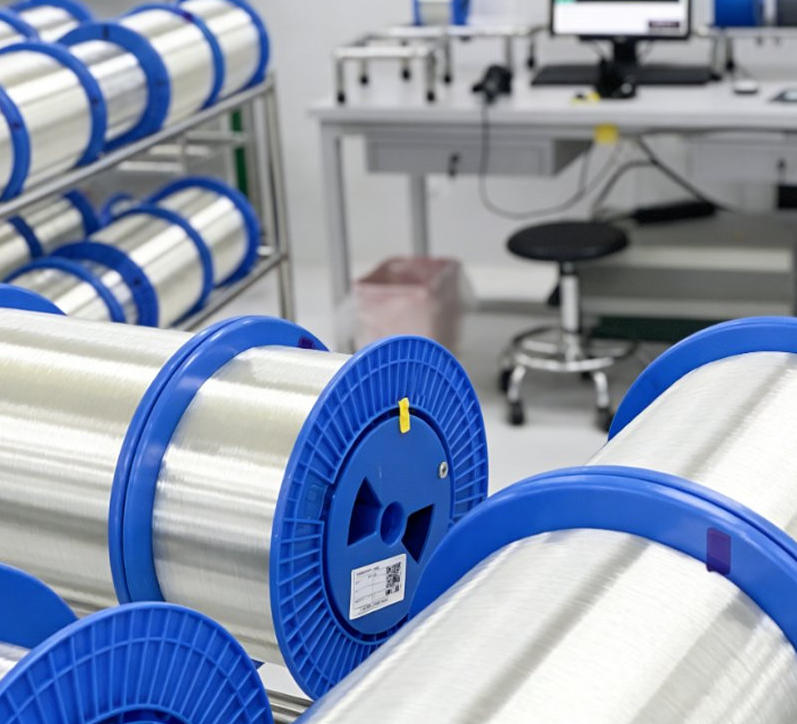
In recent years, industrial and defense fiber-guided drones have become an emerging incremental market for G657A2. Radio control signals face risks of electromagnetic interference and signal interception, while optical fiber transmission achieves anti-jamming, low-latency real-time data transmission. Each drone carries several kilometers of ultra-fine bare fiber wound on compact spools.
Fiber needs to endure continuous winding, unwinding and sharp bending during flight. Only G657A2 maintains stable optical performance under repeated bending stress. This special demand brings additional bulk consumption, further tightening global G657A2 fiber supply and supporting high market demand.
4. Reduce Total Lifecycle Cost: Why G657A2 Delivers Better ROI for Projects
Many purchasers initially hesitate because G657A2 raw fiber price is slightly higher than G657A1 and significantly higher than G652D. However, calculating total project cost proves G657A2 brings superior long-term economic benefits.
First, G657A2 lowers construction rework costs. Signal loss failures caused by bending are one of the most common engineering problems. Rework involves labor, material waste and project delay penalties. Using G657A2 maximizes construction flexibility, allowing engineers to follow existing pipeline routes without new drilling or pipeline reconstruction. For renovation projects in historic buildings, residential communities and completed commercial buildings, the savings are extremely substantial.
Second, G657A2 reduces after-sales maintenance expenses. Operators and property management teams receive fewer network fault reports caused by fiber bending attenuation. Long-term operation and maintenance workload drops significantly.
Third, G657A2 supports cable miniaturization. Thanks to outstanding bending tolerance, manufacturers can produce micro optical cables suitable for air-blown installation inside microducts. Smaller cable outer diameter improves pipeline utilization. Existing crowded pipe resources can accommodate more fiber cores, postponing expensive pipeline expansion investment.
From the perspective of 20–30 year network service lifecycle, the small premium of G657A2 raw fiber is offset by saved construction, maintenance and infrastructure expansion costs. More budget-conscious project owners gradually recognize this value and upgrade fiber specifications.
5. G652D vs G657A1 vs G657A2: Clear Selection Reference for Buyers
To help procurement and engineering teams accurately judge when G657A2 is necessary, we summarize applicable scenarios:
- G652D: Long-distance trunk lines, metro backbone networks; spacious pipeline environment with standardized large bending radius routing. Not recommended for indoor wiring, FTTH drop cables and dense rack cabling.
- G657A1: General FTTH projects, simple indoor wiring with moderate bending requirements. Balanced cost and bend resistance for conventional access networks.
- G657A2: Old building renovation, narrow concealed conduits, compact termination boxes, high-density data center racks, pre-terminated fiber assemblies, complex multi-corner wiring, industrial equipment internal wiring. Ideal when installation space is limited and routing cannot be optimized.
If your project contains uncertain routing conditions, tight pipelines, many turning points or long-term stable high-speed transmission requirements, G657A2 is the safest specification choice to avoid hidden network risks.
6. Outlook: G657A2 Demand Will Maintain Upward Trend in Coming Years
Multiple factors guarantee sustained robust demand for G657A2 fiber. First, global broadband penetration continues rising, and developing countries keep investing in FTTx infrastructure. Second, AI computing infrastructure construction cycle remains long, driving steady demand for indoor high-density fiber. Third, 5G-A and future 6G networks require larger-capacity optical access networks, raising standards for fiber stability. Fourth, more network operators update technical specifications, incorporating G657A2 as the preferred fiber for access and indoor cabling in new tender documents.
Limited by production technology, the expansion pace of high-quality G657A2 fiber preform capacity cannot fully catch up with fast-growing market demand. Short-term supply tightness will persist, further lifting market attention toward G657A2 fiber and finished optical cables.
Conclusion
The booming demand for ITU-T G657A2 fiber is not temporary market speculation, but the inevitable result of digital infrastructure development. Its core value lies in solving the universal industry pain point of fiber bending loss, while maintaining complete compatibility with traditional G652D networks. For FTTH operators, data center builders, system integrators and optical cable manufacturers, G657A2 provides flexible installation space, reduces project risk and optimizes long-term return on investment.
When facing complex construction environments with limited space and unavoidable sharp bends, G657A2 stands out as the most cost-effective, future-proof bend-insensitive single-mode fiber solution. As global high-speed network construction accelerates, market demand for G657A2 will keep growing steadily in the next 3–5 years.
FAQ
Q1: Can G657A2 fiber mix with G652D fiber?
A1: Yes. G657A2 belongs to Category A fiber fully compliant with G652D, seamless splicing and mixed deployment.
Q2: Is G657A2 necessary for all FTTH projects?
A2: No. For newly built apartments with sufficient pipeline space, G657A1 meets demands. Choose G657A2 for old building renovation and complex wiring scenarios.
Q3: What is the difference between G657A2 and G657B3?
A3: G657A2 supports full-network deployment and compatible with G652D; G657B3 is ultra-bendable but lacks compatibility, limited to short-distance indoor wiring.