Copper-clad aluminum (CCA) network cable is an Ethernet cable that uses aluminum as the main conductor and a thin layer of copper as the outer cladding. Because the conductor surface is copper-colored, CCA cable can look very similar to a pure copper network cable, but the two materials have significantly different electrical, mechanical, cost, and application characteristics.
CCA network cable is mainly developed to reduce conductor cost and cable weight. Aluminum is considerably less expensive and lighter than copper, while the copper coating provides a conductive outer surface. However, CCA has higher electrical resistance and lower mechanical strength than pure copper. For this reason, buyers should carefully distinguish between CCA cable and standards-compliant pure copper Ethernet cable, especially for permanent structured cabling, PoE, commercial buildings, and other demanding applications.
This guide explains what copper-clad aluminum network cable is, how it works, its advantages and disadvantages, common applications, and the key differences between CCA and pure copper network cable.
1. What Is Copper-Clad Aluminum Network Cable?
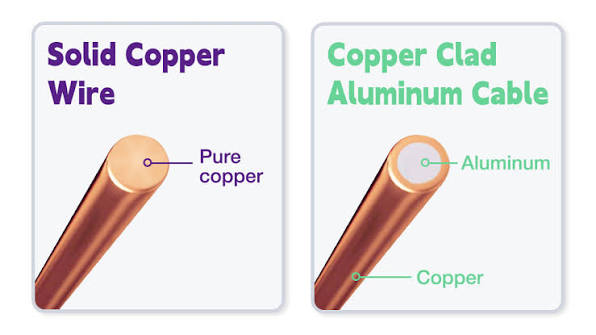
Copper-clad aluminum network cable, commonly called CCA Ethernet cable, is a cable whose conductors consist primarily of an aluminum core covered by a bonded layer of copper.
The basic conductor structure can be simplified as:
Copper outer layer → Aluminum core → Copper outer layer
Unlike pure copper cable, the conductor is not made entirely from copper.
The copper coating gives the conductor a copper surface, while aluminum provides most of the conductor’s volume. Copper-clad aluminum technology itself is a recognized conductor technology for certain electrical applications; for example, ASTM B566 specifies copper-clad aluminum wire and defines classes with nominal 10% or 15% copper by volume. However, the existence of a CCA conductor specification does not mean that a particular CCA Ethernet cable automatically meets the requirements for a Category-rated structured cabling system.
This distinction is important because the terms “CCA wire,” “CCA cable,” “Cat6 cable,” and “pure copper Cat6 cable” are not interchangeable.
For professional Ethernet cabling, conductor material is one of the first specifications that should be verified.
2. How Is CCA Network Cable Constructed?
A typical CCA network cable contains multiple twisted pairs. A conventional Ethernet cable has four twisted pairs, giving eight individual conductors.
In a CCA cable, each conductor generally contains:
- An aluminum center
- A thin copper cladding layer
- Insulation around the conductor
- Twisted-pair construction
- An outer cable jacket
The copper layer helps protect the aluminum core and provides a copper surface for electrical contact. The aluminum core reduces material cost and overall cable weight.
From the outside, however, CCA and copper conductors can look almost identical. This is why simply looking at a cable jacket or conductor color is not always enough to determine its material.
Fluke Networks has specifically warned that CCA and other non-standard conductors can appear similar to standard communications cable and may be difficult to identify through visual inspection alone.
3. Why Is CCA Used in Network Cable?
The main reason manufacturers use CCA is cost reduction.
Copper has excellent electrical conductivity, but it is significantly more expensive than aluminum. By replacing most of the copper with aluminum while maintaining a copper outer layer, manufacturers can reduce conductor material costs.
CCA cable also has another obvious advantage: lower weight.
This can be attractive for applications where cable cost or weight is a major consideration.
However, reducing copper content also changes the electrical characteristics of the cable. Aluminum has higher electrical resistivity than copper, so a CCA conductor of the same diameter has substantially higher resistance than a pure copper conductor.
Fluke Networks notes that aluminum conductors have roughly 55% greater resistance than copper conductors of the same diameter, which can create additional heating and voltage-drop concerns, particularly in PoE applications.
Therefore, CCA should not simply be viewed as “the same Ethernet cable at a lower price.” It is a different conductor construction with different performance limitations.
4. Main Characteristics of CCA Network Cable
4.1 Lower Material Cost
The most obvious advantage of CCA is its lower conductor cost.
Because aluminum replaces most of the copper, CCA cable can often be sold at a significantly lower price than comparable pure copper cable.
This makes CCA attractive to buyers whose primary objective is minimizing the initial purchase price.
However, the initial cable price should not be the only factor considered. Installation labor, network reliability, replacement costs, certification requirements, and equipment compatibility can have a much greater impact on total project cost.
4.2 Lower Cable Weight
Aluminum is much lighter than copper.
As a result, CCA conductors can reduce the overall weight of a cable compared with a copper conductor of similar dimensions.
Lower weight can be useful in certain applications, especially when transportation, handling, or cable quantity is important.
Nevertheless, for fixed Ethernet installations, the weight advantage is often less important than electrical performance and compliance.
4.3 Higher Electrical Resistance
This is one of the most important disadvantages of CCA.
Copper has better electrical conductivity than aluminum. Consequently, CCA conductors have higher resistance than equivalent pure copper conductors.
Higher resistance can contribute to:
- Greater voltage drop
- Higher conductor heating
- Greater transmission loss
- Reduced performance margin
- More difficulty supporting power delivery
These problems become more important as cable length increases or when the cable carries power as well as data.
4.4 Lower Mechanical Strength
Aluminum is generally softer and mechanically weaker than copper.
CCA conductors can therefore be more vulnerable to damage from excessive pulling, repeated bending, or improper termination.
This matters during installation because Ethernet cable is frequently pulled through conduits, cable trays, ceilings, walls, and other pathways.
Poor handling can damage the conductor or termination and create intermittent network problems.
4.5 Greater Sensitivity to Termination Quality
The interface between a cable conductor and an RJ45 plug, keystone jack, or other connector is critical.
Because CCA contains an aluminum core beneath a copper surface, installers must pay particular attention to connector compatibility and termination quality.
A cable that appears to work during initial testing may still have lower reliability under long-term environmental, mechanical, or electrical stress.
5. CCA vs. Pure Copper Network Cable: The Key Differences
The easiest way to understand CCA is to compare it directly with pure copper.
| Feature | CCA Network Cable | Pure Copper Network Cable |
|---|---|---|
| Conductor | Aluminum core + copper coating | Copper throughout |
| Electrical conductivity | Lower | Higher |
| Electrical resistance | Higher | Lower |
| Cable weight | Lower | Higher |
| Material cost | Lower | Higher |
| Mechanical strength | Generally lower | Generally higher |
| Voltage drop | Higher | Lower |
| PoE suitability | Limited / generally unsuitable for standards-compliant applications | Excellent |
| Long-distance performance | More limitations | Better |
| Permanent structured cabling | Generally not recommended | Recommended |
| Professional networks | Limited suitability | Preferred |
| Initial purchase price | Lower | Higher |
| Long-term reliability | Generally lower | Higher |
The fundamental difference is simple:
CCA optimizes for lower material cost and lower weight, while pure copper optimizes for electrical performance, reliability, and standards-compliant Ethernet deployment.
6. CCA vs. Pure Copper: Conductivity
Conductivity is one of the most important technical differences.
Pure copper provides excellent electrical conductivity and low resistance. This allows Ethernet signals and electrical power to travel with lower losses.
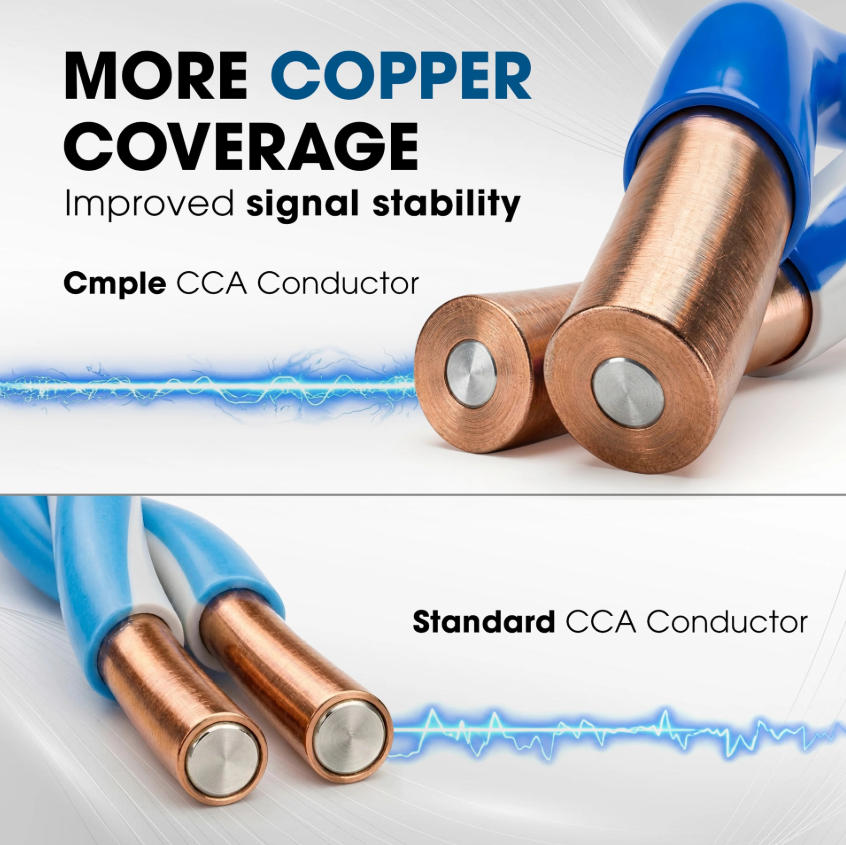
CCA relies mainly on aluminum for the conductor cross-section. Although the copper surface can contribute to high-frequency conduction through the skin effect, Ethernet cabling is still subject to resistance and other transmission requirements. The copper coating does not transform an aluminum core into a solid copper conductor.
Therefore, CCA generally provides less electrical performance margin than pure copper.
For short, low-demand connections, this difference may not always be immediately visible. But as cable length, data rate, temperature, or power requirements increase, the difference becomes more important.
7. CCA vs. Pure Copper: PoE Performance
Power over Ethernet (PoE) is one of the strongest reasons to choose pure copper.
PoE technology allows Ethernet cable to transmit both data and electrical power to devices such as:
- IP security cameras
- Wireless access points
- VoIP phones
- Network intercoms
- IoT devices
- Other powered Ethernet equipment
When power travels through a conductor, electrical resistance becomes particularly important.
Higher resistance produces greater voltage drop and heat generation. CCA’s higher resistance therefore creates additional limitations for PoE.
Fluke Networks specifically identifies increased DC resistance as a major concern with CCA cables and notes that the additional resistance can increase heating and reduce voltage available to powered devices.
For this reason, pure copper Ethernet cable is the safer and more appropriate choice for PoE, PoE+ and higher-power Ethernet deployments.
8. CCA vs. Pure Copper: Network Performance
A common misconception is that if a CCA cable is labeled “Cat6,” it must perform exactly like a pure copper Cat6 cable.
That conclusion is unsafe.
Category performance depends on the complete cable design, including conductor material, conductor diameter, insulation, twist geometry, impedance, crosstalk performance, attenuation, return loss, and other parameters.
Fluke Networks has highlighted that CCA products sold as Category-rated communications cables can fail to meet applicable cabling standards and may create network-performance problems.
Higher resistance and transmission losses can become more noticeable over longer cable runs.
Possible symptoms can include:
- Unstable connections
- Reduced transmission margin
- Packet retransmissions
- Link negotiation problems
- Reduced reliability
- Poor PoE performance
The exact behavior depends on the cable design, length, network equipment, installation environment, and application.
9. CCA vs. Pure Copper: Standards and Compliance
This is perhaps the most important issue for professional buyers.
A cable being physically capable of carrying Ethernet signals does not automatically mean that it is a standards-compliant Category cable.
Fluke Networks states that CCA conductors are not compliant with the requirements for standard multi-conductor communications cabling referenced by standards such as TIA-568 and ISO/IEC 11801, and it also raises concerns regarding applicable NEC and safety listings.
Therefore, buyers should not purchase a cable simply because the jacket says:
Cat5e / Cat6 / Cat6A
Instead, verify:
- Conductor material
- Manufacturer datasheet
- Applicable Category certification
- Safety listing
- Jacket rating
- DC resistance
- Installation requirements
- Intended application
For commercial structured cabling, compliance should take priority over the lowest purchase price.
10. Is CCA Network Cable Safe?
The answer depends on the specific product and installation environment.
CCA is not inherently a “fake material.” Copper-clad aluminum is a real conductor technology with legitimate electrical applications. The problem arises when CCA communications cable is marketed or installed as though it were standards-compliant solid copper Category cable.
The risk becomes particularly important in building installations, PoE systems, enclosed spaces, and projects subject to electrical and fire codes.
Fluke Networks notes that CCA communications cables may lack valid safety listings required for certain building applications and warns about increased heating associated with their higher resistance.
Therefore:
Do not assume that a low-cost CCA Ethernet cable is an acceptable substitute for pure copper structured cabling.
Always check local codes and the manufacturer’s certification before installation.
11. Common Applications of CCA Network Cable
CCA cable may be encountered in cost-sensitive or less demanding applications, particularly where:
- Cable runs are short
- Power is not transmitted through Ethernet
- The installation is temporary
- Network requirements are relatively light
- Local regulations permit the particular product
- The product is specifically designed and certified for the intended application
However, CCA is generally a poor choice for mission-critical infrastructure.
Pure copper is normally the better choice for:
- Enterprise networks
- Data centers
- Commercial buildings
- Permanent structured cabling
- PoE security cameras
- Wireless access points
- VoIP systems
- Industrial Ethernet
- Long-term installations
- High-speed network infrastructure
12. How to Identify CCA Network Cable
CCA cable can be difficult to distinguish from pure copper by appearance.
Several methods can help.
Check the Datasheet
The manufacturer’s technical specification should clearly identify the conductor material.
Look for terms such as:
- Bare copper
- Solid copper
- Stranded copper
- Copper-clad aluminum
- CCA
If the conductor material is not clearly specified, buyers should ask the manufacturer before purchasing.
Examine a Cut Conductor
If a conductor is cut or stripped, CCA typically shows a copper-colored exterior with a lighter-colored aluminum core underneath.
However, this method should not be used casually on installed cables.
Compare Cable Weight
Because aluminum is lighter than copper, CCA cable may weigh substantially less than an equivalent pure copper cable.
Fluke Networks has mentioned weighing cable as one possible identification method, although this is not by itself a definitive certification method.
Use Professional Cable Testing
For large commercial projects, professional cable certification equipment is a better approach than visual inspection.
This can help determine whether the installed cable meets the required transmission and resistance characteristics.
13. Why Is Pure Copper Usually the Better Choice?
Pure copper cable costs more, but it provides several important advantages.
Better Conductivity
Copper has excellent electrical conductivity, reducing conductor resistance and signal losses.
Better PoE Performance
Lower resistance helps minimize voltage drop and heat generation when Ethernet cable carries power.
Better Mechanical Reliability
Pure copper generally provides better mechanical robustness during installation and termination.
Better Long-Term Value
A low-cost CCA cable can become expensive if it causes repeated troubleshooting, replacement, downtime, or equipment problems.
For permanent network infrastructure, total cost of ownership is more important than initial cable price.
14. CCA vs. Pure Copper: A Procurement Decision
The decision can be summarized as follows:
Choose CCA only when the specific product is appropriate, permitted, and certified for the intended application.
Choose pure copper when performance, reliability, PoE, standards compliance, and long service life are important.
For most professional Ethernet infrastructure, pure copper is the recommended conductor material.
A useful procurement rule is:
If the cable will be installed permanently, carry PoE, support critical equipment, or be installed inside a commercial building, verify that it uses compliant copper conductors rather than selecting a cable solely because it is cheaper.
15. Frequently Asked Questions About CCA Network Cable
Is Copper-Clad Aluminum the same as copper cable?
No. CCA has an aluminum core covered by copper, while pure copper cable uses copper throughout the conductor.
Is CCA cable cheaper than pure copper?
Generally, yes. The use of aluminum reduces conductor material cost, which is the primary economic reason CCA products exist.
Is CCA good for Ethernet?
CCA can transmit Ethernet signals, especially in less demanding circumstances, but it should not automatically be considered equivalent to standards-compliant pure copper Category cable.
Can CCA cable be used for PoE?
CCA is generally not recommended for PoE applications because its higher resistance can cause greater voltage drop and heat generation. Pure copper is the preferred choice for PoE infrastructure.
Is CCA Cat6 really Cat6?
A cable may be marketed with a Category designation, but conductor material and compliance must be verified. CCA should not be assumed to meet the requirements of a standards-compliant Category 6 structured cabling system.
Is pure copper better than CCA?
For professional Ethernet networking, the answer is generally yes. Pure copper provides lower resistance, better conductivity, better PoE performance, greater reliability, and better suitability for permanent structured cabling.
Conclusion
Copper-clad aluminum network cable is an Ethernet cable that uses an aluminum conductor core covered with a copper layer. Its main advantages are lower material cost and lower weight, which explain why CCA cables are attractive in price-sensitive markets.
However, CCA has important limitations. Compared with pure copper, it has higher electrical resistance, lower mechanical strength, greater voltage-drop and heating concerns, and significant limitations for PoE and standards-compliant structured cabling.
Pure copper Ethernet cable uses copper throughout the conductor. Although its initial purchase price is higher, it provides better electrical performance, reliability, power-delivery capability, and suitability for professional network infrastructure.
For buyers comparing CCA vs. pure copper network cable, the key question should not simply be “Which cable is cheaper?” Instead, ask:
What network performance, safety, compliance, PoE capability, and service life does the project require?
For temporary, low-demand, cost-sensitive applications where the product is permitted and suitable, CCA may have a place. For permanent Ethernet infrastructure, commercial networks, PoE devices, enterprise systems, and other mission-critical installations, standards-compliant pure copper network cable is generally the better long-term choice.