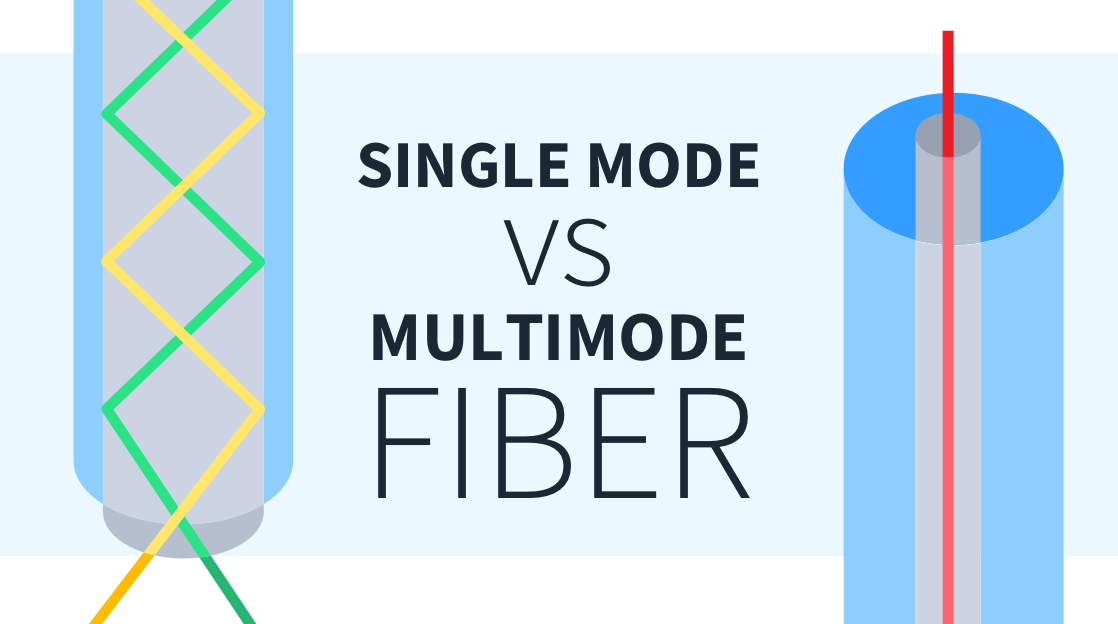
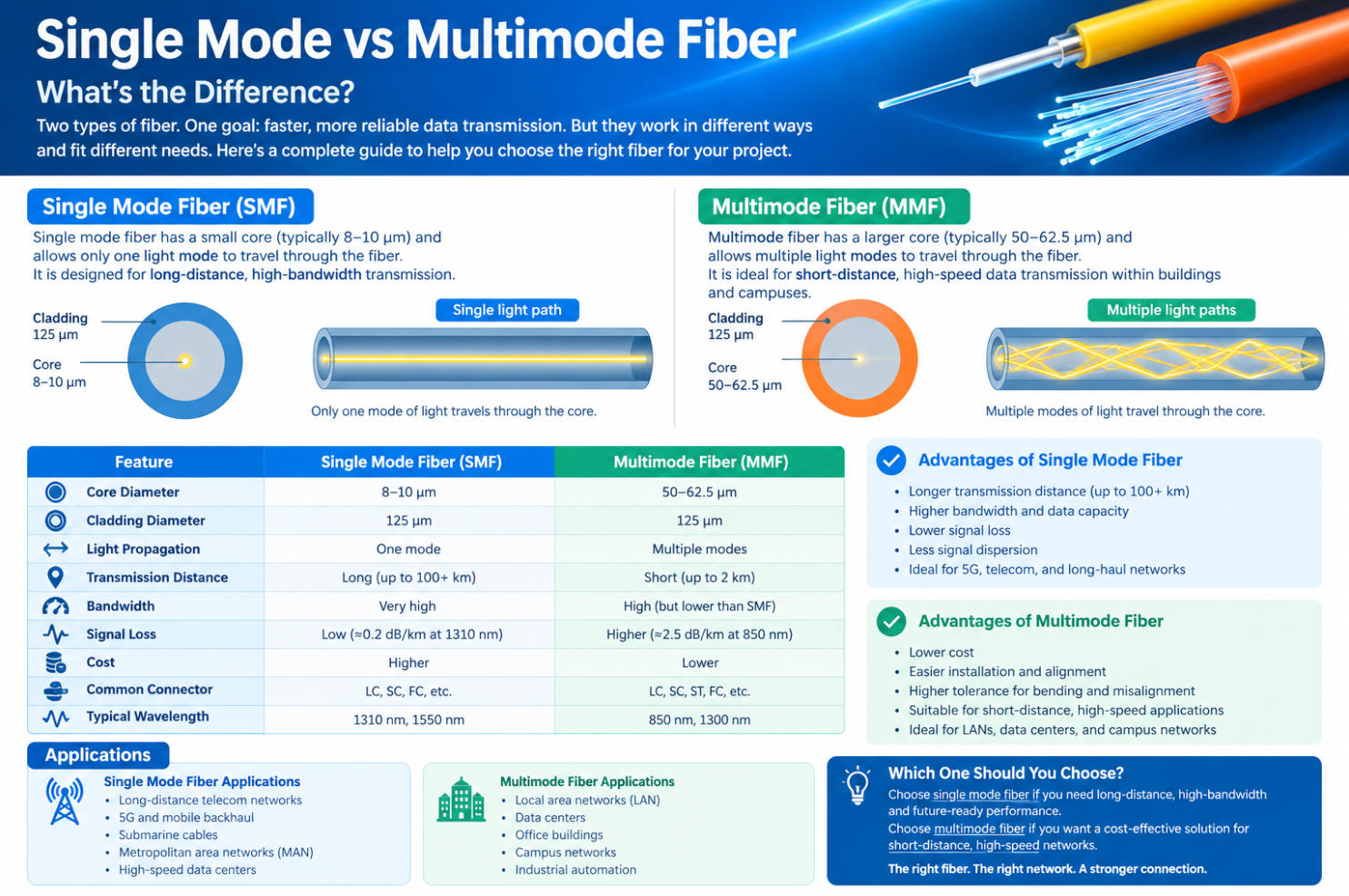
The main difference: single mode fiber uses a very small core to transmit one mode of light, making it suitable for long-distance and high-bandwidth communication, while multimode fiber has a larger core that allows multiple modes of light to travel through the fiber and is mainly used for shorter-distance networks.
Choosing the right fiber type can affect network performance, installation cost, optical transceiver compatibility, transmission distance, and future network upgrades.
What Is Single Mode Fiber?
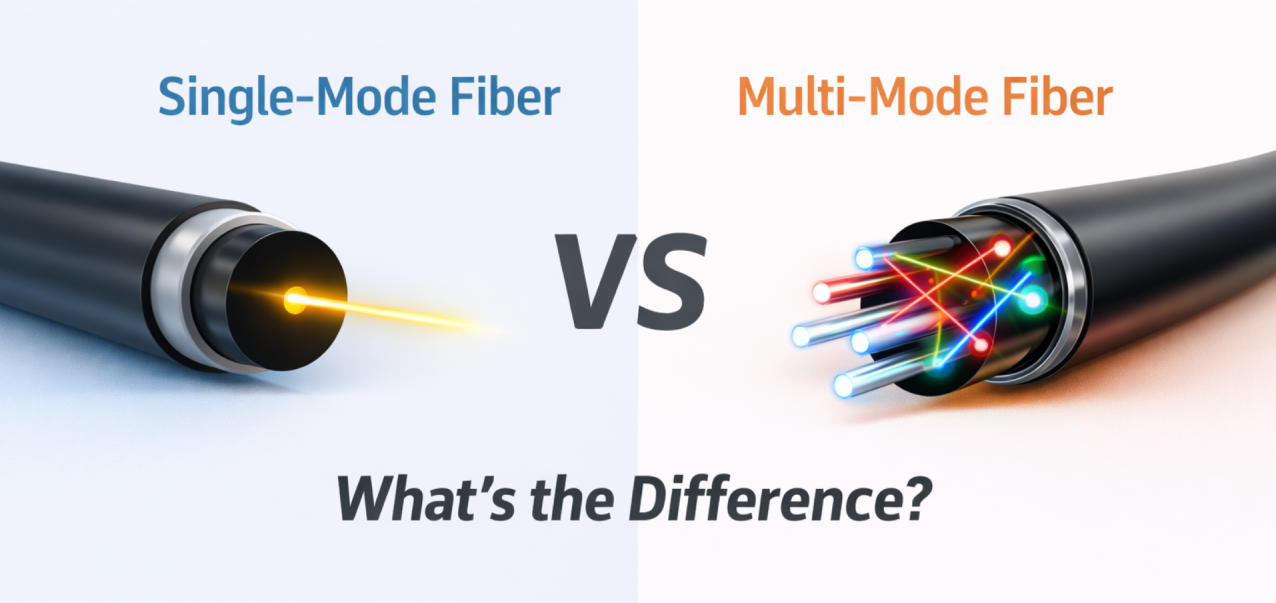
Single mode fiber (SMF) is an optical fiber designed to transmit a single mode, or path, of light through a very small fiber core.
A typical single mode fiber has a core diameter of approximately 8–10 microns, surrounded by a 125-micron cladding. Because the core is extremely small, light travels primarily along one propagation path.
The small core significantly reduces modal dispersion, allowing optical signals to travel much farther while maintaining high bandwidth and signal quality.
Common single mode fiber types include:
- OS1 fiber
- OS2 fiber
- G.652 fiber
- G.657A1 fiber
- G.657A2 fiber
Single mode fiber is commonly used in telecommunications, FTTH networks, long-distance backbone networks, data center interconnections, metropolitan area networks, and high-capacity communication systems.
Advantages of Single Mode Fiber
Single mode fiber offers several important advantages.
1. Long transmission distance
Single mode fiber is designed for long-distance communication. Depending on the optical transceiver, fiber type, network design, and system budget, transmission distances can range from several kilometers to tens or even hundreds of kilometers.
2. High bandwidth
Because single mode fiber experiences very low modal dispersion, it supports extremely high data rates and is suitable for high-capacity communication systems.
3. Low attenuation
Single mode fiber generally provides low optical attenuation, which makes it suitable for long-haul networks.
4. Excellent scalability
Single mode fiber is a strong choice when a network may require higher bandwidth or longer transmission distances in the future.
5. Wide range of applications
SMF is widely used in telecom networks, FTTH, ISP infrastructure, 5G backhaul, data centers, and enterprise networks.
What Is Multimode Fiber?
Multimode fiber (MMF) is an optical fiber with a much larger core that allows multiple modes of light to propagate through the fiber simultaneously.
The most common multimode fiber core diameter is 50 microns, although older multimode systems may use 62.5-micron cores.
Common multimode fiber categories include:
- OM1
- OM2
- OM3
- OM4
- OM5
The larger core makes multimode fiber easier to couple with light sources and can simplify some network installations. However, multiple light paths create modal dispersion, which limits the maximum transmission distance compared with single mode fiber.
Multimode fiber is especially common in data centers, enterprise networks, server rooms, campus networks, and short-distance high-speed connections.
Advantages of Multimode Fiber
1. Lower equipment cost in many short-distance applications
Multimode networks have historically used relatively economical optical transceivers and VCSEL-based light sources.
2. Easier light coupling
The larger core makes it easier for optical sources to couple light into the fiber.
3. Suitable for short-distance networks
MMF is an excellent choice for connections between switches, servers, racks, and equipment within buildings or data centers.
4. High-speed transmission
Modern OM3, OM4, and OM5 multimode fibers can support high-speed Ethernet applications over appropriate distances.
5. Practical for data centers
Multimode fiber can be particularly attractive when transmission distances are relatively short and the network architecture is stable.
Single Mode vs Multimode Fiber: Key Differences
The following table provides a quick comparison.
| Feature | Single Mode Fiber | Multimode Fiber |
|---|---|---|
| Core diameter | Approximately 8–10 µm | 50 µm or 62.5 µm |
| Light propagation | One mode | Multiple modes |
| Typical wavelength | 1310 nm / 1550 nm | 850 nm, sometimes 1300 nm |
| Transmission distance | Long distance | Shorter distance |
| Modal dispersion | Very low | Higher |
| Bandwidth | Very high | High |
| Typical applications | Telecom, FTTH, backbone, WAN | Data centers, LAN, enterprise |
| Typical fiber types | OS1, OS2, G.652, G.657 | OM1, OM2, OM3, OM4, OM5 |
| Common light source | Laser | VCSEL/laser |
| Long-distance performance | Excellent | Limited |
| Installation environment | Indoor and outdoor | Mainly indoor |
| Future scalability | Excellent | Good for short-distance networks |
| Typical color coding | Often yellow | Often orange, aqua or lime green |
| Best use case | Long-distance/high-capacity networks | Short-distance/high-speed networks |
Single Mode vs Multimode: Core Size
One of the most important differences between SMF and MMF is core diameter.
Single mode fiber typically has a core diameter of around 8–10 microns. This small core restricts light propagation to essentially one mode.
Multimode fiber generally has a 50-micron core, while older OM1 fiber commonly uses a 62.5-micron core.
The larger multimode core makes optical coupling easier, but multiple propagation paths cause modal dispersion.
In simple terms:
Small core = fewer propagation modes = lower modal dispersion = longer transmission distance.
Large core = multiple propagation modes = higher modal dispersion = shorter transmission distance.
Single Mode vs Multimode: Transmission Distance
Transmission distance is one of the biggest factors when selecting fiber optic cable.
Single Mode Fiber Distance
Single mode fiber is optimized for long-distance transmission. Depending on the optical module and network architecture, SMF can support:
- Several kilometers
- 10 km
- 20 km
- 40 km
- 80 km
- 100 km or more in specialized systems
The actual distance depends on optical power, receiver sensitivity, attenuation, dispersion, connectors, splices, wavelength, and transceiver specifications.
Multimode Fiber Distance
Multimode fiber is primarily designed for shorter links.
Typical applications include:
- Server-to-switch connections
- Switch-to-switch connections
- Data center rack connections
- Building networks
- Campus networks
The maximum distance depends heavily on the MMF category and Ethernet speed.
For example, OM3 and OM4 fiber are widely used for high-speed data center applications, while OM5 is designed to support short-wavelength-division multiplexing applications using multiple wavelengths in the 850–953 nm range.
Therefore, if the network requires several kilometers of transmission, single mode fiber is normally the preferred solution.
Single Mode vs Multimode: Bandwidth
Single mode fiber has a significant advantage for long-distance and extremely high-capacity communication.
Because single mode fiber has minimal modal dispersion, it can support high data rates over long distances.
Multimode fiber can also provide very high bandwidth, especially OM3, OM4, and OM5. However, its distance performance is limited by modal bandwidth and the interaction between the fiber and optical transceiver.
For modern network design, the important question is not simply:
Which fiber has higher bandwidth?
Instead, ask:
How much bandwidth is required, over what distance, and with which optical transceiver?
For short data center links, multimode fiber can provide excellent performance. For long-distance backbone or telecom networks, single mode fiber is usually the better option.
Single Mode vs Multimode: Wavelength
Another major difference is the wavelength typically used.
Single mode fiber commonly operates at:
- 1310 nm
- 1550 nm
- Other wavelengths depending on the transmission system
Multimode fiber is commonly associated with:
- 850 nm
- 1300 nm
Modern multimode data center systems frequently use 850 nm VCSEL-based transceivers.
Single mode systems commonly use 1310 nm or 1550 nm laser sources because these wavelengths are well suited for long-distance optical communication.
Single Mode vs Multimode: Optical Transceivers
Fiber type must match the optical transceiver.
A common mistake is assuming that any SFP, SFP+, QSFP, or other optical module can work with any fiber.
That is not correct.
For example:
- A single mode SFP is normally designed for single mode fiber.
- A multimode 850 nm transceiver is normally designed for multimode fiber.
- The connector type must also match the equipment.
- The wavelength must be compatible.
- The optical power budget must be sufficient for the link.
Before purchasing fiber optic cable, always check the specifications of the optical transceiver.
Single Mode vs Multimode: Cost
Cost is another important consideration.
Historically, multimode fiber networks could provide a lower overall cost for short-distance applications because multimode optical transceivers were often less expensive.
Single mode systems may require more expensive long-distance optical modules, particularly for extended-reach applications.
However, the actual network cost depends on more than the fiber cable itself.
Total cost can include:
- Fiber optic cable
- SFP/SFP+/SFP28/QSFP modules
- Patch cords
- Fiber distribution boxes
- Fiber optic enclosures
- Connectors
- Splicing
- Installation
- Testing
- Maintenance
- Future upgrades
For a short link inside a data center, MMF can be economical.
For a network that may eventually expand to longer distances or higher capacity, SMF can offer better long-term value.
Single Mode vs Multimode: Installation
Single mode and multimode fiber both require proper installation practices.
However, single mode systems can be more sensitive to connector cleanliness, insertion loss, return loss, and optical power budget because they are frequently deployed in high-performance networks.
Important installation practices include:
- Do not exceed the minimum bend radius.
- Keep connectors clean.
- Use appropriate fiber cleaning equipment.
- Avoid excessive pulling tension.
- Protect the cable from mechanical damage.
- Perform optical loss testing after installation.
- Label both ends of the fiber.
- Verify polarity where required.
- Confirm transceiver compatibility.
For bend-intensive FTTH installations, G.657A1 and G.657A2 bend-insensitive single mode fibers are commonly used.
Single Mode Fiber Applications
Single mode fiber is widely used in communication networks where long distance, high capacity, and future scalability are important.
Typical applications include:
1. FTTH Networks
Fiber-to-the-home networks commonly use single mode fiber because access networks may extend over significant distances.
2. Telecommunications
Telecom operators use single mode fiber for backbone, metro, access, and long-distance networks.
3. 5G Networks
Fiber optic infrastructure is an important component of 5G transport and backhaul networks.
4. Data Center Interconnection
Single mode fiber can connect data centers across campuses, cities, or longer distances.
5. ISP Networks
Internet service providers use SMF for high-capacity network infrastructure.
6. Long-Distance Ethernet
When Ethernet connections exceed the practical distance of multimode fiber, single mode fiber is normally preferred.
7. Industrial Networks
Single mode fiber can be used for long-distance industrial communication and infrastructure where electrical interference may be a concern.
Multimode Fiber Applications
Multimode fiber is particularly useful for short-distance communication.
Typical applications include:
1. Data Centers
OM3 and OM4 multimode fiber are widely used for connections between servers, switches, and network equipment.
2. Enterprise Networks
MMF can be used for high-speed connections within office buildings.
3. Campus Networks
For relatively short building-to-building connections, multimode fiber may be suitable when the distance and speed requirements are compatible.
4. Server Rooms
Multimode patch cables are commonly used for equipment interconnections.
5. High-Speed Ethernet
OM3, OM4 and OM5 fiber can support various high-speed Ethernet applications over specified distances.
OM1 vs OM2 vs OM3 vs OM4 vs OM5
Multimode fiber itself has several categories.
| Fiber Type | Core | Typical Use |
|---|---|---|
| OM1 | 62.5 µm | Legacy networks |
| OM2 | 50 µm | Older enterprise networks |
| OM3 | 50 µm | High-speed data centers |
| OM4 | 50 µm | Higher-performance data centers |
| OM5 | 50 µm | SWDM and advanced short-reach applications |
For new installations, OM3 and OM4 are commonly considered practical multimode options, while OM5 can be considered when the network architecture specifically benefits from its wideband multimode capabilities.
OS1 vs OS2 Single Mode Fiber
Single mode fiber is also divided into different categories.
OS1 is commonly associated with tighter-buffered indoor applications, while OS2 is generally used for low-loss outdoor and long-distance applications.
However, actual cable construction varies by manufacturer, so buyers should always check the cable’s attenuation, construction, fiber standard, and application specifications instead of selecting cable based only on the OS1/OS2 label.
For outdoor telecommunications, FTTH, backbone, and long-distance applications, OS2 single mode fiber is commonly considered.
Single Mode vs Multimode Fiber: Which Is Better?
There is no universal winner.
The correct question is:
Which fiber is better for your specific network?
Choose single mode fiber when:
- Transmission distance is long.
- Future bandwidth requirements are high.
- The network is part of a telecom or ISP infrastructure.
- The connection may be upgraded in the future.
- You need FTTH or long-distance backbone connectivity.
- The network connects buildings or sites over several kilometers.
Choose multimode fiber when:
- Transmission distance is relatively short.
- The network is inside a data center.
- The application is primarily server-to-switch or switch-to-switch.
- Compatible multimode transceivers are available.
- The network does not require long-distance transmission.
Can Single Mode and Multimode Fiber Be Used Together?
Generally, single mode and multimode fiber should not be directly treated as interchangeable media.
Their core sizes, modal properties, wavelengths, and optical characteristics are different.
A network designer should use compatible transceivers and appropriate media for each link.
If a network contains both SMF and MMF sections, the transition should be designed using appropriate optical equipment rather than simply connecting the two fiber types together.
Can You Use a Single Mode SFP With Multimode Fiber?
In general, you should not assume that a single mode SFP can be used with multimode fiber.
The optical module is designed around specific parameters such as:
- Wavelength
- Fiber type
- Transmission distance
- Optical power
- Receiver sensitivity
- Connector type
Although some combinations may work under specific conditions, they should only be used when the transceiver manufacturer explicitly supports the configuration.
The safest approach is to match:
Transceiver + wavelength + fiber type + connector + transmission distance.
How to Choose Between Single Mode and Multimode Fiber
A simple selection process can help.
Step 1: Determine the Transmission Distance
If the link is only tens or hundreds of meters, MMF may be suitable.
If the link extends to several kilometers or more, SMF is usually the better choice.
Step 2: Determine the Required Data Rate
Identify whether the network requires:
- 1G
- 10G
- 25G
- 40G
- 100G
- 200G
- 400G
- Higher speeds
Then check the fiber and transceiver specifications for the required distance.
Step 3: Check the Optical Transceiver
Do not select the cable independently of the transceiver.
Confirm wavelength, fiber compatibility, reach, connector, and optical budget.
Step 4: Consider Future Expansion
If the network may eventually require longer links or higher capacity, single mode fiber can provide greater flexibility.
Step 5: Evaluate Total Cost
Compare the complete system cost rather than only the price per meter of fiber cable.
Frequently Asked Questions
Is single mode fiber faster than multimode fiber?
Not necessarily. Both can support high data rates. The major advantage of single mode fiber is that it can maintain high-speed transmission over much longer distances with very low modal dispersion.
Which is cheaper, single mode or multimode fiber?
The answer depends on the entire network. Multimode may be economical for short-distance applications, while single mode may provide better long-term value for long-distance and scalable networks.
Which fiber is better for data centers?
Both can be used. Multimode fiber such as OM3 and OM4 is commonly used for short-reach data center connections, while single mode fiber is increasingly important for longer links and higher-capacity interconnection requirements.
Which fiber should I use for FTTH?
Single mode fiber is the standard choice for FTTH networks because it supports long-distance transmission and high-capacity optical access systems.
Is OM4 single mode or multimode?
OM4 is multimode fiber. It has a 50-micron core and is designed for high-speed short-reach applications.
Is OS2 single mode or multimode?
OS2 is a single mode fiber category, commonly used for outdoor, backbone, and long-distance optical networks.
Can multimode fiber transmit 100G?
Yes. Certain multimode fiber types, optical transceivers, and Ethernet standards support 100G transmission over specified distances. The exact reach depends on the fiber category and transceiver.
Does single mode fiber have a higher bandwidth?
Single mode fiber has extremely high bandwidth potential and significantly lower modal dispersion than multimode fiber. This makes it particularly suitable for high-capacity, long-distance systems.
Conclusion: Single Mode vs Multimode Fiber
The fundamental difference between single mode fiber and multimode fiber is the way light propagates through the fiber.
Single mode fiber has a small core and carries one primary mode of light, providing low modal dispersion, long transmission distances, high bandwidth, and excellent scalability.
Multimode fiber has a larger core and allows multiple modes of light to propagate, making it well suited for short-distance networks such as data centers, enterprise networks, and building infrastructure.
For FTTH, telecommunications, ISP networks, long-distance backbone connections, 5G transport, and high-capacity interconnection, single mode fiber is generally the preferred solution.
For short-distance data center, server room, and enterprise network connections, multimode fiber such as OM3 or OM4 can be an effective and economical choice.
Ultimately, the best fiber optic cable depends on transmission distance, data rate, optical transceiver, network architecture, installation environment, budget, and future expansion requirements.
When selecting fiber optic cable for a new project, it is recommended to evaluate the complete optical link rather than choosing a cable based only on price or fiber type.