In today’s digital world, fast and reliable network connectivity is essential for homes, businesses, data centers, and industrial applications. Whether you’re streaming 4K videos, hosting cloud applications, operating IP surveillance systems, or building enterprise networks, the quality of your Ethernet cabling directly affects network performance.
Among the various Ethernet cable categories available today, CAT6 cable (Category 6 cable) has become one of the most popular choices due to its excellent balance of speed, bandwidth, affordability, and future-proofing capabilities.
This comprehensive guide explores everything you need to know about CAT6 cable, including its specifications, advantages, applications, differences from other Ethernet cable categories, installation best practices, and how to choose the right CAT6 cable for your networking needs.
What Is CAT6 Cable?
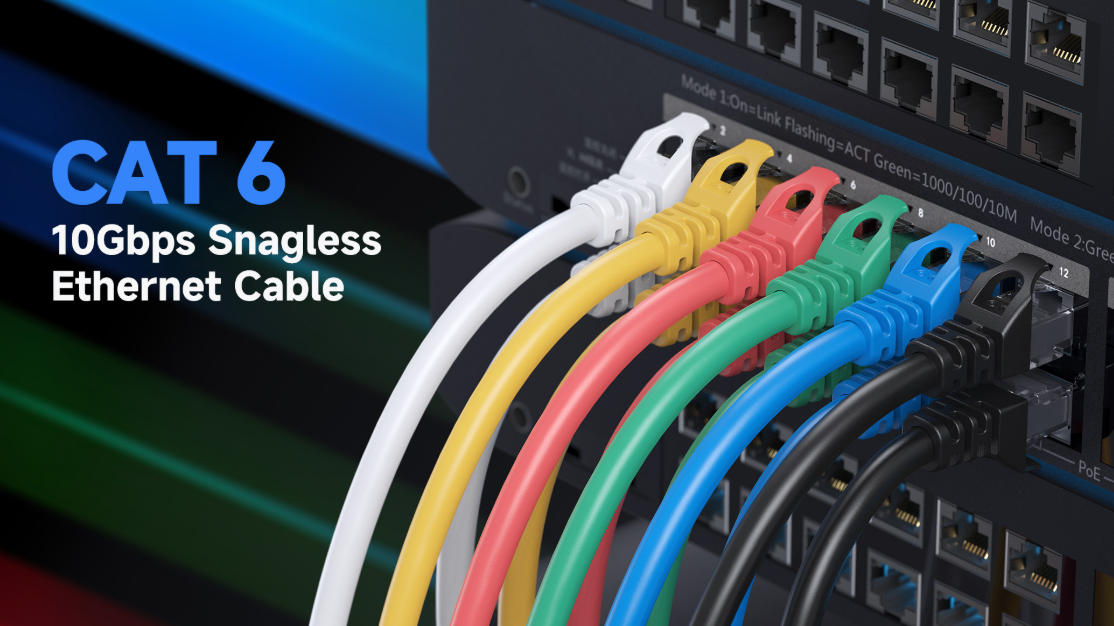
CAT6 cable, short for Category 6 Ethernet cable, is a standardized twisted-pair network cable designed to support high-speed data transmission.
Developed as an upgrade to CAT5e, CAT6 cables provide:
- Higher bandwidth
- Faster transmission speeds
- Reduced crosstalk
- Improved signal integrity
- Better overall network performance
CAT6 cable complies with the standards established by:
- ANSI/TIA-568
- ISO/IEC 11801
- IEEE Ethernet standards
These cables are commonly terminated with RJ45 connectors and support a wide range of networking devices including:
- Computers
- Routers
- Switches
- Servers
- Access points
- IP cameras
- VoIP phones
- Smart home devices
CAT6 Cable Specifications
Understanding CAT6 specifications helps users select the appropriate cable for their network infrastructure.
Maximum Data Rate
CAT6 cables support:
- 1 Gbps up to 100 meters (328 feet)
- 10 Gbps up to 55 meters (180 feet)
This makes CAT6 suitable for both Gigabit Ethernet and many 10-Gigabit Ethernet applications.
Bandwidth
CAT6 offers a bandwidth capacity of:
250 MHz
Compared to CAT5e’s 100 MHz bandwidth, CAT6 can handle significantly more data traffic.
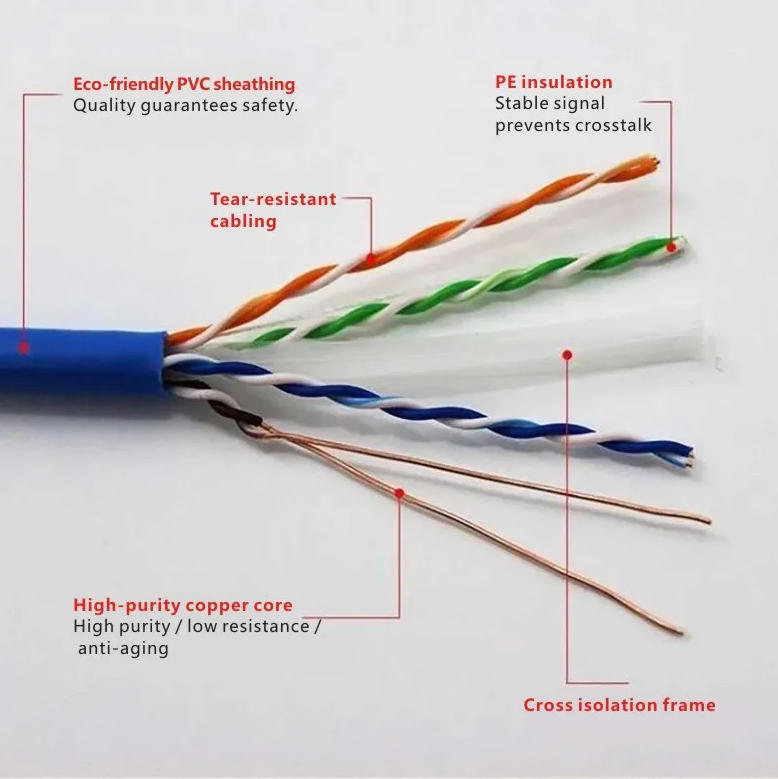
Cable Structure
CAT6 cables typically contain:
- Four twisted pairs
- 23 AWG copper conductors
- Enhanced insulation
- Internal spline separator (in many designs)
The separator helps reduce:
- Near-End Crosstalk (NEXT)
- Alien Crosstalk
- Electromagnetic interference
Key Advantages of CAT6 Cable
1. Higher Network Performance
One of the biggest benefits of CAT6 cable is its ability to support high-speed networks.
Advantages include:
- Faster file transfers
- Improved cloud application performance
- Better video conferencing quality
- Lower latency
Organizations relying on large-scale data transmission can significantly improve network efficiency with CAT6 infrastructure.
2. Reduced Crosstalk
Crosstalk occurs when signals from one wire pair interfere with another.
CAT6 cables feature:
- Tighter twist ratios
- Better insulation
- Internal separators
These design improvements greatly reduce signal interference and improve transmission reliability.
3. Future-Proof Network Infrastructure
As internet speeds continue increasing and network applications become more demanding, CAT6 provides a future-ready solution.
Many businesses choose CAT6 because it can support:
- Gigabit Ethernet
- PoE devices
- Cloud computing
- IoT deployments
- High-definition video systems
This reduces the need for costly infrastructure upgrades later.
4. Excellent Cost-to-Performance Ratio
Compared with CAT6A or CAT7 cables, CAT6 delivers excellent performance at a lower cost.
Benefits include:
- Affordable installation
- Wide availability
- Compatibility with existing equipment
- Long-term value
For many organizations, CAT6 represents the best balance between budget and performance.
CAT6 Cable vs CAT5e
Many buyers wonder whether CAT6 is worth the upgrade from CAT5e.
| Feature | CAT5e | CAT6 |
|---|---|---|
| Maximum Speed | 1 Gbps | 10 Gbps (55m) |
| Bandwidth | 100 MHz | 250 MHz |
| Crosstalk Protection | Good | Better |
| Conductor Size | 24 AWG | 23 AWG |
| Future-Proofing | Moderate | High |
| Cost | Lower | Slightly Higher |
Why Choose CAT6 Over CAT5e?
CAT6 provides:
- Greater bandwidth
- Better noise immunity
- Higher speed capabilities
- Improved reliability
For new installations, CAT6 is generally the preferred choice.
CAT6 vs CAT6A
CAT6A (Augmented Category 6) is an enhanced version of CAT6.
| Feature | CAT6 | CAT6A |
| Bandwidth | 250 MHz | 500 MHz |
| 10G Support | 55m | 100m |
| Cable Diameter | Smaller | Larger |
| Installation Flexibility | Easier | More Difficult |
| Cost | Lower | Higher |
CAT6A is ideal for:
- Large enterprises
- Data centers
- High-density networking
CAT6 remains an excellent choice for most commercial and residential environments.
Types of CAT6 Cable
UTP CAT6 Cable
UTP stands for Unshielded Twisted Pair.
Advantages:
- Lower cost
- Lightweight
- Easy installation
- Flexible routing
Common applications include:
- Offices
- Homes
- Schools
FTP CAT6 Cable
FTP stands for Foiled Twisted Pair.
Features:
- Aluminum foil shielding
- Better EMI protection
- Improved signal stability
Suitable for environments with moderate electrical interference.
STP CAT6 Cable
STP stands for Shielded Twisted Pair.
Benefits include:
- Maximum EMI protection
- Enhanced signal integrity
- Industrial-grade performance
Commonly used in:
- Factories
- Industrial plants
- Medical facilities
CAT6 Cable Applications
Enterprise Networks
Businesses depend on CAT6 cable for:
- Workstations
- Server connections
- VoIP systems
- Wireless access points
The cable’s reliability helps maintain stable communication across the organization.
Data Centers
Many small and medium-sized data centers use CAT6 cabling for:
- Rack connectivity
- Server management networks
- Storage systems
Its high bandwidth supports demanding workloads efficiently.
Smart Homes
Modern smart homes require robust networking infrastructure.
CAT6 supports:
- Smart TVs
- Home automation
- Gaming consoles
- Security cameras
- Streaming devices
It ensures smooth performance across multiple connected devices.
IP Surveillance Systems
CAT6 cable is widely used in CCTV and security networks.
Benefits include:
- Stable video transmission
- Power over Ethernet support
- Long-distance connectivity
- High-resolution camera compatibility
Educational Institutions
Schools and universities deploy CAT6 for:
- Computer labs
- Wi-Fi networks
- Administrative systems
- E-learning platforms
Reliable connectivity is essential for digital learning environments.
CAT6 Cable and Power over Ethernet (PoE)
Power over Ethernet allows network cables to transmit both data and electrical power.
CAT6 supports:
- PoE
- PoE+
- PoE++
- IEEE 802.3af
- IEEE 802.3at
- IEEE 802.3bt
Devices powered through CAT6 include:
- IP cameras
- Wireless access points
- VoIP phones
- Smart sensors
Using a single cable reduces installation complexity and costs.
Indoor vs Outdoor CAT6 Cable
Indoor CAT6 Cable
Characteristics:
- PVC jacket
- Flexible design
- Cost-effective
Best for:
- Homes
- Offices
- Commercial buildings
Outdoor CAT6 Cable
Features:
- UV-resistant jacket
- Waterproof construction
- Weather-resistant materials
Designed for:
- Outdoor surveillance
- Campus networks
- Building-to-building links
Outdoor CAT6 provides superior durability in harsh environments.
CAT6 Installation Best Practices
To maximize network performance, follow these installation guidelines.
Avoid Sharp Bends
Excessive bending can damage cable pairs and reduce signal quality.
Maintain the recommended bend radius throughout installation.
Keep Distance from Power Cables
Running CAT6 alongside electrical wiring can introduce interference.
Maintain adequate separation whenever possible.
Use Quality Connectors
Low-quality RJ45 connectors can degrade performance.
Choose certified components to ensure reliable connections.
Proper Cable Management
Use:
- Cable trays
- Patch panels
- Cable organizers
Good cable management simplifies maintenance and troubleshooting.
Conduct Cable Testing
After installation, verify:
- Continuity
- Wire mapping
- Signal quality
- Certification standards
Testing ensures optimal network operation.
How to Choose the Right CAT6 Cable
When selecting CAT6 cable, consider the following factors.
Conductor Material
Choose:
Solid Bare Copper
Advantages:
- Better conductivity
- Lower resistance
- Improved PoE performance
- Longer lifespan
Avoid Copper-Clad Aluminum (CCA) whenever possible for professional installations.
Shielding Requirements
Select:
- UTP for standard environments
- FTP for moderate EMI
- STP for high-interference areas
The correct shielding improves network reliability.
Jacket Rating
Common ratings include:
CM
General-purpose indoor cable.
CMR
Riser-rated cable for vertical spaces.
CMP
Plenum-rated cable for air-handling spaces.
Always comply with local building codes.
Length Requirements
Consider:
- Device locations
- Future expansion
- Patch panel routing
Proper planning minimizes waste and simplifies upgrades.
Common CAT6 Cable FAQs
Is CAT6 Good for Gaming?
Yes.
CAT6 provides:
- Low latency
- Stable connections
- Fast download speeds
- Improved online gaming performance
Many gamers prefer wired CAT6 connections over Wi-Fi.
Can CAT6 Support 10 Gigabit Ethernet?
Yes.
CAT6 supports:
10GBASE-T up to 55 meters
For longer distances, CAT6A is recommended.
Is CAT6 Better Than Wi-Fi?
In terms of reliability and consistency, yes.
Advantages include:
- Lower latency
- Higher stability
- Better security
- Consistent throughput
Many organizations combine CAT6 wired infrastructure with wireless networking.
How Long Does CAT6 Cable Last?
Properly installed CAT6 cable can last:
10–20 years or more
Factors affecting lifespan include:
- Environmental conditions
- Installation quality
- Cable materials
Future of CAT6 Cabling
Despite the emergence of CAT6A, CAT7, and CAT8, CAT6 remains highly relevant.
Reasons include:
- Cost efficiency
- Broad compatibility
- Adequate performance for most networks
- Strong support for Gigabit and many 10G applications
As organizations continue upgrading digital infrastructure, CAT6 will remain a core networking solution for years to come.
Conclusion
CAT6 cable has become the industry standard for modern Ethernet networking thanks to its impressive combination of speed, bandwidth, reliability, and affordability.
Whether you’re building a home network, upgrading an office infrastructure, deploying IP surveillance systems, or supporting enterprise applications, CAT6 provides a dependable and future-ready cabling solution.
Key benefits include:
- Up to 10 Gbps performance
- 250 MHz bandwidth
- Reduced crosstalk
- Excellent PoE support
- Long-term scalability
- Strong cost-performance value
By selecting high-quality CAT6 cables and following proper installation practices, organizations can build robust network infrastructures capable of meeting today’s connectivity demands and tomorrow’s technological advancements.