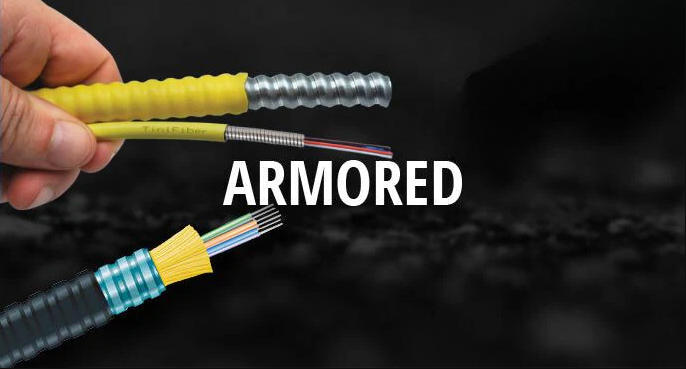
Armored fiber optic cable is a type of fiber optic cable that includes an additional protective layer—known as armor—designed to protect the internal optical fibers from physical damage, crushing forces, rodent attacks, moisture, and harsh environmental conditions.
Unlike standard fiber optic cables, armored versions are built with a reinforced structure, often using materials like:
- Corrugated steel tape
- Aluminum armor
- Stainless steel tubing
- Steel wire braid
This armor layer makes the cable significantly more durable, especially in environments where cables may be exposed to mechanical stress or outdoor hazards.
In simple terms:
Armored fiber optic cable = Standard fiber optic cable + extra mechanical protection layer
2. Why Armored Fiber Optic Cable is Important
Fiber optic networks are the backbone of modern digital communication. However, traditional fiber cables are relatively fragile. They can be damaged by:
- Construction work or digging
- Rodents and pests
- Extreme temperatures
- Moisture or flooding
- Crushing pressure in underground installations
Armored fiber optic cables solve these problems by adding a protective shield that significantly increases durability and lifespan.
This makes them essential for:
- Outdoor installations
- Industrial environments
- Underground duct systems
- Direct burial applications
- Military and security networks
3. Structure of Armored Fiber Optic Cable
Understanding the structure helps explain why armored fiber optic cable is so reliable.
A typical armored fiber optic cable consists of the following layers:
3.1 Optical Fiber Core
This is the heart of the cable where data is transmitted using light signals. It is usually made of high-purity glass or plastic.
3.2 Buffer Coating
A protective coating surrounds the fiber to protect it from microbending and moisture.
3.3 Strength Members
Materials like aramid yarn (Kevlar) or fiberglass rods provide tensile strength and prevent stretching.
3.4 Inner Jacket
A polymer layer that provides basic insulation and structural integrity.
3.5 Armor Layer
This is the defining feature. Common materials include:
- Steel tape armor (STA)
- Aluminum interlocked armor
- Corrugated steel armor
It protects against crushing, rodent bites, and physical impact.
3.6 Outer Jacket
The final protective layer, typically made of polyethylene (PE), PVC, or LSZH (Low Smoke Zero Halogen) materials.
4. Types of Armored Fiber Optic Cable
There are several types of armored fiber optic cables, each designed for specific environments.
4.1 Single Armor Cable
- Contains one layer of metal armor
- Lightweight and flexible
- Suitable for indoor/outdoor use
4.2 Double Armor Cable
- Two layers of armor (often steel + corrugated metal)
- Extremely durable
- Used in harsh underground or industrial environments
4.3 Interlocked Armor Cable
- Aluminum interlocking tape
- Easier to install in indoor or conduit environments
- Good balance between flexibility and protection
4.4 Steel Tape Armored Cable (STA)
- Uses steel tape wrapped around the cable
- Excellent rodent resistance
- Common in direct burial installations
4.5 Corrugated Steel Armored Cable (CST)
- Highly resistant to crushing and impact
- Ideal for deep underground or mining applications
5. Key Advantages of Armored Fiber Optic Cable
Armored fiber optic cables provide several important benefits over non-armored versions.
5.1 Enhanced Mechanical Protection
The armor layer protects the fiber from crushing, bending, and external impact.
5.2 Rodent Resistance
Rodents are a major cause of cable failure in underground networks. Steel or aluminum armor prevents chewing damage.
5.3 Environmental Protection
Armored cables resist moisture, chemicals, and temperature fluctuations.
5.4 Longer Lifespan
Due to added protection, armored fiber cables typically last significantly longer than standard cables.
5.5 Reduced Maintenance Costs
Fewer repairs and replacements reduce long-term operational costs.
5.6 Suitable for Harsh Environments
Ideal for industrial plants, oil and gas facilities, and outdoor infrastructure.
6. Disadvantages of Armored Fiber Optic Cable
While armored cables offer many benefits, they also have some limitations:
- Higher cost compared to standard fiber cables
- Heavier weight
- Slightly less flexible (depending on armor type)
- More complex installation in tight spaces
However, in most outdoor and industrial applications, the benefits outweigh the drawbacks.
7. Applications of Armored Fiber Optic Cable
Armored fiber optic cables are widely used across multiple industries.
7.1 Telecommunications Networks
Used by ISPs and telecom companies for backbone infrastructure and long-distance transmission.
7.2 Data Centers
Protects high-density fiber networks connecting servers and storage systems.
7.3 Industrial Automation
Used in factories and manufacturing plants where machinery can damage standard cables.
7.4 Military and Defense
Provides secure and durable communication lines in harsh environments.
7.5 Oil and Gas Industry
Used in offshore rigs, refineries, and pipelines where environmental exposure is extreme.
7.6 Smart Cities and Infrastructure
Supports traffic systems, surveillance networks, and IoT infrastructure.
7.7 Underground and Direct Burial Installations
Ideal for burial without conduit due to its protective armor layer.
8. Armored vs Non-Armored Fiber Optic Cable
| Feature | Armored Cable | Non-Armored Cable |
|---|---|---|
| Protection | High | Low |
| Cost | Higher | Lower |
| Flexibility | Moderate | High |
| Installation Environment | Harsh/Outdoor | Indoor/Protected |
| Rodent Resistance | Yes | No |
| Lifespan | Longer | Shorter |
In summary, armored cables are designed for durability, while non-armored cables are designed for flexibility and cost efficiency.
9. Installation of Armored Fiber Optic Cable
Proper installation is crucial to ensure performance and longevity.
9.1 Planning the Route
Identify underground paths, avoid sharp bends, and ensure compliance with local regulations.
9.2 Handling the Cable
Even though armored, cables should not be excessively bent or twisted.
9.3 Direct Burial Installation
Armored cables can often be buried directly in trenches without additional conduit.
9.4 Using Conduits
In urban areas, conduits provide additional protection and easier maintenance.
9.5 Splicing and Termination
Use professional fusion splicing tools to ensure low signal loss.
9.6 Testing
Perform OTDR (Optical Time Domain Reflectometer) testing to verify signal integrity.
10. How to Choose the Right Armored Fiber Optic Cable
When selecting an armored fiber optic cable, consider the following factors:
10.1 Installation Environment
- Indoor → interlocked armor
- Outdoor → steel tape armor
- Underground → corrugated steel armor
10.2 Required Protection Level
Higher risk environments require double armor solutions.
10.3 Fiber Count
Choose based on current and future bandwidth needs.
10.4 Cable Diameter and Weight
Ensure compatibility with installation space and conduit size.
10.5 Temperature and Weather Resistance
Check specifications for extreme environments.
10.6 Budget Considerations
Balance cost with long-term reliability.
11. Industry Trends and Future of Armored Fiber Optic Cable
The demand for armored fiber optic cables is expected to grow significantly due to:
- Expansion of 5G and 6G networks
- Growth of hyperscale data centers
- Increased fiber-to-the-home (FTTH) deployments
- Smart city infrastructure projects
- Industrial IoT expansion
Manufacturers are also developing:
- Lighter armor materials
- Higher-density fiber cores
- Eco-friendly LSZH jackets
- Improved bend-insensitive fibers
Companies like OUFU Incorporated are leading innovations in fiber optic technology, including advanced ruggedized cable designs.
12. Frequently Asked Questions (FAQ)
Q1: What is the main purpose of armored fiber optic cable?
The main purpose is to protect fiber optic strands from physical damage, environmental stress, and rodent attacks.
Q2: Can armored fiber optic cable be buried directly?
Yes, most armored fiber optic cables are designed for direct burial without additional conduit.
Q3: Is armored fiber optic cable waterproof?
Yes, it typically includes moisture-resistant layers, making it suitable for outdoor and underground use.
Q4: Does armor affect internet speed?
No. The armor only provides physical protection and does not impact data transmission speed.
Q5: Where is armored fiber cable most commonly used?
It is commonly used in outdoor telecom networks, industrial sites, and underground installations.
13. Conclusion
Armored fiber optic cable is a critical component in modern communication infrastructure. Its reinforced design provides superior protection against physical damage, environmental hazards, and long-term wear, making it ideal for demanding installations.
While it may cost more than standard fiber optic cables, its durability, reliability, and reduced maintenance requirements make it a cost-effective solution in the long run.
As global connectivity demands continue to rise, armored fiber optic cables will remain essential in building the resilient, high-speed networks of the future.