Among the most commonly used indoor-outdoor fiber drop cable types in China and global export markets are GJYXCH and GJYXFCH.
Although these two cable types look similar at first glance, they differ significantly in structure, mechanical strength, application scenarios, and performance. Choosing the wrong type can lead to installation failures, signal degradation, or unnecessary cost increases.
1. What is GJYXCH Fiber Optic Cable?
1.1 Definition
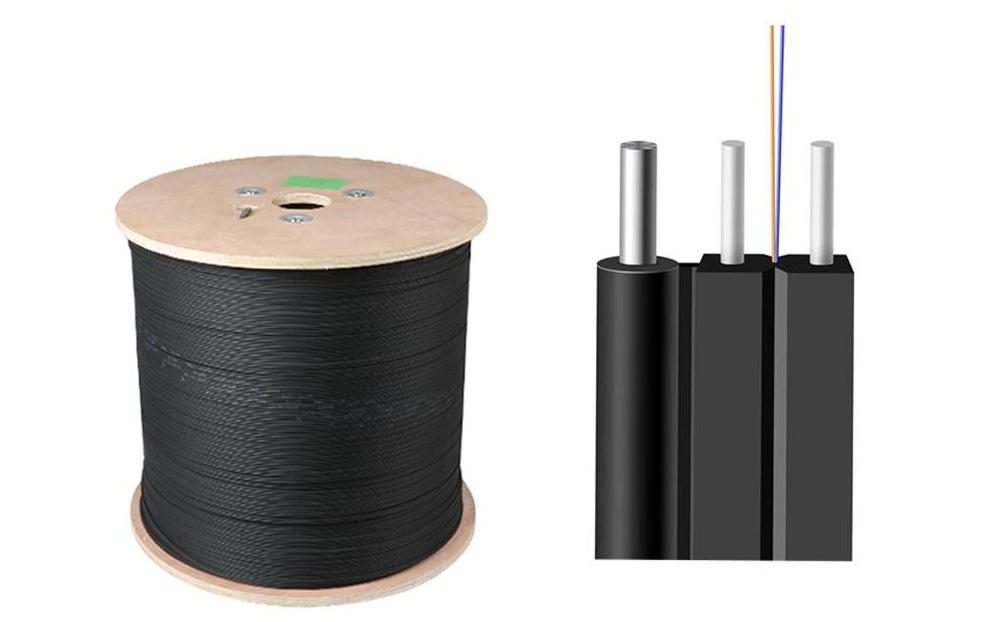
GJYXCH is a type of FTTH drop cable with steel wire reinforcement and LSZH sheath, widely used in indoor and short-span outdoor fiber access networks.
It is a flat-type or bow-type drop cable designed for aerial installation in last-mile connectivity.
1.2 Structure of GJYXCH Cable
A typical GJYXCH cable includes:
- Optical fiber (1–4 cores commonly)
- Two parallel steel wires (strength members)
- Central loose buffer tube or tight buffer fiber
- LSZH (Low Smoke Zero Halogen) outer jacket
1.3 Key Features
- Good tensile strength due to steel reinforcement
- Low smoke and halogen-free jacket for indoor safety
- Suitable for aerial self-supporting short-span deployment
- Cost-effective solution for FTTH last-mile access
1.4 Typical Applications
- FTTH last-mile connection
- Residential broadband deployment
- Indoor-to-outdoor transition networks
- Telecom operators’ access networks
2. What is GJYXFCH Fiber Optic Cable?
2.1 Definition
GJYXFCH is an upgraded version of FTTH drop cable that includes steel wire reinforcement + additional FRP (Fiber Reinforced Plastic) strength member for higher mechanical performance.
It is designed for more demanding installation environments where higher tensile strength and better anti-interference performance are required.
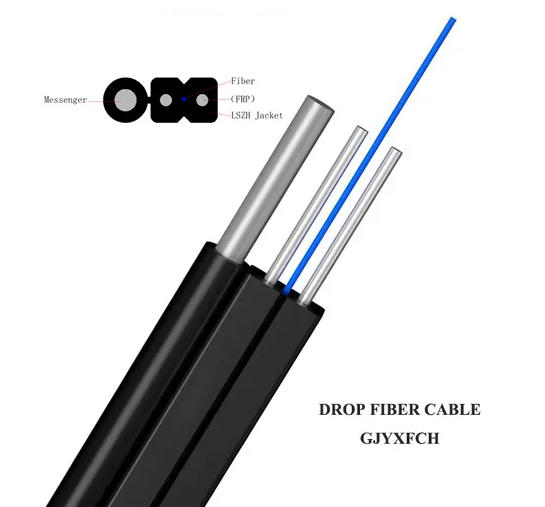
2.2 Structure of GJYXFCH Cable
GJYXFCH typically consists of:
- Optical fiber core(s)
- Central FRP strength member
- Two parallel steel wires (optional depending on design)
- Tight buffer fiber
- LSZH flame-retardant outer jacket
2.3 Key Features
- Higher tensile strength than GJYXCH
- Improved anti-bending and anti-crush performance
- Better stability in long-span aerial installations
- Enhanced durability in harsh environments
- Stronger resistance to rodent and mechanical damage
2.4 Typical Applications
- Long-span aerial FTTH deployment
- Rural or suburban broadband networks
- Areas with strong wind, ice, or mechanical stress
- High-reliability telecom infrastructure projects
3. GJYXCH vs GJYXFCH: Core Structural Differences
Understanding the structural difference is essential for selecting the correct cable.
3.1 Strength Member Design
- GJYXCH: Uses two parallel steel wires only
- GJYXFCH: Combines steel wires + FRP central strength member
Result: GJYXFCH has significantly higher mechanical strength.
3.2 Mechanical Performance
| Feature | GJYXCH | GJYXFCH |
|---|---|---|
| Tensile Strength | Medium | High |
| Crush Resistance | Standard | Enhanced |
| Bending Resistance | Good | Excellent |
| Span Capability | Short | Medium to long |
3.3 Cable Flexibility
- GJYXCH is slightly more flexible due to simpler structure
- GJYXFCH is slightly stiffer but more stable under stress
3.4 Cost Difference
- GJYXCH: Lower cost, budget-friendly FTTH solution
- GJYXFCH: Higher cost due to additional FRP reinforcement
4. Performance Comparison in Real Deployment
4.1 Aerial Installation Performance
In aerial FTTH deployment, cables are exposed to:
- Wind load
- Temperature changes
- Mechanical tension
- Occasional impact stress
GJYXCH Performance:
- Suitable for short spans (typically <80–100m)
- May experience sag in long-distance installations
GJYXFCH Performance:
- Stable over longer spans (100–150m or more depending on design)
- Better resistance to sagging and deformation
4.2 Indoor Transition Performance
- GJYXCH performs well in standard indoor-to-outdoor entry points
- GJYXFCH is over-engineered for indoor use but provides extra safety margin
4.3 Wind and Weather Resistance
- GJYXCH: Standard resistance, suitable for mild climates
- GJYXFCH: Better performance in high-wind or icy environments
4.4 Long-Term Reliability
GJYXFCH generally offers:
- Longer service life
- Lower maintenance cost
- Reduced risk of fiber breakage
5. Installation Differences
5.1 Ease of Installation
- GJYXCH is easier to install due to lighter structure
- GJYXFCH requires slightly more careful handling due to higher rigidity
5.2 Recommended Installation Scenarios
GJYXCH Recommended For:
- Urban FTTH networks
- Short-distance pole-to-building connections
- Cost-sensitive projects
GJYXFCH Recommended For:
- Rural telecom expansion
- Long-span pole networks
- Harsh environmental conditions
5.3 Splicing and Termination
Both cable types use standard fiber termination methods:
- Fusion splicing
- Pre-terminated connectors
- FTTH fast connectors
No major difference in connector compatibility.
6. Technical Parameter Comparison
6.1 Tensile Strength
- GJYXCH: ~200–400 N (typical range)
- GJYXFCH: ~400–800 N or higher depending on design
6.2 Crush Resistance
- GJYXCH: Moderate
- GJYXFCH: High
6.3 Operating Temperature
Both cables typically support:
- -40°C to +70°C
No significant difference.
6.4 Fiber Count Options
Both types commonly support:
- 1 core
- 2 cores
- 4 cores
7. Cost Analysis: Which One Is More Economical?
7.1 Material Cost Difference
GJYXFCH includes:
- Additional FRP rod
- Higher production complexity
- More raw material usage
Therefore:
GJYXFCH is typically 10%–30% more expensive than GJYXCH.
7.2 Total Project Cost Impact
Although GJYXFCH is more expensive per meter, it can reduce:
- Maintenance costs
- Replacement frequency
- Installation failures
So in long-term infrastructure, it may be more cost-effective.
8. Application Scenarios: How to Choose Correctly
8.1 Choose GJYXCH If:
- Budget is limited
- Installation distance is short
- Environment is stable
- Urban FTTH deployment
8.2 Choose GJYXFCH If:
- Long-span aerial installation is required
- Weather conditions are harsh
- Network reliability is critical
- Rural or mountainous regions
9. Common Mistakes When Choosing Between GJYXCH and GJYXFCH
9.1 Choosing Based Only on Price
Many buyers select GJYXCH only because it is cheaper, but this may lead to:
- Cable sagging
- Fiber attenuation issues
- Higher maintenance cost
9.2 Overengineering Small Projects
Using GJYXFCH for very short indoor connections is unnecessary and increases cost.
9.3 Ignoring Span Distance
The most important factor is span length, not just cable type.
10. Market Trends for GJYXCH and GJYXFCH
10.1 Growing FTTH Demand
Global FTTH expansion continues to increase demand for both cable types, especially in:
- Southeast Asia
- Africa
- South America
- Middle East
10.2 Shift Toward Stronger Cable Types
There is a noticeable trend toward:
- GJYXFCH adoption in rural deployments
- Hybrid reinforced designs for extreme environments
10.3 Price Optimization Pressure
Manufacturers are focusing on:
- Cost reduction
- Material optimization
- Improved tensile performance without cost increase
11. Engineering Recommendations
11.1 For Telecom Operators
- Use GJYXCH for dense urban FTTH rollout
- Use GJYXFCH for backbone-to-premises long-distance access
11.2 For EPC Contractors
- Always evaluate mechanical load requirements before selection
- Consider environmental stress factors (wind, ice, temperature)
11.3 For Distributors
- Stock both types to serve different market needs
- Promote GJYXFCH in rural infrastructure projects
12. Summary Table: GJYXCH vs GJYXFCH
| Feature | GJYXCH | GJYXFCH |
|---|---|---|
| Strength | Medium | High |
| Structure | Steel wire only | Steel wire + FRP |
| Cost | Lower | Higher |
| Span Capability | Short | Medium–Long |
| Installation Ease | Easier | Slightly harder |
| Durability | Standard | Enhanced |
| Application | Urban FTTH | Harsh/Rural FTTH |
13. Conclusion
The difference between GJYXCH and GJYXFCH fiber optic cables lies primarily in their mechanical reinforcement design and application suitability.
- GJYXCH is a cost-effective, standard FTTH drop cable suitable for short-distance urban deployments.
- GJYXFCH is a reinforced, high-performance solution designed for long-span and harsh environmental conditions.
Choosing between them should not be based solely on price, but on:
- Span length
- Environmental conditions
- Mechanical load requirements
- Long-term maintenance expectations
In modern fiber optic network planning, selecting the right drop cable type directly impacts network stability, lifespan, and total cost of ownership.
FAQ: GJYXCH vs GJYXFCH Fiber Drop Cables
1. What is the main difference between GJYXCH and GJYXFCH?
The main difference is the strength member design.
- GJYXCH uses mainly parallel steel wires for reinforcement.
- GJYXFCH adds an FRP (Fiber Reinforced Plastic) central strength member, making it stronger and more suitable for harsh environments and longer spans.
2. Which cable is stronger: GJYXCH or GJYXFCH?
GJYXFCH is stronger.
Because it combines steel wires with FRP reinforcement, it provides higher tensile strength, better crush resistance, and improved long-term mechanical stability compared to GJYXCH.
3. When should I use GJYXCH cable?
GJYXCH is best for:
- Short-span FTTH aerial installations
- Urban residential broadband projects
- Indoor-to-outdoor last-mile connections
- Cost-sensitive deployments
It is ideal when mechanical stress is relatively low.
4. When should I choose GJYXFCH cable?
GJYXFCH is recommended for:
- Long-span aerial installations
- Rural or mountainous FTTH networks
- Areas with strong wind, ice, or mechanical stress
- Projects requiring higher reliability and durability
5. Is GJYXFCH more expensive than GJYXCH?
Yes. GJYXFCH is typically 10%–30% more expensive due to the added FRP strength member and higher manufacturing complexity. However, it may reduce long-term maintenance costs.
6. Can GJYXCH and GJYXFCH be used indoors?
Yes, both can be used indoors in FTTH transition points.
However:
- GJYXCH is more commonly used for indoor-to-outdoor entry points
- GJYXFCH is usually over-specified for indoor-only use
7. Which cable has better bending performance?
- GJYXCH: Slightly more flexible, easier to route in tight spaces
- GJYXFCH: More rigid but offers better structural stability under tension
8. What is the typical span distance for these cables?
- GJYXCH: Usually suitable for short spans (around 50–100 meters depending on design)
- GJYXFCH: Suitable for medium to long spans (often 100–150+ meters depending on engineering conditions)
9. Do GJYXCH and GJYXFCH support the same fiber types?
Yes. Both can support common fiber configurations such as:
- G.652D single-mode fiber
- 1-core, 2-core, or 4-core designs